
A slope question looks simple until the forklift carries a real load.
Many buyers ask me:
"What slope can this forklift climb?"
I understand why they ask. A slope number feels easy to compare. But in real outdoor work, the better question is not only whether a forklift can climb a certain grade one time.
The better question is:
"Can this forklift handle our slope every day, with our load, on our ground, with our operator and route?"
That difference matters a lot.
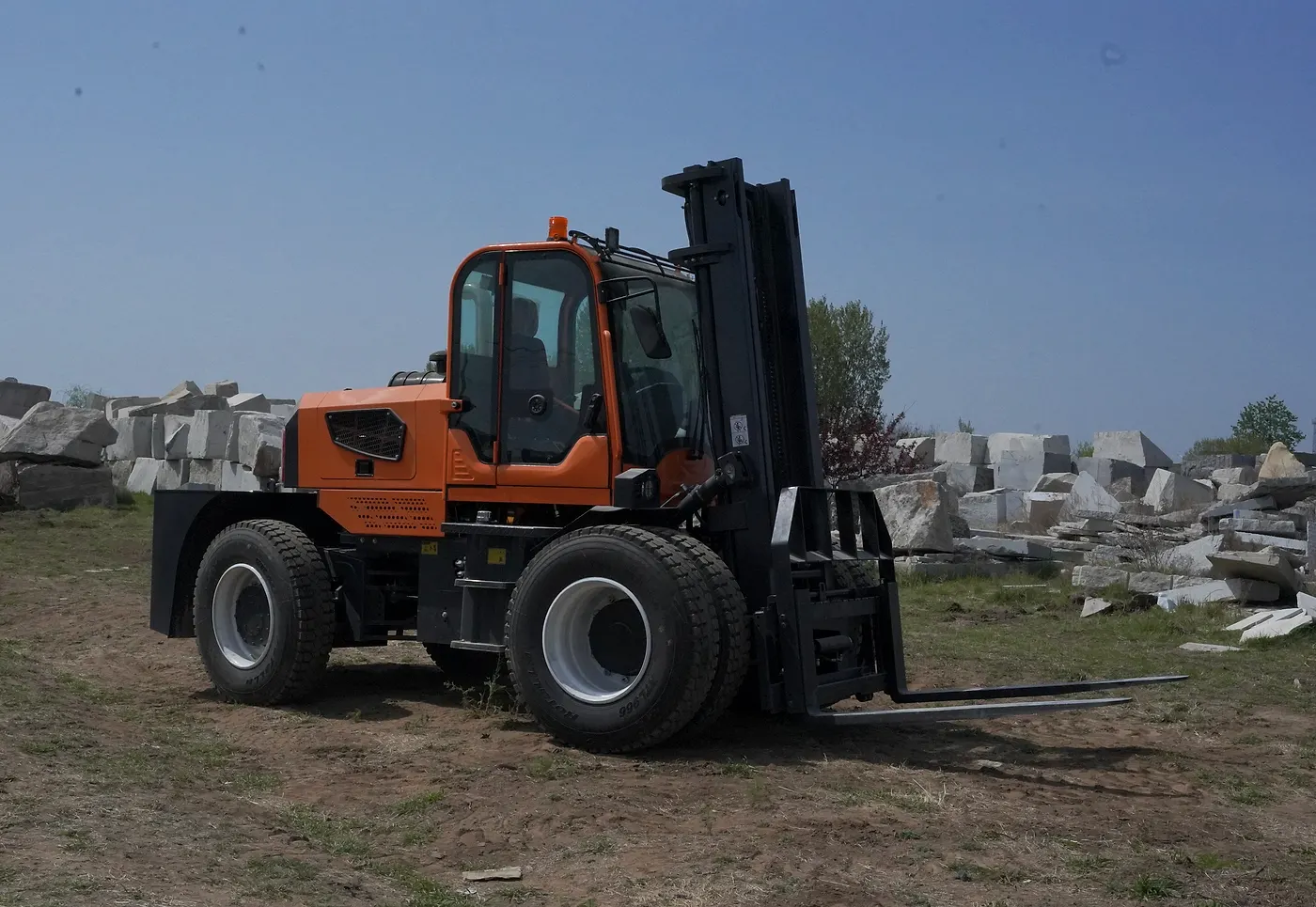
A rough terrain forklift may look strong in a photo. It may have large tires, 4WD, and a higher ground clearance than a warehouse forklift. But slope work adds another layer of risk and stress. The load moves differently. The tires grip differently. The operator has less room for mistakes. Rain, loose soil, gravel, mud, and sharp turns can change the same slope from manageable to dangerous.
So before I recommend a forklift for slope work, I do not only ask for the rated load.
I ask to see the site.
The Short Answer
A forklift on slopes should be selected by checking the full working condition, not only the maximum slope number.
For export buyers, I usually check:
- slope angle or approximate grade
- ground surface
- dry-season and rainy-season conditions
- load weight and load shape
- load center
- travel direction on the slope
- whether the forklift must turn on or near the slope
- tire type and traction
- braking and steering control
- operator experience
- route width and escape space
- local maintenance ability
A BLANC-ELE rough terrain forklift may be a better direction than a standard warehouse forklift for outdoor slope work, but the final choice still depends on the real site.
That is why I avoid giving a casual answer like "yes, it can handle slopes." It sounds confident, but it is not useful enough.
For slope work, the wrong confidence can become expensive after the machine arrives.
Why The Maximum Slope Number Can Mislead Buyers
The maximum slope number is not useless.
It is just incomplete.
A forklift may climb a slope under one condition and struggle under another. The same route can behave differently depending on:
- whether the forklift is loaded or empty
- whether the load is compact or long
- whether the surface is concrete, gravel, soil, mud, or grass
- whether the operator drives uphill, downhill, or across the slope
- whether the forklift must stop and restart on the incline
- whether the tires are clean, worn, wet, or clogged with mud
- whether there is a sharp turn at the top or bottom
This is why I prefer to discuss slope work as a complete route problem.
A short slope with a clean concrete surface may be easier than a mild-looking dirt ramp that becomes slippery after rain. A wide uphill route may be easier than a narrow ramp where the operator must turn near a truck. A pallet with a low and compact load may behave very differently from a tall or uneven load.
So if a buyer sends only one message saying, "Our site has a slope," I usually need more information before making a serious recommendation.
A Typical Case: The Ramp Was Not Long, But The Work Was Repeated
A typical case starts like this:
"The ramp is not very steep. We only need to move pallets from the yard to the loading area."
That sounds simple.
Then the site photos show more details.
The ramp is short, but the forklift must use it many times a day. The surface is compacted soil mixed with gravel. The loading point is near the top of the ramp. Trucks sometimes park slightly off line, so the operator must correct direction while carrying the load. After rain, water collects near the bottom. The buyer also wants to carry different load sizes, not only standard pallets.
In that situation, I would not treat the job as a normal flat-yard forklift selection.
I would ask:
- Does the forklift carry the load uphill or downhill?
- Can the truck position be improved?
- Can the ramp surface be repaired or compacted?
- Is there enough straight travel before turning?
- Does the operator need to stop on the ramp?
- What is the heaviest daily load, not the rare heaviest load?
- Are there photos from rainy-season conditions?
The machine choice matters, but the route design matters too.
Sometimes the best answer is not simply "choose a bigger forklift." A better tire choice, clearer route, improved ramp surface, lower travel speed, better loading position, and more realistic spare parts planning can all be part of the solution.
Ground Condition Changes The Slope
Slope work is not only about angle.
The ground decides how much of the forklift's power and braking control can actually be used.
On a clean concrete ramp, the operator may feel stable and predictable. On loose gravel, the tires may lose grip. On wet soil, the same ramp can become much harder. On grass or clay, the surface may look acceptable in the dry season and become a problem after rain.
For buyers in the Middle East, Southeast Asia, Africa, and other developing markets, I often see job sites where the ground is not fully prepared before the machine arrives. Construction sites, farms, plantations, brick yards, quarry support yards, and rural warehouses often have mixed surfaces.
That is why I like seeing close-up ground photos.
A wide photo of the whole site is useful, but it can hide the real surface. A close photo of tire tracks, loose stones, mud, compacted soil, or broken concrete tells me much more about what the forklift will face every day.
For related reading, this guide on what slope a forklift can handle explains why slope ability should be checked with real working conditions.
Load Shape Matters More On Slopes
Many buyers first tell me the load weight.
That is necessary, but it is not enough.
On slopes, load shape and load center become more important. A compact pallet, a long bundle, a tall crate, a loose agricultural load, and an attachment-based load can all affect how the forklift feels on an incline.
I want to know:
- the normal load weight
- the heaviest working load
- load dimensions
- whether the load is stable or loose
- required lifting height
- whether the forklift travels with the load raised or low
- whether attachments are used
- whether the route includes turning while loaded
This is also why I do not like confirming a forklift only from rated capacity. Rated capacity is based on specific conditions. Real site work can change the load center, visibility, travel route, and stability margin.
If the buyer plans to use longer forks, side shift, fork positioners, clamps, buckets, or other attachments, that discussion should happen before final configuration. Attachments can help the work, but they also change how the machine handles the load.
Tires And Drive System Are Only Part Of The Answer
Large tires and 4WD are important for many outdoor jobs.
But they are not magic.
I have seen buyers focus heavily on 4WD and forget to discuss the route, soil, slope direction, turning space, and load. That is risky because a drive system helps the forklift move, but safe and efficient slope work also depends on traction, braking, steering control, load position, operator behavior, and site layout.
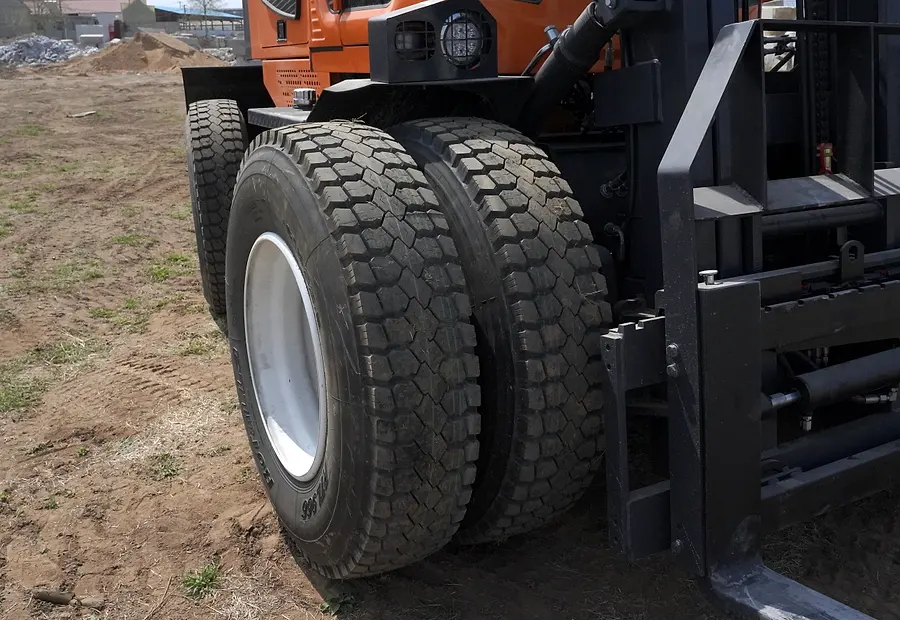
Before choosing tires for slope work, I usually ask:
- Is the ground mainly soil, gravel, concrete, grass, or mixed surface?
- Does the site become muddy after rain?
- Are there sharp stones or debris?
- Does the forklift travel long distances with load?
- Does the operator need to turn near the slope?
- Can replacement tires be sourced locally?
For buyers comparing models, our article on why 4WD alone does not make a forklift ready for rough terrain is a useful reminder. A forklift should be selected for the full working condition, not one feature.
Route Design Is Often The Hidden Problem
The route can make a good forklift look bad.
If the forklift must turn on a slope, stop halfway, reverse near a drop, or enter a narrow loading point at an angle, the risk increases. Even if the machine has enough power, the operation may become slow and stressful.
For slope applications, I prefer routes that allow:
- straight travel before and after the incline
- enough width for correction
- good visibility
- no unnecessary turning on the slope
- stable loading and unloading positions
- a clean surface without loose debris
- a place for trucks to park consistently
Sometimes buyers show me a slope and ask whether the forklift can climb it.
I also look at what happens before and after the slope.
Where does the forklift pick the load? Where does it place the load? Does the operator need to turn immediately after climbing? Is the unloading area level? Is there mixed traffic from trucks, loaders, workers, or motorcycles?
That is why a short route video is often more useful than a single photo. A video shows how the forklift would actually move through the site.
Operator Practice Still Matters
A better forklift does not remove the need for good operating practice.
Official forklift guidance from OSHA treats operator training, load handling, inspection, and operating conditions as important parts of powered industrial truck safety. That matches what I see in export projects. Machine selection is only one part of the work.
For slope work, the buyer should also think about:
- operator training
- daily inspection
- speed control
- keeping the load low during travel
- avoiding sudden turns or braking
- checking route condition before work
- stopping work when the ground becomes unsafe
- setting site rules for trucks and people near the route
I try to be careful with this point because no supplier should promise that a forklift is safe on every slope.
The honest answer is more practical:
Choose the right machine, confirm the final configuration, improve the route where possible, and operate within site rules.
What I Ask Before Recommending A Forklift For Slope Work
Before recommending a forklift on slopes, I usually ask buyers to send the following information:
| Question | Why it matters |
|---|---|
| What is the approximate slope angle or grade? | It helps us judge the route, but it is only one part of the decision. |
| What is the surface material? | Concrete, gravel, soil, mud, grass, and mixed ground all behave differently. |
| What load will be carried? | Weight, dimensions, and load center affect the recommendation. |
| Does the forklift travel uphill or downhill with load? | Direction changes the operating risk and route planning. |
| Does the operator need to turn on or near the slope? | Turning space is often more important than buyers expect. |
| What happens after rain? | Rainy-season photos often reveal problems hidden in dry-season photos. |
| How often will the slope be used each day? | Repeated work creates more wear, heat, fatigue, and downtime risk. |
| Who will maintain the machine locally? | Export buyers should plan inspection and spare parts before shipment. |
These questions may look simple, but they prevent many wrong choices.
They also help the buyer avoid buying a forklift that only looks correct in a quotation and then struggles in real use.
What Buyers Should Send Us
If your forklift will work on slopes, ramps, hilly farms, construction access roads, brick yards, plantations, quarry support yards, or outdoor warehouses, send us:
- site photos from different angles
- a short route video
- close-up ground photos
- slope or ramp photos
- rainy-season photos if available
- load photos
- load weight range
- load dimensions
- lifting height requirement
- travel distance with load
- turning area photos
- attachment requirements
- destination country and local service situation
With this information, we can give a more useful recommendation for a rough terrain forklift for outdoor work instead of guessing from one capacity number.
You may also find these related articles useful:
- How can you work safely with a forklift on inclined surfaces?
- What is the best forklift for construction sites with slopes?
- What's the best forklift for hilly terrain?
Final Thought
Slope work should be checked before choosing the forklift, not after the machine reaches the site.
A rough terrain forklift can be the right direction for many outdoor slope applications, but the real decision should come from the load, ground, route, operator practice, tire choice, maintenance plan, and final machine configuration.
If your site includes slopes or ramps, send us your working condition. A few photos and a short route video can make the recommendation much more reliable.