
Four-wheel drive sounds reassuring on a forklift quotation.
I understand why buyers like it.
For outdoor work, 4WD feels like the simple answer. The site is not flat, the road is not clean, and a normal warehouse forklift may slip, sink, or stop too easily. So the buyer asks for a 4WD forklift and expects the problem to be solved.
But in real rough terrain forklift selection, 4WD is only one part of the answer.
It helps the machine send power to the ground. It does not automatically solve bad tires, low ground clearance, poor route planning, unstable loads, narrow turning space, weak maintenance access, or a site that becomes much worse after rain.
That is why I usually do not stop at the question:
"Is it 4WD?"
I ask a better question:
"Is the whole forklift configuration ready for this ground, this load, and this daily work?"
The Short Answer
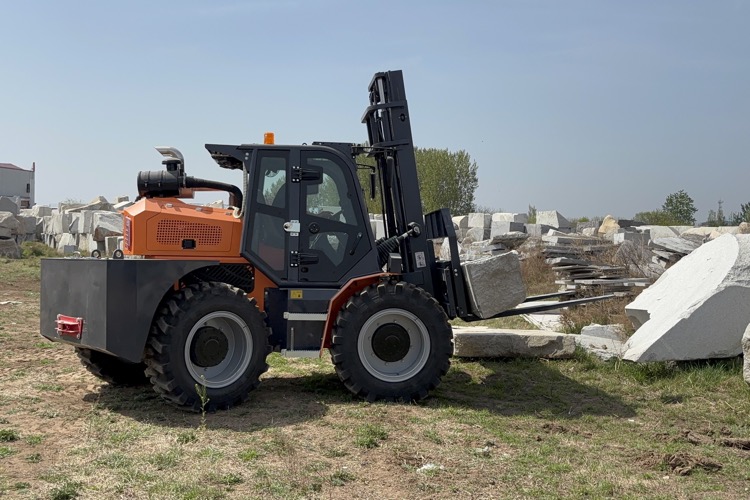
A 4WD forklift can be a good starting point for outdoor work, but 4WD alone does not make a forklift ready for rough terrain.
Before choosing a machine, buyers should also check:
- ground condition
- tire type and tire condition
- ground clearance
- load weight and load shape
- travel distance with load
- turning space
- slope or ramp work
- attachment use
- operator visibility
- daily maintenance and spare parts support
For buyers comparing drive systems, this guide on forklift drive types is a useful background article. But once the work moves outside onto soil, gravel, mud, stone yards, farms, or construction sites, the discussion should become more practical than drive type alone.
That is where the BLANC-ELE rough terrain forklift range becomes relevant.
Why Buyers Often Overtrust 4WD
Many buyers have already experienced the problem.
A normal forklift works well on concrete, then becomes weak outdoors. It spins on wet soil. It cannot move confidently through gravel. It struggles on a small slope. The operator feels the machine is fighting the ground.
After that experience, the buyer naturally thinks:
"Next time, I need 4WD."
That thinking is reasonable, but it is incomplete.
4WD helps traction, especially compared with a forklift that is not designed for outdoor ground. But traction is a chain. If one link is weak, the whole machine still struggles.
For example:
- 4WD with poor tires can still slip.
- 4WD with low clearance can still touch the ground.
- 4WD with the wrong load center can still feel unstable.
- 4WD with a narrow route can still waste time turning and correcting.
- 4WD with poor service access can still become expensive to keep working.
This is why I treat 4WD as a feature, not a complete solution.
A Typical Case: The Buyer Asked For 4WD, But The Site Asked For More
A typical overseas buyer may send a short message:
"We need one 4WD forklift for outdoor material handling."
At first, this sounds clear.
Then we ask for site photos and the real work becomes more detailed:
- the forklift will load trucks from an unpaved yard
- the ground is soil mixed with gravel
- stone pieces and broken concrete are on the route
- the forklift carries palletized blocks and some long materials
- the site becomes soft after rain
- the operator must turn close to stacked materials
- the forklift works several hours each day, not only a few short lifts
In this situation, the buyer does need to think about 4WD.
But the buyer also needs to think about tires, clearance, fork length, load center, route width, underbody protection, cooling, maintenance access, and spare parts planning.
If we recommend only "a 4WD forklift," we are still guessing.
If we check the full working condition, the recommendation becomes much more useful.
4WD Helps Only If The Tires Can Use The Power
The tire is the part that actually meets the ground.
That sounds obvious, but it is often forgotten.
On outdoor jobs, tire choice affects traction, steering control, braking feel, ground pressure, tire wear, and operator confidence.
A tire that looks strong in a photo may still be wrong for the site.
For example:
| Ground condition | What can go wrong if only 4WD is considered |
|---|---|
| Wet soil | The tire may slip or fill with mud. |
| Loose sand | The forklift may sink or lose momentum. |
| Sharp gravel | Tire wear and sidewall damage may become the real problem. |
| Broken concrete | Vibration, puncture risk, and underbody clearance matter. |
| Mixed indoor and outdoor work | A very aggressive tire may not suit every floor. |
This is why I prefer to ask for close photos of the ground, not only photos of the forklift model.
For a deeper tire-focused article, see our guide on 4WD forklift tires and outdoor performance.
Ground Clearance Is Not A Small Detail
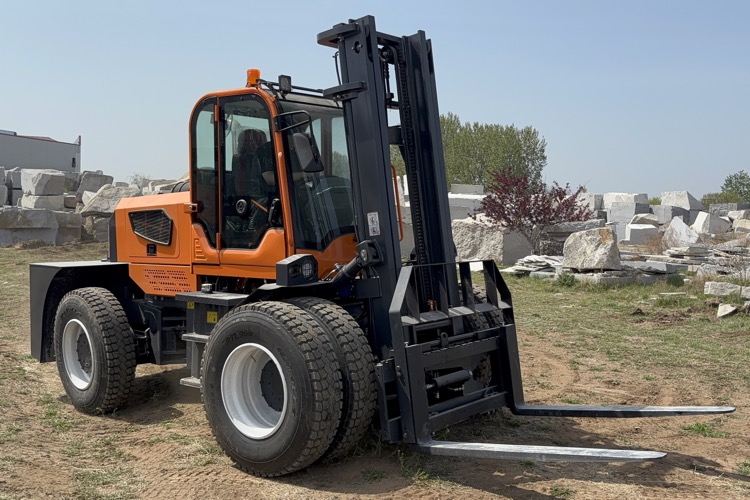
A forklift can have four-wheel drive and still be uncomfortable on rough ground if the lowest parts of the machine are too close to the surface.
Ground clearance matters on:
- ruts left by trucks
- uneven stone yards
- broken construction roads
- farm paths
- brick yards
- muddy entrances
- outdoor yards with debris
The risk is not only getting stuck.
Low clearance can also create repeated impacts, scraping, vibration, and operator hesitation. The operator slows down, avoids certain routes, or spends more time repositioning the machine.
In daily work, that becomes lost efficiency.
This is one reason a rough terrain forklift should be judged as a whole machine, not only a drive system.
Load Shape Can Defeat A Good Drive System
Some buyers describe the load only by weight.
That is not enough.
A compact pallet near the mast is very different from a long steel bundle, wide formwork, stone slab, pipe bundle, bale clamp load, or bucket material.
Load shape affects:
- load center
- stability margin
- fork length
- mast visibility
- attachment choice
- turning space
- braking and travel feel
4WD does not fix a poor load match.
If the load is long, wet, unstable, or carried far from the mast, the forklift may need a different configuration even if the rated capacity looks acceptable.
For attachment-related jobs, this article on rough terrain forklift attachments and configurations is worth reading before order.
Route And Turning Space Still Decide Daily Efficiency
Many outdoor sites are not wide open.
The forklift may work between trucks, pallets, stacked materials, walls, sheds, containers, drainage channels, or temporary construction barriers.
In that situation, 4WD may help the forklift move, but it does not automatically make the route efficient.
The buyer should check:
- the narrowest turning point
- where the forklift picks up the load
- where it must place the load
- whether the route is one-way or shared with trucks
- whether the operator must turn with the load raised
- whether the site layout changes during the project
This is also why I often ask buyers to send a short route video.
A route video shows more than a product photo. It shows how the forklift will live every day.
Slopes Need Careful Wording And Careful Operation
Some buyers ask whether 4WD is enough for slopes.
The honest answer is: it depends.
Slope work depends on the machine, tire condition, ground surface, load weight, load center, travel direction, operator training, and site management. No responsible supplier should say that 4WD makes slope work simple or risk-free.
For slope-related work, the recommendation should combine machine selection with safe operating practice.
OSHA's powered industrial truck guidance treats training, inspection, operating surface, load handling, and safe operation as important parts of forklift use. That matches what we see in real projects: the machine matters, but the site and the operator matter too.
If slope work is important for your site, read this related BLANC-ELE article on working safely with a forklift on inclined surfaces.
What I Ask Before Recommending A 4WD Forklift
Before I recommend a 4WD rough terrain forklift, I usually want to know:
| Question | Why I ask |
|---|---|
| What ground will the forklift drive on? | 4WD behaves differently on soil, gravel, sand, mud, concrete, and stone. |
| Does the ground change after rain? | Seasonal ground changes often create the real problem. |
| What is the normal load and heaviest load? | Rated capacity must match daily work, not only one best-case lift. |
| What is the load shape? | Long or irregular loads can change fork and attachment needs. |
| How far will the forklift travel with load? | Long travel increases tire wear, heat, fuel use, and operator fatigue. |
| Is there slope or ramp work? | Inclines need careful machine selection and safe operation. |
| How tight is the route? | Turning space can decide whether the machine is practical. |
| Will attachments be used? | A bucket, clamp, side shift, or fork positioner changes the configuration. |
| Who will handle maintenance locally? | Export buyers should think about downtime before shipping. |
These questions are simple, but they prevent many wrong purchases.
What Buyers Should Send Before Asking For A Final Recommendation
The best inquiry is not long.
It is clear.
For a 4WD forklift or rough terrain forklift recommendation, send:
- load photo
- load weight range
- load size and shape
- route video
- ground close-up photo
- rainy-season or worst-condition photo if available
- required lifting height
- expected working hours per day
- attachment requirement
- destination country and local service situation
This gives the supplier enough information to check the full configuration, not only the drive system.
Final Thought
I like 4WD for many outdoor forklift applications.
It is useful. It is often necessary. It gives the forklift more working margin than a machine built only for smooth indoor floors.
But 4WD is not magic.
For rough terrain work, the real question is not only whether the forklift has four-wheel drive.
The real question is whether the whole machine matches the ground, tires, clearance, load, route, operator, maintenance plan, and daily working pressure.
If you are choosing a 4WD forklift for construction sites, farms, stone yards, brick yards, outdoor warehouses, or developing-market projects, send us your working condition, route photos, load details, and target use.
We can help you check whether a BLANC-ELE 4WD rough terrain forklift is the right direction before you place the order.
For a configuration check, you can also contact BLANC-ELE with your site details.