
Drive type sounds like a technical detail.
On an outdoor job site, it becomes a daily working problem.
Many buyers compare FWD, RWD, and 4WD forklifts as if they are only different drivetrain labels. I understand that. The words look simple. Front wheel drive, rear wheel drive, four wheel drive. Easy to list, easy to ask about, easy to put into a quotation.
But after working with many overseas buyers, I do not treat drive type as a small checkbox.
I treat it as one part of the whole working condition.
A forklift that works well on a clean factory floor may feel wrong in a construction yard. A 4WD forklift may still struggle if the tires are wrong, the route is too soft, the slope is wet, the load center is long, or the operator has to turn in a narrow corner. A buyer may ask for 4WD because it sounds stronger, but the real question is whether the whole machine matches the site.
So before I recommend FWD, RWD, or 4WD, I ask a more practical question:
"Where will the forklift actually drive every day?"
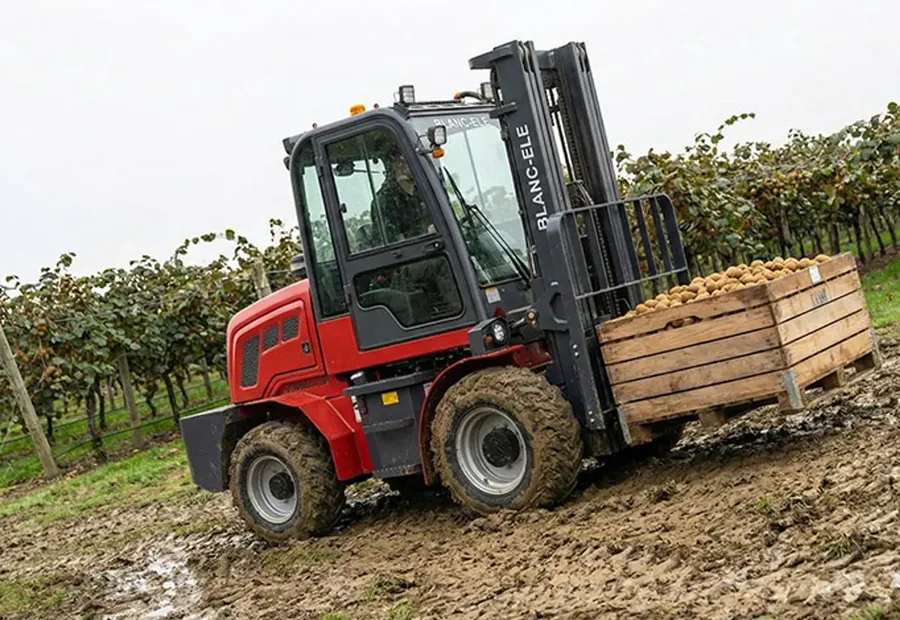
The Short Answer
For outdoor rough ground, FWD, RWD, and 4WD should not be compared only by the drivetrain name.
Buyers should check:
- ground surface
- load weight and load shape
- slope or ramp areas
- tire type
- turning space
- travel distance with load
- rainy-season conditions
- operator practice
- service and spare parts support
For many construction sites, farms, brick yards, plantations, quarries, and outdoor storage yards, a rough terrain forklift or 4WD forklift is more suitable than a normal warehouse forklift. But even then, 4WD is not the full answer by itself.
The machine still needs the right tires, clearance, steering behavior, load margin, maintenance access, and route planning.
For a basic explanation of the drivetrain terms, see our guide to forklift drive types: FWD, RWD, and 4WD. This article goes one step further and explains how I use those terms when talking with real outdoor buyers.
What FWD, RWD, And 4WD Usually Mean In Buyer Discussions
In simple buyer language:
- FWD means the front wheels provide driving force.
- RWD means the rear wheels provide driving force.
- 4WD means four wheels can provide driving force.
That is the easy part.
The harder part is understanding what the forklift will do on the ground.
On many indoor or paved-yard jobs, the forklift drives on a firm and predictable surface. The buyer may care more about lifting height, turning radius, warehouse aisle width, and daily pallet handling. In that situation, drive type may not be the biggest problem.
Outdoor work is different.
The forklift may need to move through:
- compacted soil
- gravel
- mud after rain
- broken concrete
- farm tracks
- temporary construction roads
- loading yards with ruts
- slopes or ramp entrances
- mixed surfaces in one route
This is where drive type becomes more important, but also more misunderstood.
If the ground is soft, traction matters. If the route is uneven, ground clearance matters. If the forklift turns tightly with load, steering and tire wear matter. If the site is far from service support, maintenance planning matters.
Drive type helps the forklift move, but the full job site decides whether the machine works well.
A Typical Case: The Buyer Asked For 4WD, But The Route Was The Real Issue
A typical buyer message may sound like this:
"We need a 4WD forklift for outdoor work."
That is a useful starting point, but it is not enough for a serious recommendation.
After asking for photos and a short route video, the real picture may look different:
- the forklift travels 200 to 300 meters between storage and loading
- the ground is hard in the dry season but soft after rain
- the operator turns near a truck loading point
- the load is not always a standard pallet
- the buyer wants to use longer forks later
- spare parts support is far from the job site
In this case, I would not only say, "Yes, choose 4WD."
I would also check tire pattern, ground clearance, turning space, load center, lifting height, attachment plan, radiator cleaning, daily inspection, and spare parts preparation.
If we only focus on the drive type, we may miss the reason the forklift will slow down later.
Sometimes the correct answer is still 4WD. But the useful answer is a complete configuration, not only a drivetrain label.
FWD Or RWD May Be Fine On Controlled Ground
Not every buyer needs a rough terrain forklift.
If the forklift works mainly on flat concrete, a paved yard, or an indoor warehouse, a standard forklift may be enough. The buyer should still check load, aisle width, lifting height, operating hours, battery or engine choice, maintenance support, and local service.
The problem starts when a buyer expects a warehouse-style forklift to work like an outdoor machine.
A normal forklift may look strong during a short test. It may lift the load. It may drive across a yard once. But daily outdoor work is not the same as one clean test.
If the route includes mud, soft soil, stones, slopes, loose gravel, or uneven construction roads, the buyer should slow down and check whether the forklift is really built for that environment.
This is one reason I often ask for a route video. A video shows vibration, ruts, tight corners, surface changes, and how trucks or workers share the same space.
4WD Helps, But It Does Not Fix Every Outdoor Problem
4WD can help with traction and movement on rougher ground.
But I do not like presenting 4WD as a magic answer.
I have seen buyers choose a 4WD forklift and still face problems because:
- the tire pattern did not suit the ground
- the forklift had to turn in a tight muddy area
- the load was longer than expected
- the operator drove with the load too high
- the route had a slope transition
- dust and mud made inspection more important
- spare parts were not prepared before shipment
That is why our article on why 4WD alone does not make a forklift ready for rough terrain is important. 4WD is part of the solution, but the buyer still needs to check the complete working condition.
For a rough terrain forklift, I usually discuss 4WD together with:
- tires
- ground clearance
- steering behavior
- braking and operator control
- load center
- mast and fork configuration
- route width
- slope use
- maintenance access
This is more work before order, but it is much better than discovering the problem after the machine arrives.
Tires Often Decide Whether Drive Type Can Help
Drive type sends power to the wheels.
Tires decide how much of that power can become real grip.
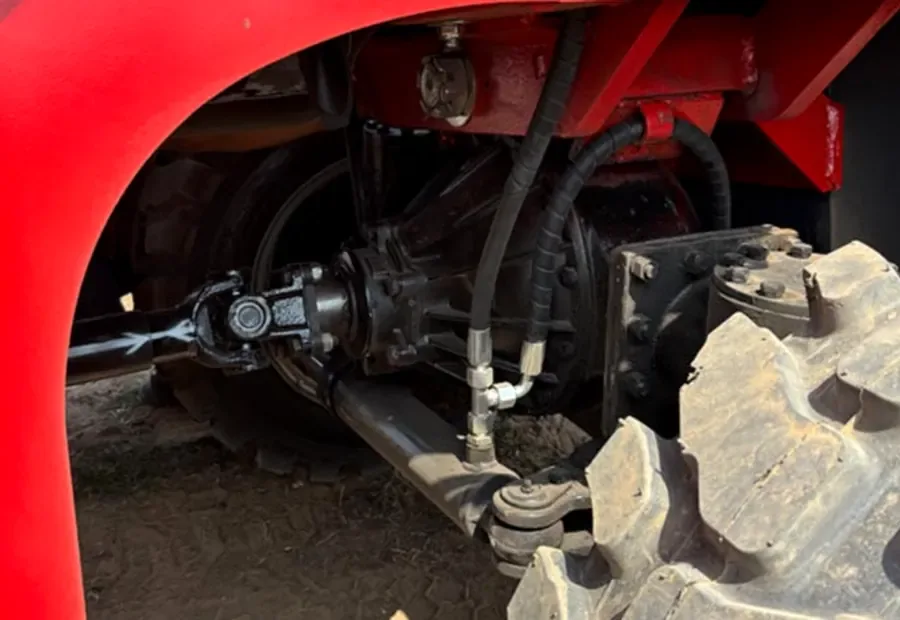
On outdoor sites, tires may face:
- mud
- gravel
- stones
- wet soil
- concrete mixed with dirt
- long travel routes
- frequent turning with load
If the tires do not match the ground, even a strong drivetrain can feel disappointing.
This is especially true in export projects. Some buyers focus on engine power or 4WD first, then treat tires as a small detail. In daily work, tires are not a small detail. They affect traction, vibration, wear, steering feel, and downtime.
Before recommending tire direction, I ask:
- Is the ground mostly hard, soft, muddy, rocky, or mixed?
- Does the site become worse after rain?
- Are there sharp stones or debris?
- How far does the forklift travel with load?
- Does it turn tightly near trucks or stockpiles?
- Can replacement tires be sourced locally?
The answer may change the recommendation more than the buyer expects.
Steering And Turning Space Should Be Checked Together With Drive Type
Many buyers ask about drive type before they ask about steering.
I think both should be discussed together.
Outdoor work usually gives the operator less perfect control than a clean warehouse floor. The ground can be uneven. Tires may slip slightly. Trucks may block part of the route. The operator may need to turn near a slope, stockpile, wall, or loading area.
In that situation, steering behavior and turning space become very practical.
For more detail, I recommend reading our article on why forklift steering matters more on rough terrain than buyers expect.
When I check a buyer's site, I ask:
- How wide is the narrowest route?
- Where does the forklift turn with load?
- Does the operator turn before or after a slope?
- Is there enough level ground near the loading point?
- Can truck parking position be improved?
- Will the forklift use attachments that increase working width?
A 4WD forklift can still feel wrong if the route is too tight or the steering arrangement does not suit daily work.
Slopes, Mud, And Load Center Change The Decision
Drive type becomes more sensitive when the forklift works on slopes or wet ground.
A buyer may say:
"The slope is not very steep."
That may be true in dry weather. But if the forklift carries a heavy or long load on wet soil, the same slope can become a different job.
For slope work, I do not judge only by the drivetrain. I also check surface grip, load center, travel direction, stopping points, operator practice, and the route before and after the slope.
This is also why I link drive type discussion with our article on slope work before choosing a rough terrain forklift. Slope work is a full site question, not only a power question.
A Simple Buyer Checklist
Before choosing FWD, RWD, or 4WD, buyers should send the following information:
| Information | Why I ask for it |
|---|---|
| Ground photos | Surface condition affects traction, tire choice, and ground clearance. |
| Route video | A video shows turns, ruts, slopes, traffic, and loading points. |
| Load photos | Load shape and load center can change the recommendation. |
| Load weight range | Daily load is usually more useful than only the maximum load. |
| Travel distance | Long travel affects tire wear, operator fatigue, and maintenance planning. |
| Slope or ramp photos | Drive type must be checked together with slope, surface, and load. |
| Rainy-season condition | Dry-season photos can hide the real problem. |
| Attachment plan | Longer forks, side shift, buckets, or clamps can change stability and working width. |
| Local service situation | Export buyers should plan spare parts and inspection before shipment. |
This checklist is simple, but it saves time.
It helps the supplier recommend a machine for the real site, not for a clean specification sheet.
What I Usually Recommend Buyers Avoid
I usually warn buyers against these shortcuts:
- choosing 4WD only because it sounds stronger
- using a warehouse forklift for repeated outdoor mud work
- judging tires only by appearance
- ignoring turning space near the loading point
- checking capacity but not load center
- forgetting rainy-season ground conditions
- asking for attachments after the forklift configuration is already fixed
- treating spare parts as a problem for later
These are not theoretical mistakes. They are the kind of small assumptions that create big trouble after delivery.
The forklift may still run, but it runs slower. Operators become cautious. Tires wear faster. Maintenance becomes harder. A small part delay becomes downtime.
For export buyers, that is exactly what we want to prevent before the order is confirmed.
Final Thought
FWD, RWD, and 4WD are useful terms, but they are not the whole decision.
For outdoor work, the buyer should connect drive type with ground condition, tire choice, load center, steering, slopes, route width, operator practice, and after-sales planning.
If your forklift will work outside a clean warehouse floor, do not send only the load capacity. Send photos, videos, ground details, route details, and load information.
With that information, we can recommend a rough terrain forklift configuration that fits the real job site better.
If you are not sure whether your site needs FWD, RWD, or 4WD, contact BLANC-ELE and send us the working condition. A few clear photos and a short route video are often enough to start the right discussion.