
There is no responsible single slope number that fits every forklift. A published gradeability figure is usually tested under controlled conditions, while real slope work changes with load weight, load center, mast height, attachment weight, tire condition, ground surface, travel direction, braking distance and operator practice. For outdoor buyers, a diesel 4WD rough terrain forklift can be the right direction when the route includes uneven ground, gravel, farm soil or construction-site ramps. But final slope suitability should be checked against the specific model sheet, load condition and site route before quotation.
What Actually Changes Forklift Slope Capability?
The practical question is not only “What slope can a forklift handle?” It is “What slope can this forklift handle with this load, on this surface, in this travel direction?”
| Factor to confirm | Why it changes the answer |
|---|---|
| Published gradeability | A useful starting point, but it may not represent loaded travel on loose or wet ground. |
| Load weight and load center | A heavier or forward-heavy load reduces margin, especially when traveling up or down a slope. |
| Mast height and attachment weight | Raised loads and added attachments change stability and braking requirements. |
| Surface condition | Concrete, gravel, mud, grass, wet soil and loose stone do not behave the same. |
| Tire pattern and tire condition | Deep-tread tires help outdoor traction, but worn or unsuitable tires reduce control. |
| Travel direction and turning points | Driving straight, reversing, turning across a slope and braking downhill carry different risks. |
| Route width and stopping distance | A narrow ramp or short stopping zone can be a bigger problem than the slope number itself. |
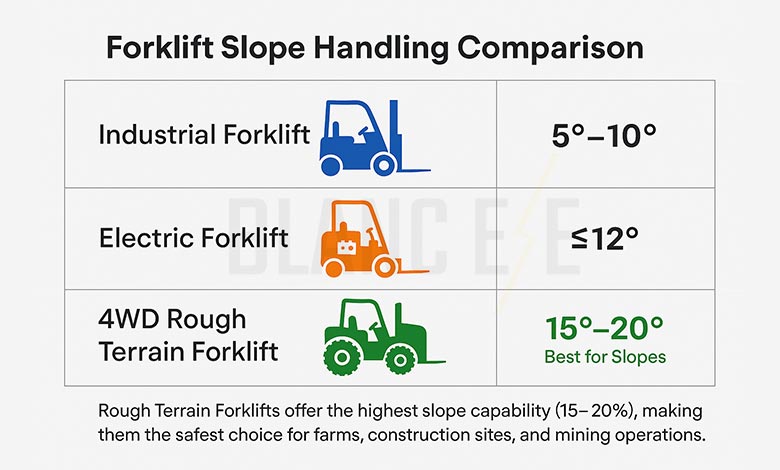
Safer Gradeability Wording For Outdoor Buyers
A 4WD rough terrain forklift can improve traction compared with a standard indoor forklift when the jobsite includes gravel, uneven ground, soft soil or mixed outdoor routes. It should not be described as safe on every slope. Slope work depends on the machine specification, load condition, ground firmness, tire grip, travel direction, braking, operator training and site rules.
When slope work is important, send the supplier photos or video of the ramp and route, the maximum load weight, load dimensions, load center, lifting height, attachment requirement and whether the forklift must travel loaded uphill or downhill. The final recommendation should be confirmed with the formal specification sheet and quotation, not with a generic angle claim.
For route-focused support, see slope work before choosing a rough terrain forklift and forklift ramp slope planning. Those pages support route planning details; this page remains the general slope-capability owner.
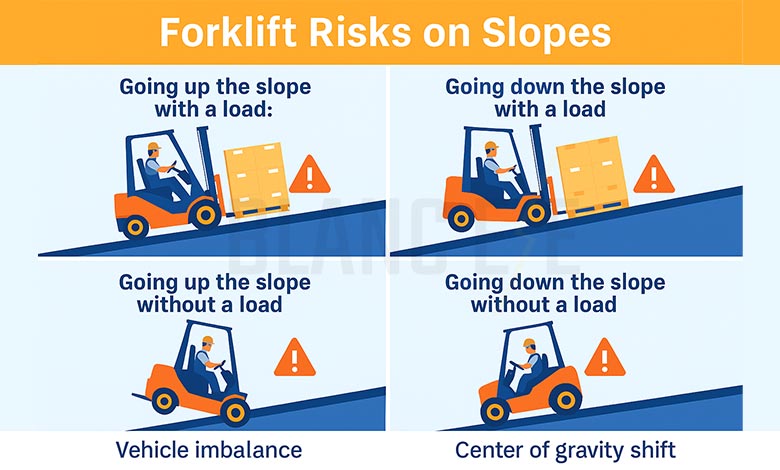
When To Compare A Rough Terrain Forklift For Slopes
| Buyer situation | Better next step |
|---|---|
| Smooth indoor floor with only small dock transitions | Confirm the warehouse forklift manual and site safety rules first. |
| Outdoor yard with gravel, wet ground or soft soil | Compare a 4WD rough terrain forklift configuration, tire pattern and ground clearance. |
| Construction route with ramps, temporary roads or uneven loading points | Send route photos, slope direction and load details before model selection. |
| Farm or plantation route with soil, grass, ruts or seasonal mud | Check traction, tire choice, steering space, daily travel distance and support plan. |
| Heavy loads, long forks or attachments on a slope | Confirm capacity margin, load center, mast height and attachment effect before choosing rated capacity. |
Where Slope Questions Usually Appear
Agriculture
In orchards, farms and plantations, slope questions are usually mixed with soil firmness, seasonal rain, rut depth, load shape and turning space. A rough terrain forklift should be compared only after these route conditions are clear.
Construction
On construction sites, the important details are the temporary road surface, ramp length, stopping area, load center, mast height and whether the machine must travel loaded uphill or downhill. These details matter more than a single online slope number.
Mining And Forestry
For quarry, forestry or rough project routes, buyers should confirm ground firmness, tire choice, route maintenance, turning points and daily support needs before selecting a rated capacity or attachment.
Operating Reminders For Forklifts On Slopes
- Keep the load low during travel.
- Avoid sharp turns or sudden braking on a slope.
- Check tire condition, brake condition and ground firmness before work.
- Follow the machine manual, site rules and trained operator practice.
- Stop and reassess when the route, surface or load condition changes.
FAQs
Q1: Can a forklift go up a hill?
Yes, but only when the model specification, load condition, surface, travel direction, braking distance and site rules allow it. A supplier should check the working condition before confirming suitability.
Q2: What is the maximum slope for a forklift?
There is no universal maximum slope for every forklift. Use the specific model sheet, operation manual, load condition and site route. Avoid choosing equipment from a generic online angle number.
Q3: Are rough terrain forklifts better for slopes?
They are usually a better direction for uneven outdoor routes than standard warehouse forklifts because they can combine 4WD, higher ground clearance and outdoor tires. They still require correct load margin, tire choice and safe operation.
Q4: What should I send before asking BLANC-ELE for a slope-work quote?
Send ground photos or video, slope direction, ramp length, load weight, load size, load center, lifting height, attachment requirement, route width, daily working hours and destination country.
For a general outdoor product path, start with the BLANC-ELE rough terrain forklift range. If the jobsite includes moderate loads on mixed outdoor ground, compare the 3.5 ton rough terrain forklift and 5 ton rough terrain forklift pages. For heavier stone, block, timber or project-material handling, the 7 ton 4WD rough terrain forklift may also need to be compared.
Before asking for a quote, send the slope or ramp photos, surface condition, maximum load weight, load size, load center, lifting height, attachment requirement, route width, travel direction and destination country through the BLANC-ELE contact page. BLANC-ELE can then confirm the suitable rough terrain forklift configuration and quote according to the final specification and destination-market requirements.