
A heavier forklift is not automatically the better forklift.
That is one of the first things I tell buyers who ask about 5 ton and 7 ton rough terrain forklifts.
For outdoor work, bigger capacity can give more working margin. But it can also bring a larger machine, wider turning needs, heavier ground pressure, higher shipping considerations, and a configuration that may be more than the job really needs.
The right question is not simply:
"Should I buy the bigger forklift?"
The better question is:
"What load, ground, route, lifting height, attachment, and future work does this machine need to handle?"
That is where the 5 ton and 7 ton discussion becomes useful.
The Short Answer
A 5 ton rough terrain forklift usually makes sense when the buyer needs stronger outdoor handling than compact 3 ton or 3.5 ton machines, but the work is still within a moderate heavy-duty range: construction pallets, block yards, farms, outdoor warehouses, stone yards, and mixed material handling.
A 7 ton rough terrain forklift starts to make more sense when the buyer handles heavier loads, longer materials, tougher routes, higher working margin, or more demanding quarry, mining, industrial yard, and rental-fleet applications.
But the final choice should never come from rated capacity alone.
It should come from:
- real load weight and size
- load center
- ground condition
- turning route
- lifting height
- attachment plan
- daily working hours
- support and spare parts situation
- future jobs the buyer already expects
If the buyer only compares 5 ton and 7 ton machines by the number on the model name, the quote may look simple but still miss the real working risk.
Start With Working Margin, Not Pride
Some buyers want the bigger machine because it feels safer.
I understand the thinking. Nobody wants to buy a forklift and later discover it is too small for the job.
But too much machine can also create problems.
On a tight construction site, a larger forklift may need more turning space. On soft soil, the heavier machine may require better route planning. In a dealer warehouse, a 7 ton model may be harder to position for small mixed loads. For export buyers, shipping, unloading, parts planning, and operator training also need to be considered.
So I usually separate the discussion into two parts:
- What does the job need today?
- What will the buyer probably need in the next one to three years?
If the buyer is only moving standard pallets or medium construction materials, a properly configured 5 ton 4WD rough terrain forklift may already give enough margin.
If the buyer regularly handles heavier stone, oversized materials, dense loads, or more demanding outdoor routes, the 7 ton 4WD rough terrain forklift may be the more realistic discussion.
A Simple 5 Ton vs 7 Ton Thinking Table
This table is not a final specification decision. It is a starting point for a better conversation.
| Buyer Situation | 5 Ton Discussion | 7 Ton Discussion |
|---|---|---|
| Medium-heavy pallets | Often suitable if load size and ground are reasonable | May be more than needed |
| Stone yard or quarry material | Suitable for many mixed loads | Better to discuss if loads are dense or frequent |
| Construction site pallets | Often a strong choice | Consider if loads are heavier, longer, or more demanding |
| Rental fleet | Good general heavy-duty option | Useful if customers often ask for larger capacity |
| Farm or plantation work | Useful for heavy pallets, bags, bins, and mixed routes | Consider only when load and ground justify it |
| Long forks or attachments | Must check load center and hydraulic needs | More margin may help, but still needs confirmation |
| Tight site route | Easier than a larger model in many cases | Needs more route and turning confirmation |
| Future heavier work | May be enough if future loads are close to current work | Better if heavier work is likely and frequent |
The point is not that one model is better.
The point is that each model should match the real job.
Load Center Is Where Many Mistakes Start
Rated capacity is only the headline.
The real load may be longer, wider, uneven, wet, loosely packed, or placed farther forward on the forks. That changes the working condition.
OSHA's powered industrial truck guidance treats load handling, load center, and stability as serious issues. In supplier language, I would say it this way: the same weight can behave very differently depending on where that weight sits.
A compact pallet close to the mast is not the same as long steel, wide stone, uneven timber, or a wet load on damaged pallets.
Before comparing 5 ton and 7 ton machines, I want to know:
- What is the maximum load weight?
- What is the normal daily load?
- What are the load dimensions?
- Is the load compact or long?
- Is the load stable or uneven?
- Will the buyer use long forks, a bucket, bale clamp, fork positioner, side shifter, or crane jib?
- How high must the forklift lift the load?
This is why I do not like choosing capacity from one number in a message.
The buyer may say "5 tons," but the load center may make the real job more demanding. Or the buyer may ask for 7 tons, but the actual work may fit a 5 ton machine with the right configuration.
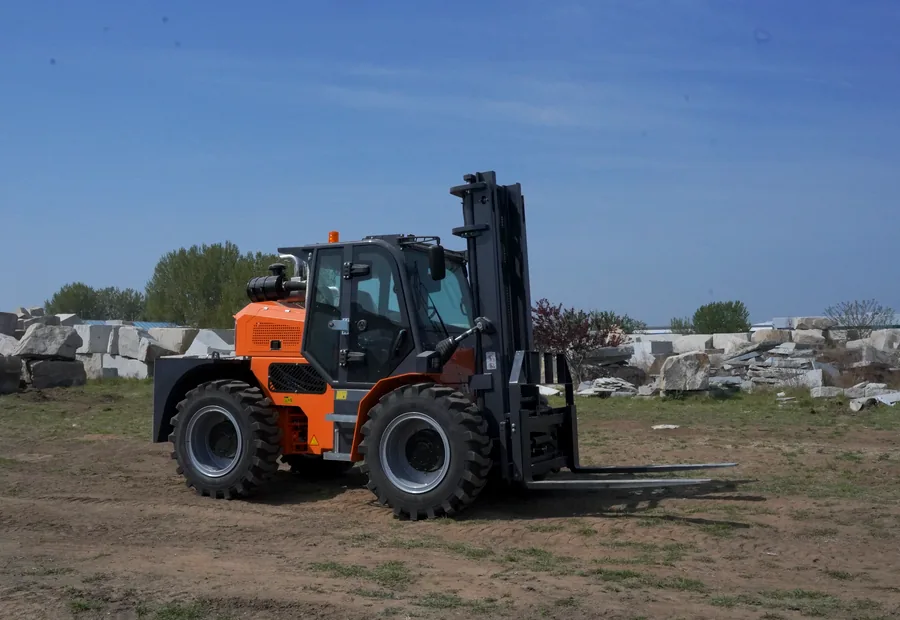
Ground And Route Can Decide The Model
A rough terrain forklift works with the ground every minute.
For heavy outdoor work, the route matters as much as the load.
A 5 ton machine on a firm, open, well-planned route may work better than a larger forklift forced into a narrow, soft, poorly arranged route. On the other hand, if the buyer works on a quarry road, outdoor stone yard, mining support site, or large construction yard with heavy loads, a 7 ton class discussion may be reasonable.
I usually ask buyers to send:
- photos of the loading area
- photos of the route after rain
- a short video of the turning point
- details about slopes or ramps
- information about mud, gravel, sand, broken concrete, or stone debris
- travel distance per trip
- whether the machine must turn while loaded
This is not paperwork for the sake of paperwork.
It prevents a quote from becoming too shallow.
Heavy-load forklift selection is not just about lifting. It is also about traveling, turning, stopping, entering the pallet cleanly, and keeping the machine serviceable after long outdoor shifts.
A Typical Case: Bigger Was Not The First Answer
A typical heavy-duty inquiry may begin with a simple request:
"We want a 7 ton rough terrain forklift for construction and stone materials."
That sounds clear, but the first answer is still not automatic.
After asking more questions, the buyer may explain that most daily loads are medium construction pallets. The route is open, the ground is compacted, and the machine works only a few hours per day. The heavier materials are occasional, not daily.
In that case, I would not immediately push the larger model. I would first check whether a 5 ton rough terrain forklift gives enough margin for the real daily work, while confirming what happens on the heaviest days.
Another buyer may look similar at first but have a different risk.
The site handles dense stone, long route travel, rough ground, and future attachment work. The buyer also plans to rent the machine to different job sites. Here, the 7 ton discussion becomes more serious because the machine is not only serving one easy route.
This is why the same question can lead to two different recommendations.
The supplier should understand the job before defending the model.
When A 5 Ton Rough Terrain Forklift Often Fits
A 5 ton rough terrain forklift is often a practical middle-heavy option for buyers who need more reserve than compact machines but still want manageable size and flexibility.
It may fit:
- construction material handling
- brick and block yards
- stone yards with moderate loads
- farms and plantations with heavy pallets or bins
- outdoor warehouses
- dealer stock for customers who need more than 3 ton or 3.5 ton
- rental fleets serving mixed outdoor work
The BLANC-ELE RT50 Series page presents the 5 ton model as a 4WD diesel rough terrain forklift and should be used for final public specifications and quotation confirmation.
For buyers who are not sure whether they really need 5 tons, it is also worth checking the 3 ton rough terrain forklift and 3.5 ton rough terrain forklift pages. Sometimes the job needs better ground performance, not simply a heavier capacity class.
When A 7 Ton Rough Terrain Forklift Deserves A Serious Look
A 7 ton rough terrain forklift should be discussed when the work is clearly heavier, more demanding, or less predictable.
It may be more relevant for:
- quarry and stone yard material movement
- mining support areas
- heavier construction loads
- large outdoor yards
- industrial material handling
- rental fleets that often receive higher-capacity requests
- buyers who expect heavier future jobs
- loads affected by long forks or attachments
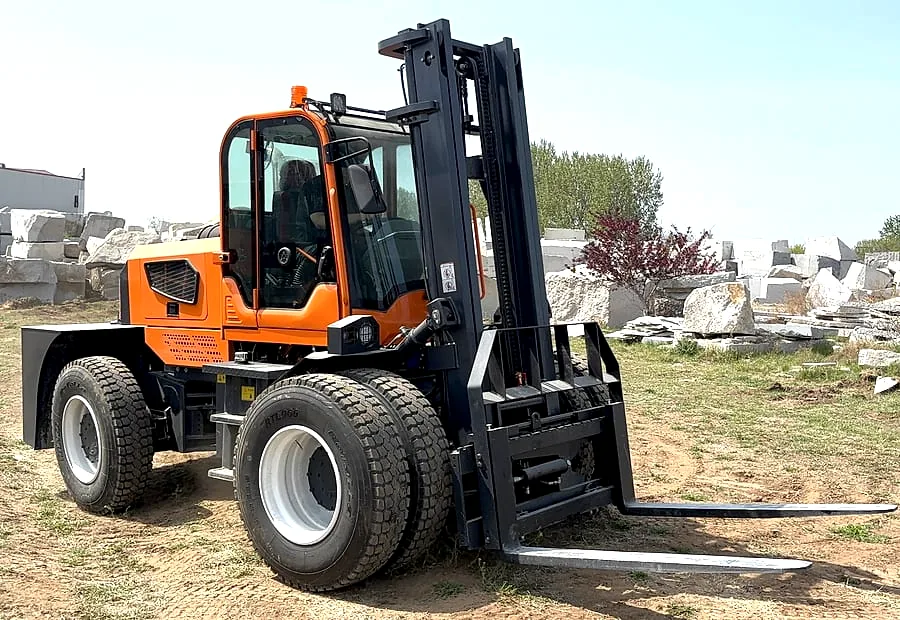
The BLANC-ELE RT70 Series page describes it as a 7 ton class 4WD diesel rough terrain forklift. It also notes that final usable capacity should be confirmed according to load center, mast height, attachment, and ground condition. That point is important. Even with a larger model, the final configuration still needs checking.
Attachments Can Change The Whole Decision
Attachments are one of the fastest ways to change the capacity discussion.
Long forks may move the load center forward. A bucket changes the working style. A bale clamp, fork positioner, side shifter, or crane jib can affect weight, hydraulic requirements, visibility, and front-end load behavior.
This does not mean every attachment requires a 7 ton machine.
It means the attachment plan must be discussed before the quote is finalized.
If the buyer chooses the machine first and talks about attachments later, the supplier may have to recheck the whole configuration. Our guide on rough terrain forklift attachments and configurations explains this in more detail. If long forks are part of the plan, this article on what buyers should check before adding long forks is also useful.
What Importers And Dealers Should Ask Before Stocking
Dealers and importers have a slightly different problem from end users.
An end user usually buys for one job.
A dealer may need a model that can serve several buyer types.
Before stocking or promoting 5 ton and 7 ton machines, I would ask:
- Which customer asks for this capacity most often?
- Are they construction companies, farms, stone yards, mining support sites, or rental fleets?
- Are they asking for capacity because of real load weight or because they are unsure?
- Do they need 4WD, ground clearance, tire strength, or simply a bigger lifting number?
- Can local mechanics service the machine?
- Which spare parts should be prepared with shipment?
- Does the dealer need both 5 ton and 7 ton options, or one stronger starting model?
This is where a supplier should help the dealer avoid random stocking.
The rough terrain forklift manufacturer checklist for importers is a good internal link for buyers who want to review supplier-side support before order.
What To Send For A Useful Quote
If you are choosing between 5 ton and 7 ton rough terrain forklifts, send the supplier more than the capacity request.
Send:
| Information | Why It Matters |
|---|---|
| Load weight range | Shows normal work and maximum demand |
| Load dimensions | Helps check fork length and load center |
| Photos of load | Shows pallet quality, shape, and stability |
| Ground photos | Helps check tire, drive, and clearance needs |
| Route video | Shows turning, slope, mud, ruts, and travel distance |
| Lifting height | Affects mast and capacity confirmation |
| Attachment plan | Changes the working margin discussion |
| Daily working hours | Affects maintenance and support planning |
| Destination country | Helps with shipping, documents, and configuration |
| Future job plans | Helps decide whether extra margin is worth it |
This information makes the quote more useful.
It also protects the buyer from choosing a machine that looks strong in a photo but does not match the real site.
I covered this broader inquiry habit in what information suppliers need before a rough terrain forklift quote.
My Practical Recommendation
For heavy outdoor work, do not choose 5 ton or 7 ton by pride, fear, or a simple model comparison.
Choose by the job.
If the daily work is medium-heavy, the route is manageable, and the buyer needs flexibility, start with a serious 5 ton discussion.
If the load is dense, the route is demanding, attachments are likely, or the buyer expects heavier future work, the 7 ton discussion may be more realistic.
In both cases, final selection should be confirmed with the official specification sheet, data plate, load center, mast height, attachment plan, route condition, and destination-market requirements before order.
If you are comparing 5 ton and 7 ton machines for a construction site, stone yard, farm, importer stock plan, or rental fleet, send your load details, route photos, lifting height, attachment plan, destination country, and expected daily work through the BLANC-ELE contact page. A better quote starts with a better picture of the job.