
Long forks look like a small change.
In real outdoor work, they can change much more than the length of the front end.
After talking with many overseas buyers, I have seen this problem several times. A buyer asks for a rough terrain forklift, then adds one sentence near the end:
"We may need longer forks."
That sentence is important.
Long forks can help support larger pallets, bundles, timber, pipes, stone, blocks, farm materials, or irregular cargo. But if they are selected casually, they can also change load center, steering feel, visibility, turning space, ground contact, and the real working margin of the machine.
So before adding long forks to a rough terrain forklift, I prefer to slow down and check the job properly.
Long forks are not only a fork option
Some buyers treat fork length like a simple accessory.
They think:
"The forklift capacity is enough. Just make the forks longer."
For indoor warehouse pallets, that thinking may not cause many questions. But for rough terrain forklifts, the working condition is usually less controlled.
The machine may work on:
- compacted soil
- gravel yards
- stone yards
- farms and plantations
- brick and block yards
- remote construction sites
- muddy or rainy-season routes
- uneven loading areas near containers or trucks
On these sites, long forks do not work alone. They work together with the load shape, tire contact, mast, ground route, operator visibility, and turning space.
If you are still comparing machine types, you can first review the BLANC-ELE rough terrain forklift range to understand the general outdoor forklift category. But for long forks, the real question is not only "which model?" It is "what load and route will this forklift face every day?"
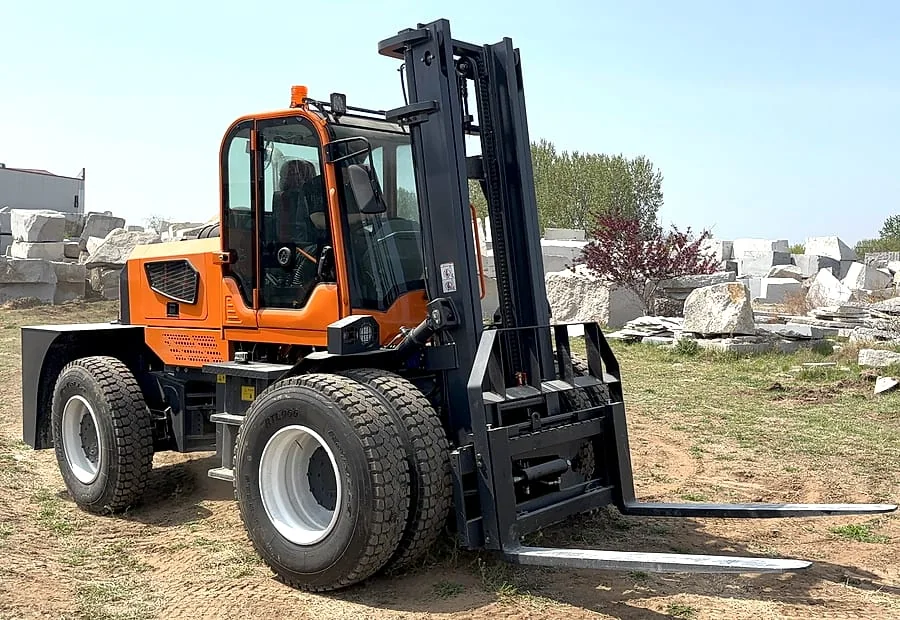
The first thing I check is load center
Fork length affects how the load is supported. But the more important issue is often load center.
A forklift rated capacity is not a free number for every load shape. OSHA's forklift guidance explains that stated capacity applies to the load center shown on the data plate, and that larger, irregular, or forward-positioned loads can reduce the real safe working capacity.
In simple words:
If the load sits farther forward, the forklift feels more load than the weight number suggests.
That is why a 2.5 ton load can behave differently depending on whether it is:
- a compact pallet close to the mast
- a long bundle sitting forward on the forks
- a wide load with poor weight distribution
- an irregular stone pallet
- a timber bundle with uneven balance
- a pipe bundle that needs more support length
Long forks can be useful, but they do not remove the need to check the load center. In some jobs, longer forks help support the load better. In other jobs, they encourage the operator to carry material too far forward.
That is the risk I want buyers to understand before production.
A typical case: the load was light, but the fork plan was not clear
A common inquiry comes from construction material yards.
The buyer says the load is not very heavy. The machine mainly needs to move pallets, long building materials, and some irregular cargo around the yard. The ground is gravel and soil. The route is not long, but the forklift must sometimes turn near stacked materials and load trucks from one side.
At first, the buyer asks only about capacity.
Then, during the configuration discussion, we learn more:
- some pallets are longer than standard pallets
- some materials are unevenly stacked
- the operator wants long forks to avoid manual repositioning
- the yard has narrow turning points
- the surface becomes soft after rain
- the forklift may later use other attachments
In this situation, I would not immediately say "yes, use long forks."
I would ask for the load size, weight, photos, route width, turning space, and lifting height. Sometimes long forks are suitable. Sometimes fork extensions, a fork positioner, a side shifter, or a different operating method should be discussed. Sometimes the buyer simply needs better load positioning and a clear capacity margin.
This is also why our guide on rough terrain forklift attachments and configurations should be read before final order, not after the machine arrives.
What buyers should confirm before choosing long forks
Here is the practical checklist I like to use.
| Item to check | Why it matters |
|---|---|
| Load weight | The forklift still needs enough real working margin. |
| Load length and width | Long or wide cargo changes support and handling behavior. |
| Load center | A forward load center can reduce usable capacity. |
| Weight distribution | Irregular loads are harder than neat pallets. |
| Fork length | Longer is not always better if the route is narrow. |
| Fork strength and section | The fork itself must suit the load and working method. |
| Carriage and mast | The front structure must match the fork plan. |
| Ground condition | Uneven ground increases the effect of poor load balance. |
| Turning space | Long forks need more room in yards, farms, and sites. |
| Operator visibility | Longer forks and larger cargo can block the view. |
| Attachment plan | Side shift, fork positioner, clamps, or buckets may change the full configuration. |
This checklist is simple, but it prevents many wrong decisions.
Many forklift problems do not begin when the machine starts working. They begin earlier, during unclear selection. I discussed that idea in another article: most forklift problems actually start before the machine arrives.
Long forks can help in the right job
I do not want buyers to think long forks are a bad option.
They can be very useful.
For example, long forks may help when the buyer handles:
- deeper pallets
- long timber
- pipe bundles
- agricultural materials
- stone slabs or uneven loads
- large packed goods
- wide construction-site materials
In these cases, the forklift may need better load support than standard forks can provide. If the fork length is too short, the load may not sit properly. The operator may work slowly, reposition too often, or handle the load in a less stable way.
So the question is not whether long forks are good or bad.
The question is whether the fork length matches the load, the forklift, and the site.
Long forks can also create problems
The main problems I see are not mysterious.
They are usually practical:
- the load center moves farther forward
- the rear of the forklift feels lighter
- steering control feels different
- the operator cannot see the fork tips clearly
- the forklift needs more turning space
- the fork tips hit ground, materials, or truck beds more easily
- the buyer forgets to update the configuration discussion
- future attachments are added without checking the full front-end setup
OSHA 1910.178 also treats front-end attachments and modifications seriously when they affect capacity and safe operation. For buyers, the lesson is simple: do not treat front-end changes as decoration. Confirm them with the supplier and final specification sheet.
If a buyer wants a rough terrain forklift to work in remote sites, the wrong front-end setup can become expensive later. Not because the fork itself is expensive, but because downtime, rework, unsafe handling, or poor daily efficiency all cost money.
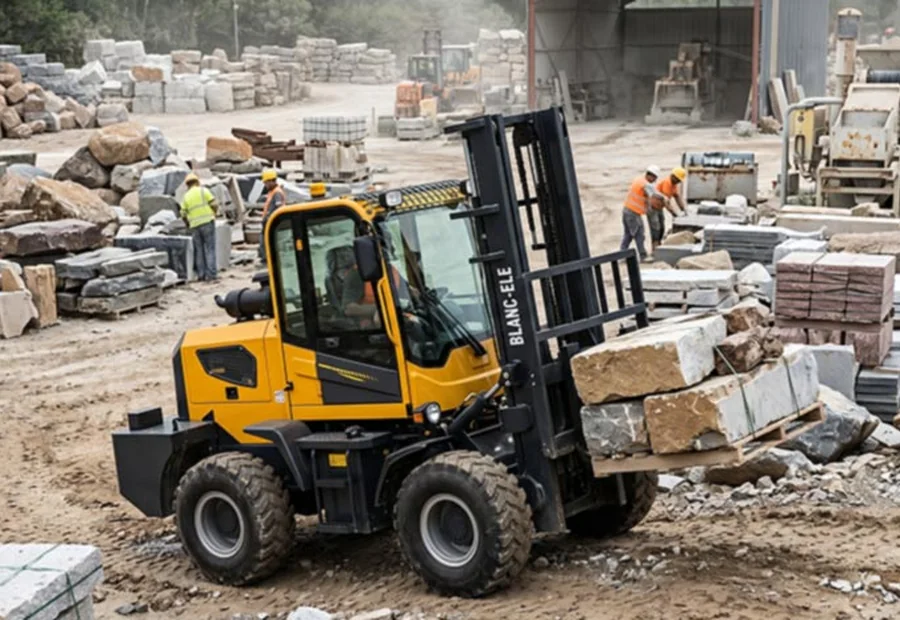
Fork length should match the route, not only the material
A common mistake is choosing fork length only by cargo size.
But outdoor jobs also need route checking.
Before confirming long forks, I like to know:
- How wide is the narrowest route?
- Does the forklift turn near walls, containers, stacks, or equipment?
- Will it load trucks from the side or from the rear?
- Does the site have slope, soft ground, or potholes?
- Is the operator moving with the load for a long distance?
- Is there enough room to keep the load low and stable?
The fork may fit the load, but the forklift may not fit the route after the forks become longer.
This is especially important for developing-market job sites, where the ground is often not as flat as an indoor warehouse. A forklift may work in a yard today, then be moved to a farm, brick yard, or rough construction area next month.
For that reason, I prefer to ask buyers for real site photos or short videos. A few clear photos can tell more than a long written description.
Do not forget future attachments
Long forks are often only one part of a bigger configuration discussion.
A buyer may start with standard forks, then later ask for:
- fork extensions
- fork positioner
- side shifter
- bale clamp
- bucket
- crane jib
- other job-specific attachments
Each change can affect the front end of the machine.
If the buyer chooses a forklift with no margin, then adds long forks or attachments later, the machine may not feel like the buyer expected.
That is why I like to discuss possible future work before order. Even if the buyer does not buy every attachment now, the supplier can at least understand the direction and recommend a more suitable configuration.
For importers and dealers, this is also useful. The final customer may not explain everything clearly at first. A dealer who asks better questions can avoid selling a machine that looks right on paper but disappoints on site.
Questions I ask before confirming long forks
If you send us a long fork request, these are the questions I usually ask:
- What material will the forklift carry?
- What is the maximum load weight?
- What are the load length, width, and height?
- Where is the load's center of gravity?
- Is the load evenly distributed or irregular?
- What lifting height is required?
- What ground surface will the forklift travel on?
- How narrow is the working route?
- Will the forklift load trucks, containers, racks, or stacks?
- Will other attachments be used now or later?
- Can you send photos or videos of the working site?
- Do you have a required fork length, or only a load size problem to solve?
The last question is important.
Sometimes the buyer asks for long forks because they already know the requirement. Sometimes they ask for long forks because they are trying to solve another problem: unstable loads, oversized pallets, poor route layout, or slow loading.
If we understand the real problem, the recommendation becomes much better.
A practical supplier view
From a supplier's side, I do not like confirming long forks only from a short message.
"We need 1.8 m forks" is not enough.
I would rather know the material, ground, route, lifting height, operating frequency, and future attachment plan. Then we can check whether long forks make sense for the forklift configuration.
This does not make the buying process complicated. It makes it clearer.
For overseas buyers, especially in Africa, the Middle East, Southeast Asia, and other developing markets, after-sales support may not be next door. So it is better to solve configuration questions before the machine leaves the factory.
The goal is not to sell more options. The goal is to avoid sending a machine that does not match the buyer's daily job.
That is also the idea behind our rough terrain forklift manufacturer checklist for importers: confirm the real working condition, documents, inspection, spare parts, and support before order.
My simple recommendation
If you are thinking about long forks for a rough terrain forklift, do not decide from fork length alone.
Check the full working condition:
- load weight
- load size
- load center
- ground condition
- turning space
- lifting height
- operator visibility
- attachment plan
- final machine specification
Long forks can be the right choice. They can also be the wrong shortcut.
Before order, send us your load photos, dimensions, ground condition, route width, lifting height, and any attachment requirement. We can review the working condition and recommend a suitable rough terrain forklift configuration.
Send us your working condition and we will check the fork and configuration plan before production.
Useful references
- OSHA Powered Industrial Trucks eTool: load composition, load center, capacity, and stability considerations: https://www.osha.gov/etools/powered-industrial-trucks/load-handling/load-composition
- OSHA 29 CFR 1910.178: powered industrial truck requirements related to modifications, attachments, markings, and capacity: https://www.osha.gov/laws-regs/regulations/standardnumber/1910/1910.178
- BLANC-ELE rough terrain forklift range: https://www.blanc-ele.com/products/rough-terrain-forklifts/