
A pro forma invoice should freeze the rough terrain forklift deal you think you are paying for. If the document only shows a model name and total amount, too many technical and export details are still open.
Short Answer: Review the PI Before the Deposit
Before paying a deposit for an imported rough terrain forklift, check that the pro forma invoice identifies the seller and buyer, exact model and quantity, agreed configuration, Incoterm and delivery point, destination, payment milestones, estimated shipment basis, validity period, warranty boundary and included documents. Reconcile the PI with the latest quotation and technical specification instead of assuming they match. If a bank account or payment procedure changes, verify it through a second trusted channel before transferring funds. A PI is an order-stage commercial record, not proof that every destination-market, customs or technical requirement has been completed.
Where the Pro Forma Invoice Fits in the Buying Process
This checklist is for importers, dealers, contractors, farms, rental companies and project buyers purchasing a new diesel 4WD rough terrain forklift for overseas delivery.
The document sits between two decisions:
- You have compared suppliers and selected a proposed machine.
- You are preparing to confirm the order and make the agreed payment.
That is different from asking for the first quote. It is also different from checking the machine before shipment.
The U.S. International Trade Administration describes a pro forma invoice as a quotation in invoice format. It may help the buyer arrange an import licence, pre-shipment inspection, letter of credit or transfer of funds, depending on the transaction. It should give the buyer enough information about the future order to make arrangements efficiently.
Country, bank and customs requirements vary. This article is a procurement checklist, not legal, customs, tax or banking advice. Confirm destination-specific requirements with the importer, bank, customs broker or freight forwarder.
What Our Real PI Records Show
I reviewed four anonymized BLANC-ELE pro forma invoices for 3T, 3.5T and 5T rough terrain forklift orders. I did not use customer names, contact details, bank information or prices for this article.
The useful lesson was not that every PI used the same layout. It was that the scope changed with the order. Across the records, the commercial description could include:
- model and quantity;
- rated-capacity class;
- steering and 4WD layout;
- engine or emission configuration;
- mast and lift arrangement;
- fork length;
- cabin and climate options;
- attachments;
- Incoterm and delivery point;
- destination information;
- estimated shipment basis;
- payment milestones and validity.
The BLANC-ELE email analysis also found payment, PI or contract discussion in 10 customer records, with 11 customer accounts classified at the payment/PI/contract stage. This is first-party historical evidence through June 19, 2026, not a current market trend.
The practical conclusion is simple: one generic line such as "3.5 ton 4WD forklift" does not preserve the full deal.
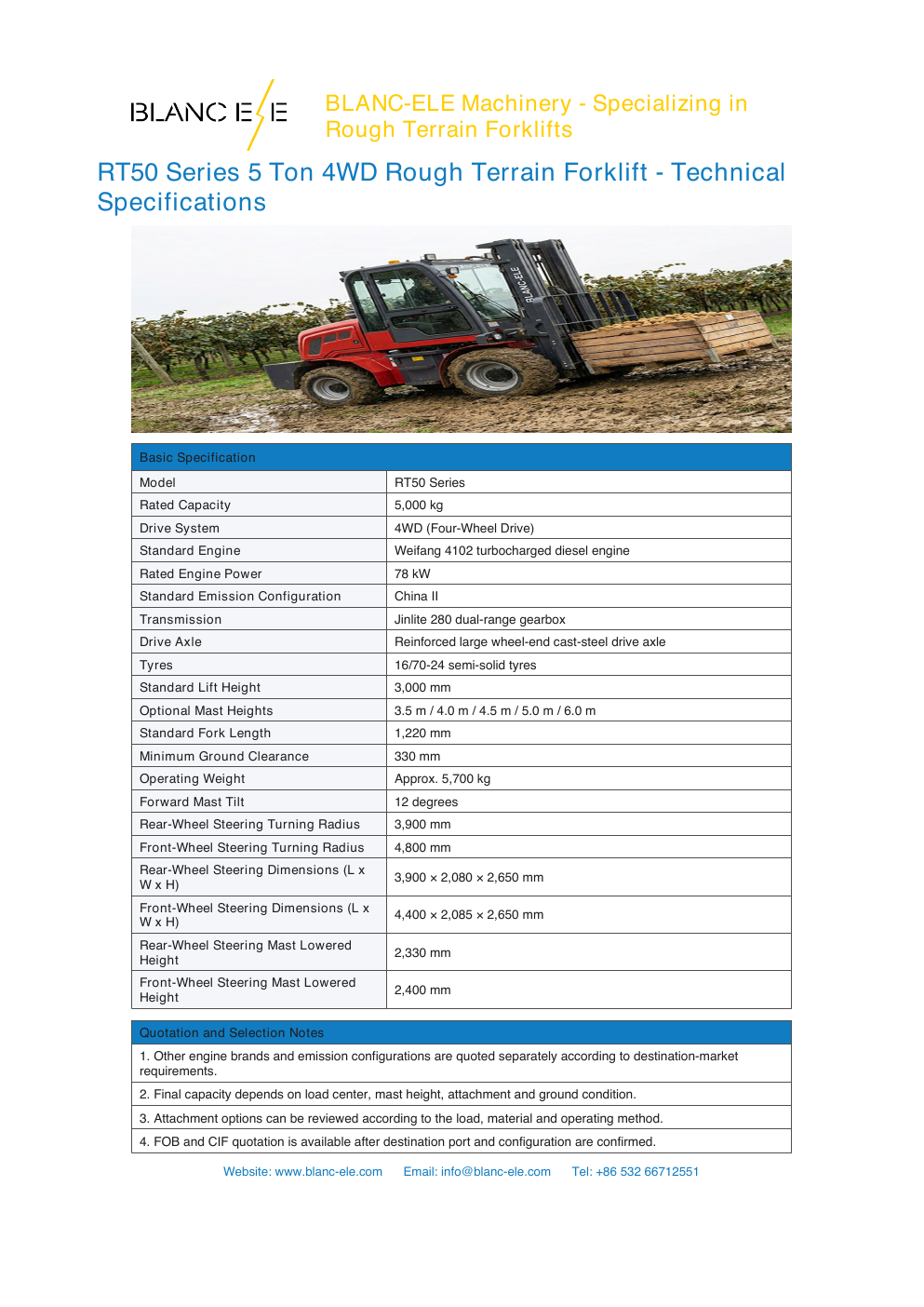
A real BLANC-ELE RT50 technical specification sheet. The buyer should reconcile the selected model, mast, forks, engine, steering and dimensions with the PI instead of treating the model name as the complete configuration.
Use This 12-Field PI Review Tool
Use the table as a red-flag and follow-up tool. A blank field is not always a reason to reject the order, but it is a reason to ask who will confirm it and in which document.
- Seller and exporter
- Confirm: The legal entity, address and contact match the agreed supplier.
- Why it matters: The brand name and payment beneficiary should not create an unexplained mismatch.
- Buyer and consignee
- Confirm: The legal buyer, consignee, address and destination details are correct.
- Why it matters: Errors can affect banking, shipping and customs preparation.
- PI identity
- Confirm: The PI number, issue date, revision and validity period are visible.
- Why it matters: Both sides need to know which version controls the proposed order.
- Machine identity
- Confirm: The PI states a new machine, exact model or series, steering version and quantity.
- Why it matters: A capacity label alone does not identify the configuration.
- Technical schedule
- Confirm: Rated class, 4WD layout, engine, mast, lift height, lowered-height basis, forks and tyres are recorded.
- Why it matters: These fields connect the PI to the working requirement and technical sheet.
- Options and attachments
- Confirm: Cabin, A/C or heater, side shift, fork positioner, clamp, bucket, longer forks and other options are listed.
- Why it matters: Missing options can change the machine, packing, capacity review and final amount.
- Weight, dimensions and packing basis
- Confirm: Values are identified as standard, selected-configuration or transport figures.
- Why it matters: Import, container and unloading planning may need different figures.
- Incoterm and delivery point
- Confirm: The PI states the agreed Incoterm, named port or place, and destination basis.
- Why it matters: A trade term without a named point is incomplete for comparison and planning.
- Production and shipment basis
- Confirm: The estimated period, the event that starts it, and items still pending are clear.
- Why it matters: An estimate should not be read as a guaranteed delivery date.
- Payment record
- Confirm: Currency, milestones, beneficiary identity and approved payment method are recorded.
- Why it matters: The buyer needs an internal approval trail before releasing funds.
- Warranty and support
- Confirm: The written warranty boundary, claim channel, spare-parts and document arrangements are defined.
- Why it matters: A short warranty line does not define parts, labour, freight or local service.
- Change control
- Confirm: The approval process for revised configuration, price, bank details or shipping instructions is clear.
- Why it matters: Both sides should be able to identify the final accepted revision.
Match the PI to Three Other Records
Do not review the PI alone. Match it to the documents that answer different questions.
1. The latest quotation
The quotation explains what is included, optional or still pending. If you are still comparing offers, use the rough terrain forklift quotation comparison guide before moving to the PI stage.
2. The technical specification
The specification should support the selected model, capacity basis, mast, forks, dimensions, steering layout, engine and other technical fields used in the order. Our guide on how to read a rough terrain forklift specification sheet explains how to reconcile those connected fields.
3. The final sales contract or accepted order record
The PI may help negotiate and describe the proposed order, but it is not a substitute for every contract, import or shipping document. Warranty terms, spare-parts arrangements, changes and responsibilities should be confirmed in the applicable formal quotation and sales contract.
If one record changes, update the connected records. A revised mast, fork length, engine, attachment or destination can affect more than one line.
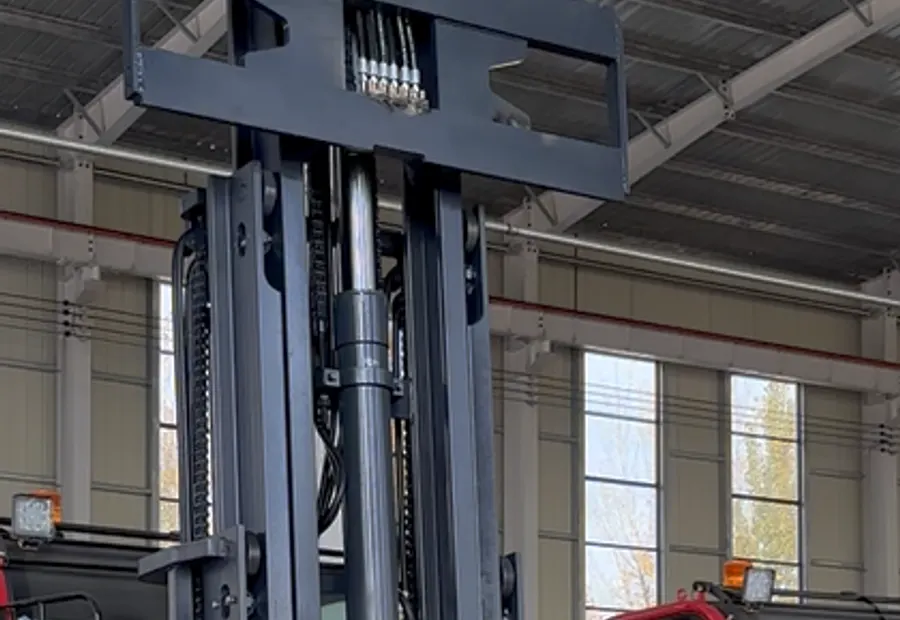
Real BLANC-ELE RT50 mast detail. The PI should identify the agreed mast and fork configuration, while the technical sheet or approved drawing carries the supporting detail.
Verify Payment Changes Outside the Email Thread
A correct-looking PI does not remove payment risk.
The FBI's Internet Crime Complaint Center warns that business email compromise can target companies and individuals making fund transfers. Its guidance recommends using a secondary channel or two-factor process to verify requests for changes in account information.
For an equipment order, use a simple rule:
- establish the supplier and beneficiary identity before payment;
- compare the beneficiary with the agreed seller/exporter record;
- treat any new account, changed beneficiary or changed payment procedure as a new verification event;
- confirm the change using a previously trusted contact method, not only the message that requested it;
- keep the approved PI revision and payment confirmation in the purchase file.
This is not a reason to publish bank details or discuss them in a public comment thread. It is an internal buyer-control step.
Buyer Inputs Needed Before the PI Can Be Final
Before asking BLANC-ELE to prepare or revise a PI, provide:
- legal buyer and consignee names;
- required capacity and model, if already selected;
- quantity;
- maximum and normal load weight;
- load dimensions and required fork length;
- lifting height, lowered-height limit and mast preference;
- ground, route and worksite conditions;
- engine or destination-market emission requirement;
- cabin, climate and attachment options;
- destination country, port or named delivery place;
- required shipping, import or bank documents;
- expected order and delivery planning window.
If those inputs are not ready, start with the rough terrain forklift quote information checklist. For a 3.5T application, review the BLANC-ELE 3.5 ton 4WD rough terrain forklift as a product starting point, then confirm the final configuration from the real job.
Final Procurement Step
Before paying a deposit, ask one person on the buyer side to perform a line-by-line PI review and record every unresolved field.
The goal is not to make the purchase slower. It is to make sure the money, machine and export plan refer to the same order.
Review the BLANC-ELE rough terrain forklift range and then send the working requirements to BLANC-ELE. We can prepare a configuration-based FOB or CIF discussion after the model, options and destination are confirmed.
References
- U.S. International Trade Administration: Pro Forma Invoice
- U.S. International Trade Administration: Common Export Documents
- FBI Internet Crime Complaint Center: Business Email Compromise
- BLANC-ELE anonymized PI, quotation, technical-specification and historical inquiry records reviewed November 2026.
Last reviewed: November 2026.