
A rough terrain forklift with a large rear body can look stronger than a smaller machine. That visual impression is useful for identifying what to inspect, but it is not enough to prove how much the forklift can lift. For a buyer comparing quotations, the correct question is not “Which counterweight looks biggest?” It is “What capacity is approved for this exact mast, fork, attachment, load center and lift height?”
Short Answer: Counterweight Size Is Not a Capacity Certificate
A counterweight helps balance the load carried at the front of a counterbalanced forklift, but its visible size does not independently prove rated capacity. Capacity belongs to the complete, approved machine configuration. Buyers should verify the model, data plate or capacity information, rated load center, lift height, mast, forks, attachment and operating weight together. A longer load, higher lift, different attachment or changed center of gravity can reduce the usable capacity even when the rear of the machine looks heavy. Never add rear weight as an informal way to lift more; any capacity-affecting modification requires manufacturer approval and updated capacity information.
What the Counterweight Actually Does
A counterbalanced forklift places weight toward the rear of the machine to help oppose the forward overturning moment created by a load on the forks. It is one part of the complete design, alongside the chassis, axles, wheelbase, mast, forks, tyres and approved load rating.
That is why two machines with different rear-body shapes cannot be compared by photos alone. A large-looking rear section may include a counterweight, engine enclosure, guards or other structural parts. Paint, body panels and camera angle can also make one machine look heavier than another.
OSHA's powered industrial truck guidance explains that capacity is stated for a specific load center and that the load's weight, size, position and distribution affect the truck's stability. The practical buying lesson is simple: appearance can start a question, but the approved capacity information must answer it.
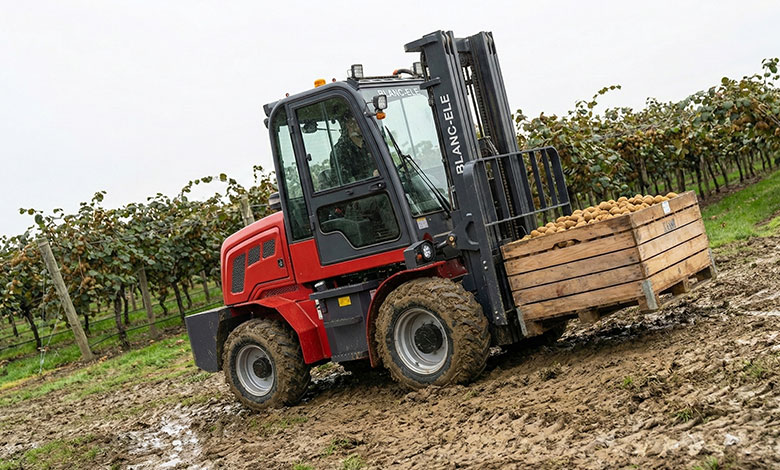
A real BLANC-ELE 5-ton-class rough terrain forklift. The complete configuration – not the visible rear section alone – determines the rated capacity.
What a Product Photo Can and Cannot Verify
A clear supplier photo can verify useful physical details:
- the general chassis and rear-body layout;
- whether the machine has an open canopy or enclosed cabin;
- the visible mast, fork carriage and tyres;
- whether the photographed unit broadly matches the quoted product family;
- the condition of visible welds, guards, covers and external components.
But a photo cannot reliably verify:
- rated capacity at the buyer's actual load center;
- residual capacity at the requested lift height;
- the effect of a side shift, clamp, bucket, fork positioner or long forks;
- the final operating weight of the ordered configuration;
- whether an added rear box or removable weight is approved;
- the data plate values for the machine that will be delivered.
For supplier verification, ask for both visual evidence and configuration documents. One without the other leaves an avoidable gap.
Use This Seven-Field Capacity Proof Check
Before treating a 3-ton, 3.5-ton, 5-ton or 7-ton model label as suitable, reconcile these seven fields in one worksheet.
- Exact model and version – Match the quotation, technical sheet, photos and final machine. A product-family photo is not a serial-specific record.
- Rated capacity and load center – Record both values together. Capacity without the stated load center is incomplete.
- Maximum lift height and mast – Confirm the actual mast in the quotation. Do not assume every mast option keeps the same usable capacity at every height.
- Forks and attachment – Record fork length and every attachment. OSHA guidance notes that an attachment can change the capacity shown for a truck.
- Actual load geometry – Provide load weight, length, width, height and where its center of gravity sits. Long or uneven loads can move the load center forward.
- Operating weight and approved counterweight configuration – Use this to reconcile the complete machine, not to calculate extra lifting capacity from machine weight alone.
- Final data plate or capacity information – Confirm that it matches the delivered configuration before the machine is put into service.
The result should be a matched set: one model, one configuration and one approved capacity basis. If the supplier changes the mast, forks, attachment or counterweight arrangement after the first quotation, reopen the worksheet rather than carrying the old capacity number forward.
Why a Larger Rear Section May Still Mislead a Buyer
There are several common reasons.
The load is longer than the rating condition
A long crate, timber bundle, pipe pack or oversized pallet may place its center of gravity farther from the fork face. The forward moment increases as that distance increases. The visible counterweight does not cancel the need to verify the load center and approved capacity.
The attachment changes the working configuration
A side shift, clamp, fork positioner, bucket or long-fork setup adds its own weight and can move the load farther forward. The correct capacity information should reflect the installed attachment. A buyer should not compare a bare-fork rating with an attachment-equipped job as though they were the same.
The required lift height is different
The quotation may include a taller or multi-stage mast. The final recommendation must be based on the requested lift height and mast configuration, not only on the base model label.
Machine weight is confused with lifting capacity
Operating weight helps with transport, unloading and site planning. It does not replace the rated-capacity and load-center information. Our separate guide to forklift operating weight versus rated capacity explains how to keep these two numbers apart.
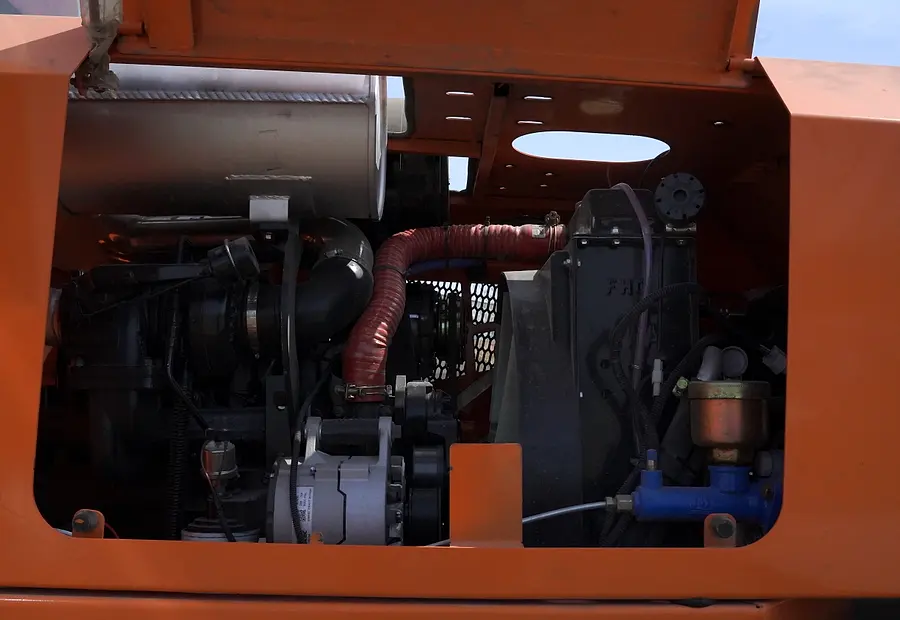
The rear enclosure of a real BLANC-ELE RT70 contains engine and service components as well as structural elements. Its visible volume is not a stand-alone counterweight or capacity measurement.
Do Not Use Extra Rear Weight as a Shortcut
An informal request such as “add more steel at the back so it can lift more” is not a safe capacity specification. OSHA rules and guidance state that modifications affecting capacity or safe operation require prior written approval, and capacity plates or markings must conform to the modified truck.
For procurement, treat any removable or additional counterweight as a controlled configuration item. Ask:
- Is it part of the manufacturer's approved design for this model?
- What exact capacity applies with and without it?
- Will the data plate or capacity information be updated?
- Does it change operating weight, transport dimensions or unloading requirements?
- Are there route, axle-load, tyre or ground-condition implications that the responsible site team must review?
If the supplier cannot connect the modification to approved documentation, do not use the added weight as evidence of capacity.
What BLANC-ELE Needs Before Recommending a Model
When we review an inquiry, a rear-view photo of the machine is less important than a clear description of the work. Send the following inputs:
- maximum load weight;
- load dimensions and weight distribution;
- required lift height;
- pallet type or fork-entry details;
- required fork length;
- side shift, fork positioner, clamp, bucket or other attachment;
- ground condition, gradient and turning space;
- cabin or canopy requirement;
- destination country and applicable engine or emission requirements;
- preferred 3T, 3.5T, 5T or 7T class, if already shortlisted.
We can then match those inputs to a proposed configuration and identify which capacity documents must be confirmed. Emission configurations are quoted according to destination-market requirements.
Choose the Machine by Evidence, Not by Silhouette
Start with the BLANC-ELE rough terrain forklift range. Buyers with medium-duty outdoor work can review the 3.5 ton 4WD rough terrain forklift, while heavier load requirements may lead to the 5 ton rough terrain forklift or 7 ton 4WD rough terrain forklift after the job details are checked.
If you are comparing supplier documents, use our guide on how to read a rough terrain forklift specification sheet alongside the seven-field check above.
Contact BLANC-ELE for an FOB or CIF quotation and include the load weight, load dimensions, lift height, forks, attachment, terrain and destination. We will base the recommendation on the requested configuration – not on how large the counterweight looks in a photograph.
References
- BLANC-ELE RT35, RT50 and RT70 technical source sheets and real product-image archive, reviewed October 15, 2026.
- OSHA Powered Industrial Trucks eTool: Load Composition.
- OSHA Powered Industrial Trucks eTool: Nameplate.
- OSHA 1917.43: Powered Industrial Trucks.
Last reviewed: October 15, 2026.