
The narrowest point on a forklift route is often decided before the machine reaches the site. A buyer checks lifting capacity, but the gate, driveway, wall opening or material lane is measured later. That order should be reversed.
The Direct Answer
Use the forklift’s listed overall width only as the starting point for a site-access check. Measure the narrowest clear opening, the approach angle to that opening, the route surface, overhead limits, turning area and the width of the load or attachment. Then ask the supplier to confirm the final configured machine dimensions on the quotation or outline drawing. A nominal 1,800 mm-wide machine does not mean that a 1,800 mm opening is workable. The required operating clearance depends on the site, steering movement, mirrors or guards, load shape, ground condition and local safety rules. Never replace a site risk assessment with one brochure number.
Why Overall Width Is Only the First Number
Overall width answers a static question: how wide is the machine in the stated configuration?
A site route creates a moving question. The operator may need to enter the opening at an angle, correct the steering, avoid a wall edge, carry a load wider than the chassis, or pass over ground that pushes the machine off the ideal line. Mud, ruts, shoulders and cross-slope can reduce the usable space even when the tape measurement looks acceptable.
This is why I do not recommend choosing a rough terrain forklift from capacity alone. The BLANC-ELE rough terrain forklift range covers several capacity classes, but the final model also has to fit the buyer’s access envelope.
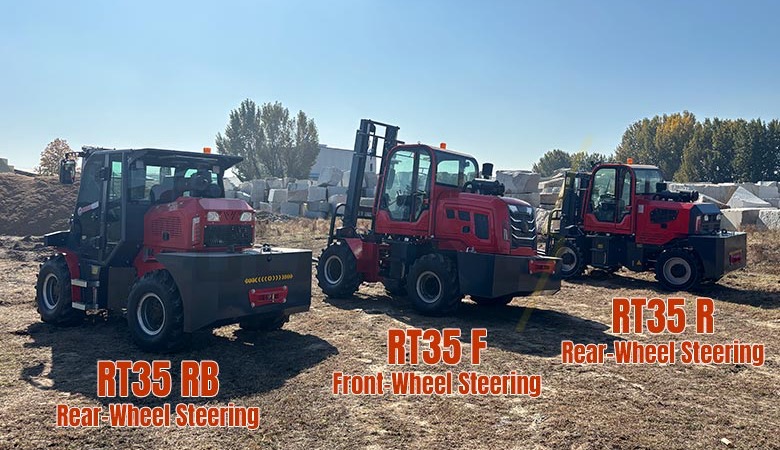
Representative Widths From Current BLANC-ELE Source Sheets
The figures below are representative source-sheet examples, not final shipment or site-clearance declarations:
- RT30 rear-wheel-steering example: 3,700 x 1,800 x 2,450 mm overall. The source sheet states that final front-wheel-steering dimensions depend on the selected steering and chassis configuration.
- RT35R example: 3,700 x 1,800 x 2,450 mm overall.
- RT50 rear-wheel-steering example: 3,900 x 2,080 x 2,650 mm overall.
- RT50 front-wheel-steering example: 4,400 x 2,085 x 2,650 mm overall.
- RT70 front-wheel-steering quote basis: 4,500 x 2,400 x 2,600 mm overall.
These numbers show why capacity changes can affect access planning. Moving from the 3-ton or 3.5-ton class to the 5-ton class adds roughly 280 mm of representative machine width in these source sheets. The RT70 example is wider again. That does not make the larger machine unsuitable; it means the route must be checked before the quotation is frozen.
The RT50 examples also show an important detail: two steering configurations can have nearly the same listed width while having different overall length and turning radius. Width alone cannot decide maneuverability.
Buyers comparing compact outdoor work can review the 3.5 ton rough terrain forklift. For heavier routes, compare the 5 ton rough terrain forklift and 7 ton 4WD rough terrain forklift only after the access measurements and load are known.
Use a Site-Access Worksheet Before You Request the Final Quote
I suggest recording the following items in one worksheet and attaching photos or a short walk-through video.
- Narrowest clear opening: measure between the actual fixed obstacles, not between nominal gate posts if hinges, locks, curbs or guards project into the path.
- Clear height: record doors, beams, pipes, cables, tree branches and any overhead structure along the complete route.
- Approach direction: note whether the machine can approach straight or must turn immediately before or after the opening.
- Available turning area: provide the open length and width on both sides of the narrow point.
- Road and shoulder condition: show hard surface, gravel, compacted soil, mud, ruts, drains and weak edges.
- Cross-slope or level change: identify any ramp, camber, step or uneven transition near the opening.
- Load envelope: give load width, length, normal weight and maximum weight. Include pallets, bags, stone, timber, forks and attachments.
- Fixed machine accessories: confirm mirrors, cabin, lighting guards, fenders and any attachment or fork arrangement that may affect the final envelope.
- Traffic and people: explain whether the route is one-way, shared with trucks, or close to pedestrians and work areas.
- Final configuration drawing: ask the supplier to mark overall width, overall length, mast-lowered height, steering layout and any projections for the ordered machine.
This is the article’s main decision tool. It turns a vague statement such as “the gate is wide enough” into a set of measurements that procurement, operations and the supplier can review together.
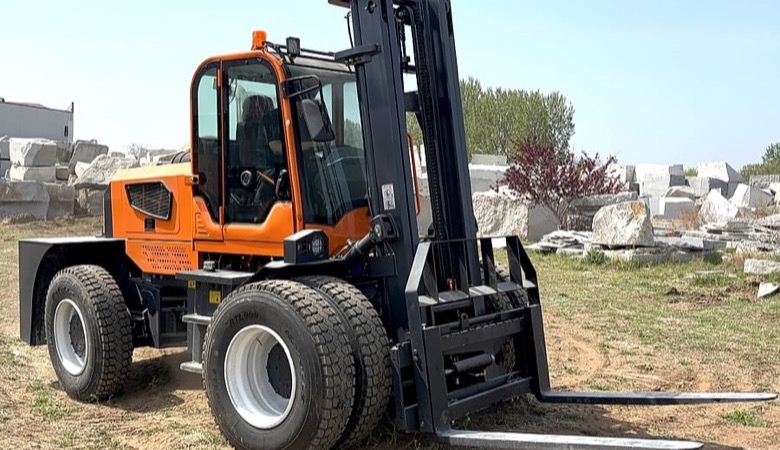
Do Not Confuse Machine Width With Required Passage Width
The machine must not simply fit between two objects while stationary. It has to pass through under the actual operating conditions.
The required passage can be affected by:
- steering corrections and rear or front swing;
- a load or attachment wider than the chassis;
- visibility at the gate or corner;
- surface movement, ruts or soft shoulders;
- pedestrians, trucks and stored materials;
- mirrors, lights, guards or cabin details;
- the site’s operating procedure and local safety requirements.
For that reason, I would not publish a universal instruction such as “add 100 mm” or “add 300 mm.” A fixed allowance may be inadequate for one site and unnecessarily restrictive for another. The responsible approach is to confirm the machine drawing, map the movement and let the site owner determine the required operating and safety clearance.
Check the Whole Route, Not Only the Main Gate
The main entrance is rarely the only restriction. Buyers should walk the route from unloading point to working point and record every bottleneck:
- site gate or farm entrance;
- warehouse doorway or covered passage;
- lane between material stacks;
- corner beside a wall, fence or drain;
- truck loading position;
- storage bay or block-yard aisle;
- maintenance area and parking location.
A machine may enter the property and still fail to reach the intended loading point. The earlier guide on reading a rough terrain forklift specification sheet explains why dimensions should be reconciled with the quotation rather than treated as isolated brochure facts. Transport access is a separate question; buyers planning a 40HC shipment can use the container door-clearance guide.
The Buyer Inputs I Need Before Recommending a Model
For a useful access review, send these exact inputs:
- clear width and clear height at the narrowest point;
- photos taken straight toward the opening and from both sides;
- a short video walking the complete route;
- available turning area before and after the opening;
- normal and maximum load weight;
- load width, length and load center;
- required lift height and mast restrictions;
- expected forks or attachment;
- ground condition in dry and wet weather;
- preferred steering layout, if already known;
- destination market and any configuration requirements.
If one measurement is uncertain, mark it as uncertain. It is better to delay the final dimension check than to turn an estimate into a purchase assumption.
What the Supplier Should Confirm
Before order confirmation, the supplier should identify the exact model and steering configuration used for the dimensional statement. The final quotation or supporting drawing should show the agreed overall width, overall length and mast-lowered height. If an attachment, special cabin, long fork, unusual guard or other option changes the envelope, that change should be recorded as well.
For BLANC-ELE machines, engine, mast, steering, attachment and destination requirements can change the final configuration. The source-sheet figures in this article are therefore comparison points, not a substitute for the final order documents.
A Better Inquiry Starts With a Measured Route
Capacity tells us what class of machine to discuss. Site access tells us whether that machine can reach the work.
If you are comparing a 3-ton, 3.5-ton, 5-ton or 7-ton rough terrain forklift, send BLANC-ELE the route measurements and site photos. Include the narrowest opening, turning area, load dimensions, lift height and ground condition. We can then review the model and configuration against a real access envelope instead of guessing from one width number.
References
- BLANC-ELE RT30 Series 3 Ton 4WD Rough Terrain Forklift – Technical Specifications.
- BLANC-ELE RT35R Rough Terrain Forklift – Technical Specifications.
- BLANC-ELE RT50 Series 5 Ton 4WD Rough Terrain Forklift – Technical Specifications.
- BLANC-ELE RT70 Series 7 Ton 4WD Rough Terrain Forklift – Technical Specifications.