
A polished 20-second clip can prove that a forklift moved in front of a camera. It cannot prove that the machine shown is the configuration in your quotation.
For an overseas buyer, the useful question is not, “Do you have a video?” It is, “Which decision will this video help me verify?”
The Short Answer: Request Evidence, Not a Showreel
A rough terrain forklift video can help a remote buyer check the machine's visible layout, working environment, steering movement, mast operation, attachment type and service-access areas. It cannot confirm the final rated capacity, load-center conditions, hidden component quality, long-term reliability or destination compliance. Ask for a short set of named shots tied to the quoted model and options, then compare the footage with the technical sheet and formal quotation. If the video shows another model or attachment, use it only as a reference. Before shipment, request evidence for the actual finished machine and arrange independent inspection when your risk level requires it.
Who This Decision Is For
This guide is for importers, equipment dealers, contractors, farms and project buyers that cannot visit the factory before choosing a new diesel 4WD rough terrain forklift.
Remote video is most useful after you have described the job. Before asking a supplier to film anything, send:
- normal and maximum load weight;
- load dimensions and estimated load center;
- required lifting height and lowest entrance height;
- fork length and attachment requirement;
- ground, ramp and route conditions;
- destination country and intended working site;
- the model or configuration currently under review.
Without these inputs, a supplier may send an attractive clip that does not answer your actual procurement question.
Use an Eight-Shot Video Request
Ask the supplier to identify each clip and explain whether it shows the quoted machine, the same model family or a reference configuration.
| Shot to request | What it can help you check | What it does not prove |
|---|---|---|
| 1. One continuous four-side walkaround | Overall layout, visible condition, mast, tyres, cab or canopy and installed attachment | Internal condition or final specification |
| 2. Model and machine identification close-up | Whether the filmed unit can be traced to a model or machine record | That every specification in a separate brochure applies |
| 3. Mast, carriage, forks and attachment | Visible fork length, attachment type and basic lift, lower and tilt movement | Rated capacity at the intended height and load center |
| 4. Engine start and instrument area | Start sequence, visible instruments and obvious warnings during the recording | Engine history, emissions approval or long-term reliability |
| 5. Slow forward, reverse and braking sequence | Basic movement in the filmed conditions | Stopping performance for every surface, speed or load |
| 6. Steering from lock to lock at low speed | Steering layout and visible wheel movement | A universal turning radius or manoeuvrability at your site |
| 7. Tyres, underside and ground-clearance views | Tread type, visible clearance points and obvious leaks or damage | Suitability for every mud, slope or soil condition |
| 8. Service-access and included-item view | Access points plus visible manuals, loose parts or agreed accessories | Local service coverage or completeness of an unverified parts list |
Treat the completed table as a request list, not an inspection certificate. A clip answers only the question that its angle, identity and conditions make visible.
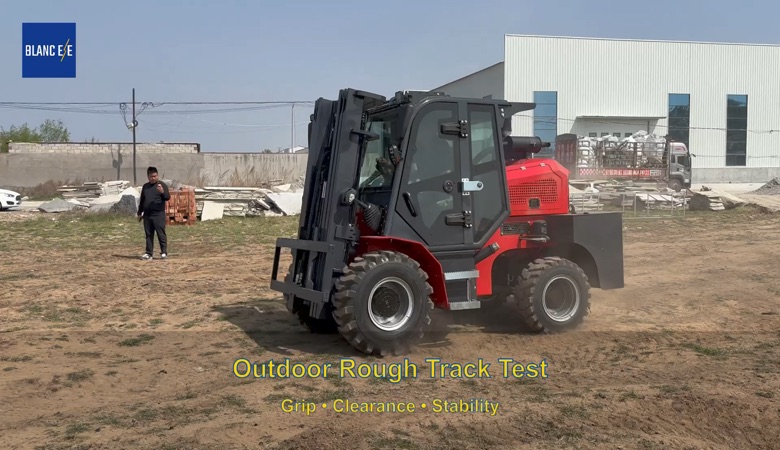
Frame from a real BLANC-ELE outdoor test video. It shows the filmed machine and test setting; it is not proof of universal terrain or stability performance.
Match Every Video to the Quotation
One of our archived sales conversations included two working videos: one showing a rough terrain forklift and another showing a bale clamp. The message explicitly warned that the clamp in the second video was a different type from the top-arm clamp being discussed.
That small note matters. A reference clip can explain how a function looks, but it should not quietly become evidence for an option that the buyer did not order.
For every video, record:
- the model or series shown;
- whether the machine is standard, optional or customer-specific;
- the mast and fork arrangement;
- the attachment shown;
- the tyre and cab configuration;
- the date or stage of production if relevant;
- whether the clip is general reference footage or evidence for your actual order.
Then reconcile the result with the rough terrain forklift specification sheet and the final quotation. If the documents and footage do not describe the same setup, ask the supplier to mark the difference in writing.
Separate Visible Function From Capacity Evidence
A video may show an unloaded mast rising smoothly. It may show a machine carrying one block across one patch of ground. Those observations are useful, but they are not a load chart.
Capacity depends on the selected machine, load center, lift height, forks and attachments. OSHA's forklift guidance notes that attachments can change capacity, visibility and the truck's center of gravity, and that relevant capacity information belongs on the machine's data plate. This is why I would not approve a configuration only because a video “looks strong.”
Ask for written capacity information for the selected configuration. If your load is long, off-center or handled with an attachment, provide the real load geometry before accepting a recommendation.
The same boundary applies to outdoor driving footage. Ground condition, tyre pattern, slope, speed and load all affect the meaning of what you see. A short field clip can show that a filmed machine moved through that filmed route. It cannot guarantee performance at your site.
Ask for the Boring Angles
The most useful buyer footage is rarely the most cinematic.
A slow view of the tyre sidewall, mast channels, hoses, fork markings, attachment interface, operator area and service access can answer more questions than a fast pass in front of the camera. Ask the operator to pause at the parts your mechanic or procurement team wants to review.
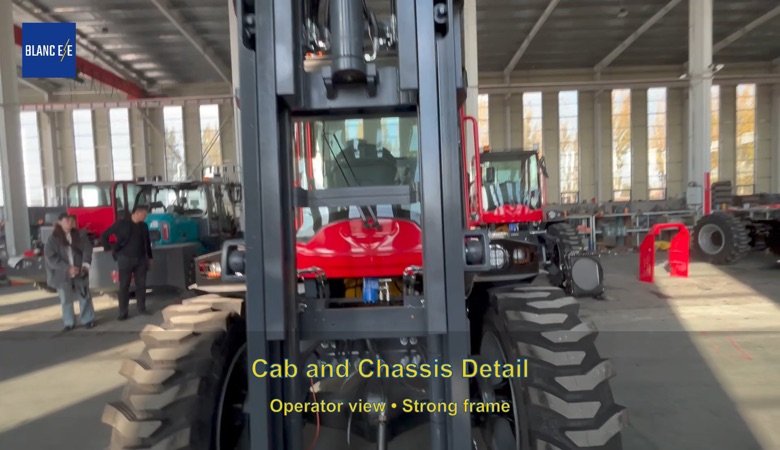
Frame from a real BLANC-ELE detail video. Visible components help a buyer ask better questions, but the frame does not replace the selected machine's manual, data plate or qualified inspection.
If the supplier cannot show a requested area on the same day, that does not automatically prove a problem. The relevant machine may be at another production stage or location. Ask for a clear explanation and agree what evidence will be supplied before order or before shipment.
Keep Three Evidence Stages Separate
Remote buyers often mix three different purposes:
- Model-understanding footage helps you see a product family before choosing a configuration.
- Order-confirmation footage should show the options relevant to the quotation or explain any reference-machine differences.
- Pre-shipment evidence should identify the actual completed machine and agreed items before loading.
BLANC-ELE's pre-shipment checklist for rough terrain forklifts covers the third stage. Do not use a general marketing clip as a substitute for the final shipment record.
Video also does not replace safe commissioning or daily checks. OSHA advises that forklifts should be examined before being placed in service and that unsafe equipment should be removed from service. Operators must be trained and evaluated for the truck and work involved. Apply the rules and competent-person requirements that govern your country and site.
What to Send With Your Video Request
If you are comparing the BLANC-ELE rough terrain forklift range or a 3.5 ton rough terrain forklift, send us one page containing:
- your load weight and dimensions;
- required lift and entrance heights;
- route and ground photos;
- selected forks, mast and attachments;
- the specific questions each requested shot should answer;
- whether you need general model footage, order-confirmation footage or actual pre-shipment evidence.
We can then identify what available footage is relevant and what still needs to be confirmed in documents or for the final machine. Emission configurations are quoted according to destination-market requirements, and video alone does not establish compliance.
If you want a configuration-based discussion, send BLANC-ELE your working conditions and video checklist. The aim is not to collect more clips. It is to leave fewer important questions unanswered before you order.
References
- OSHA: Powered Industrial Truck Pre-Operation Inspection
- OSHA: Forklift Attachments
- OSHA: Forklift Nameplate
Reviewed: September 15, 2026.