
A ramp can look harmless before the forklift carries a real load.
I have seen this many times in export inquiries. The buyer sends a photo of a concrete ramp, a dirt access path, or a yard entrance and asks a short question: "Can this forklift climb it?"
That question is understandable, but it is not enough. For outdoor work, the real problem is not only the ramp slope. It is the whole route: the ground before the ramp, the transition at the bottom, the load on the forks, the tire contact, the turning space, and what the operator must do after reaching the top.
This is why I prefer to discuss forklift ramp slope as a working-condition question, not as a simple number on a brochure.
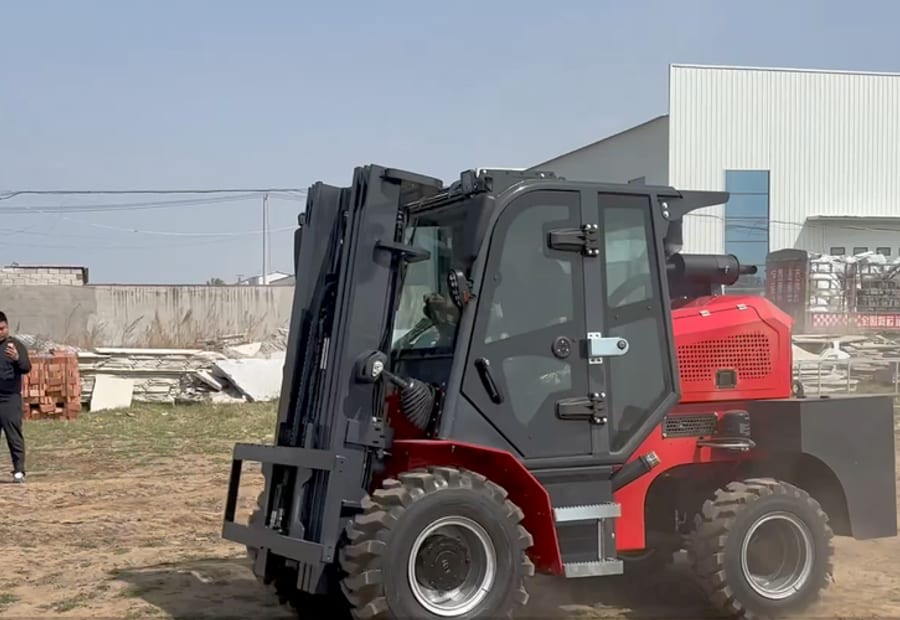
A Ramp Is Not Only a Slope Number
The slope number matters, but it is only one part of the decision.
A forklift may climb a clean ramp when empty. The same machine may feel very different when it carries a compact pallet, a long bundle, a tall crate, a bagged agricultural load, or a load that shifts slightly during travel.
The ramp surface also changes the result. Dry concrete, broken concrete, compacted soil, gravel, wet clay, sand, and muddy ground do not give the tires the same grip. A small amount of rain can turn a normal entrance into a difficult daily route.
So when I review a ramp application, I do not start by promising that one model can handle every slope. I first ask what the forklift needs to do on that ramp every day.
The Mistake I See in Many Export Inquiries
A typical case starts like this: the buyer is planning to unload materials from trucks, move them across an outdoor yard, and drive up a short ramp into a storage area or work platform.
At first, the ramp looks like the main problem. But after we discuss the site, another picture appears.
The forklift has to turn before the ramp. The ground at the bottom is not fully paved. The truck blocks part of the route. The load is heavier on some days and longer on others. The operator may need to stop and restart near the entrance. In the rainy season, the same route becomes softer and the tires sink slightly before reaching the ramp.
In that situation, the question is not only:
"Can the forklift climb this slope?"
The better question is:
"Can the forklift travel this route with this load, on this ground, repeatedly, without creating unnecessary downtime or operator stress?"
That second question leads to a much better buying decision.
Loaded Travel Changes the Ramp
Forklift ramp slope should always be reviewed with the real load in mind.
For example, a pallet of boxed goods may be compact and stable. A bundle of steel pipes, timber, scaffolding, stone slabs, blocks, or agricultural materials may be longer, uneven, or more sensitive to movement. If an attachment is used, the load center may also change.
On a ramp, the load affects:
- traction at the drive tires;
- braking and control;
- the pressure on the front axle;
- steering feel;
- operator confidence;
- the stress on tires, mast, forks, and drivetrain.
This is also why I ask buyers for more than rated capacity. Rated capacity is important, but outdoor ramp work needs a route-based review. A forklift that looks suitable on paper can still be the wrong choice if the ramp is narrow, slippery, damaged, or combined with a turn.
The Entrance and Exit Often Cause the Real Trouble
Many buyers focus on the middle of the ramp. In practice, the bottom and top of the ramp can be more important.
The bottom entrance decides whether the front tires bite into firm ground or start from loose soil. If there is a bump, rut, drainage channel, broken concrete edge, or soft patch before the ramp, the forklift may lose smooth movement before the slope even begins.
The top exit also matters. If the forklift reaches the top and immediately needs to turn, stop, reverse, or enter a narrow doorway, the operation becomes slower and more stressful. The ramp may be short, but the operator's usable space may be too small.
For this reason, I like to see photos or a short video showing:
- the ground 5-10 meters before the ramp;
- the bottom transition;
- the full ramp surface;
- the top exit area;
- the turning space at both ends;
- the normal load and pallet or material shape.
A photo taken only from the side of the ramp is useful, but it often hides the route problems that cause real delays.
Ground Clearance Is Part of Ramp Planning
Ground clearance is not a decoration on an outdoor forklift. It matters when the machine moves from flat ground to a ramp, crosses uneven ground, or passes over ruts and broken surfaces.
For example, the BLANC-ELE RT50 5 ton rough terrain forklift is listed with 4WD traction and 330 mm ground clearance. The BLANC-ELE RT70 7 ton class 4WD rough terrain forklift also lists 330 mm ground clearance, with final usable capacity depending on load center, mast height, attachment, and ground condition.
Those specifications are helpful, but I still do not treat them as a magic answer. Ramp work also depends on the entrance angle, the ground surface, the load, the route width, and the operator's procedure.
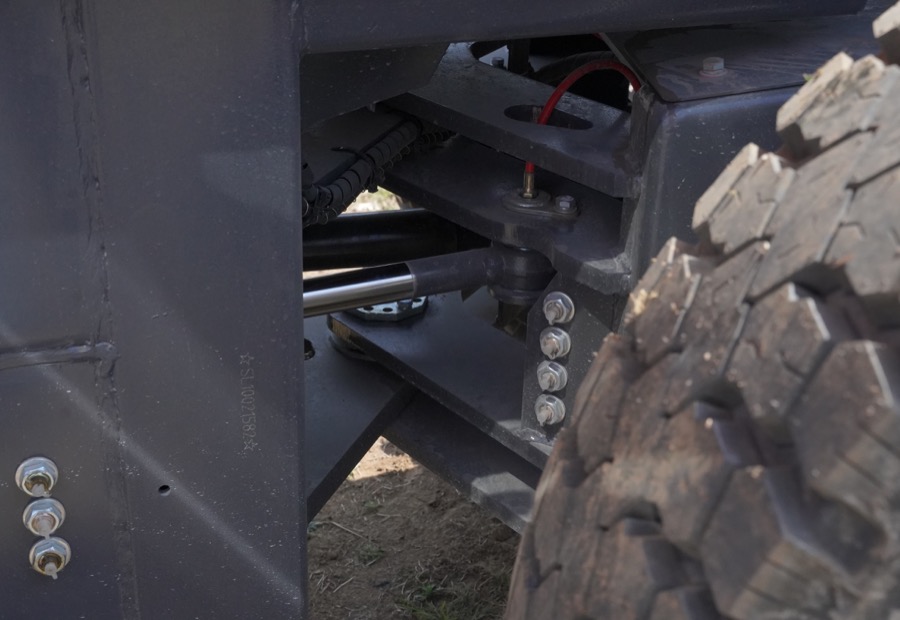
If the ramp has a sharp transition, a drainage edge, or broken ground at the bottom, the buyer should check whether the forklift's lowest points, forks, counterweight area, and underbody have enough practical clearance for that route.
How I Review a Ramp Before Recommending a Forklift
Before recommending a rough terrain forklift for ramp work, I normally ask the buyer to send the following information.
| Information Needed | Why It Matters |
|---|---|
| Ramp photos from front, side, bottom, and top | Shows slope, surface, entrance, exit, and turning area |
| Short route video | Shows whether the forklift must turn, stop, or restart near the ramp |
| Load weight and load shape | A compact pallet and a long bundle behave differently |
| Ground condition before the ramp | Loose soil, mud, gravel, or broken concrete can change traction |
| Daily working frequency | Repeated ramp travel increases tire, brake, drivetrain, and operator fatigue concerns |
| Required lift height and unloading point | Mast height and stability need to match the actual work |
| Attachment plan | Side shifters, fork positioners, clamps, longer forks, or other tools may change load center |
| Rainy-season condition | A route that works in dry weather may need a different discussion during wet months |
This information saves time for both sides. It also helps avoid a common export problem: choosing a forklift by one attractive specification and then discovering that the route needed more attention.
Where 5 Ton and 7 Ton Models Enter the Discussion
Not every ramp project needs a larger forklift. If the load is light, compact, and the route is firm, a smaller machine may be enough after checking the real working condition.
But in construction yards, brick yards, stone yards, farms, plantations, outdoor warehouses, and rental fleets, I often see buyers move from a basic capacity question to a heavier-duty discussion after we review the route.
The reason is simple. The forklift is not only lifting the load. It is carrying the load across outdoor ground, dealing with ramp transitions, turning in limited space, and repeating the same route many times.
For heavier materials, mixed outdoor surfaces, or a route where the forklift must work with more margin, buyers often compare models such as the 5 ton rough terrain forklift and the 7 ton 4WD rough terrain forklift. The final choice should still be confirmed with the load center, mast height, attachment, site condition, and formal specification sheet.
For buyers who are still comparing drivetrain and outdoor route suitability, the BLANC-ELE 4WD forklift page is also a useful starting point.
Connect Ramp Slope With Existing Site Problems
Ramp work rarely appears alone. It is usually connected to other site issues.
If the route becomes soft after rain, this guide on forklifts getting stuck in mud is worth reading before order. If the forklift moves between outdoor storage, truck loading, and warehouse entrances, the article on outdoor warehouse yard forklift selection connects ramp planning with yard route, turning space, tires, and attachments.
For buyers who only ask about maximum slope, I also suggest reading our earlier guide on slope work before choosing a rough terrain forklift. The point is the same: slope ability should be judged together with real load, ground, route, and operator practice.
My Practical Recommendation
If your site has a ramp, do not send only the slope number.
Send the ramp photos, a short route video, load details, pallet or material dimensions, ground condition, rainy-season concerns, and the distance the forklift must travel before and after the ramp. These details help us discuss whether a BLANC-ELE rough terrain forklift is suitable and which configuration should be checked first.
A good ramp discussion is not slower. It is faster, because it reduces guesswork before the machine is shipped.
For export buyers, that is often the difference between a forklift that looks strong in a catalog and a forklift that fits the real jobsite.