
Rain does not only make a construction site wet.
It changes the whole forklift job.
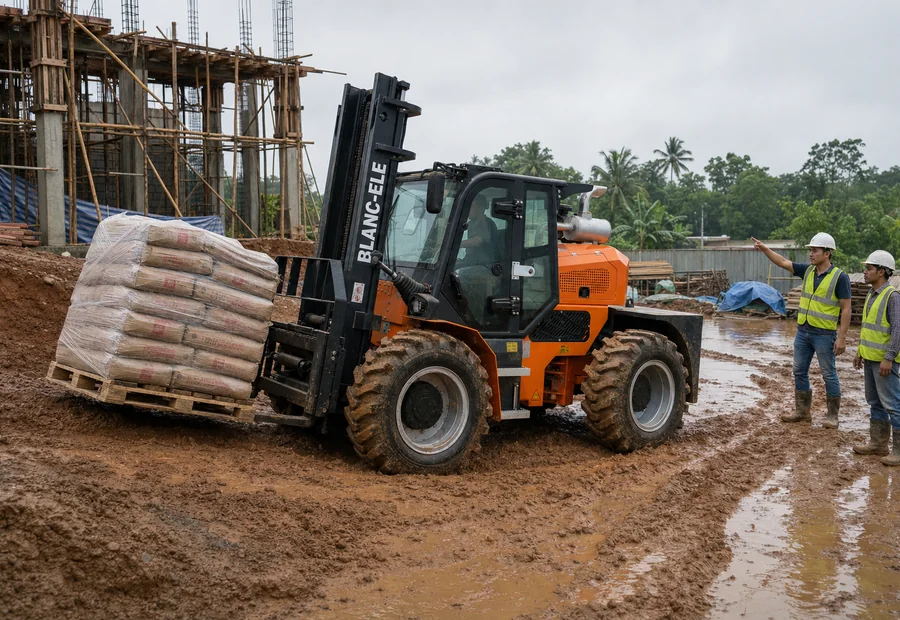
The route becomes softer. Tire tracks become deeper. A load that feels normal on dry ground can feel heavier when the machine is turning through mud. Operators slow down, trucks block the better path, and the forklift starts working in the worst part of the site because that is where the material is waiting.
This is why I do not like choosing a forklift for rainy-season construction sites only from rated capacity or a clean product photo.
For overseas buyers, especially in Southeast Asia, Africa, the Middle East, and other markets where many jobs continue through wet seasons, the forklift has to match the real route, not only the lifting number.
Start With The Ground, Not The Model
Many buyers begin with the model question:
"Should I choose 3 ton, 3.5 ton, or a bigger rough terrain forklift?"
That question matters, but it is not the first question I ask.
I usually start here:
"What happens to the site after two hours of rain?"
The answer changes the recommendation.
On a rainy construction site, ground condition may include:
- compacted soil that becomes soft near the surface
- gravel roads with muddy low spots
- unfinished paths with deep truck ruts
- slopes near loading areas
- puddles around material stacks
- narrow turning points between buildings, trucks, and stored materials
- temporary access roads that change every week
For this kind of work, the BLANC-ELE rough terrain forklift range is usually discussed because the buyer needs more than a normal indoor warehouse forklift. But even inside the rough terrain category, the right configuration still depends on the site.
The Real Question Is Not Only "Can It Drive In Mud?"
Buyers often ask:
"Can this forklift work in mud?"
My answer is usually careful.
A suitable rough terrain forklift can work much better than a standard warehouse forklift on outdoor uneven ground, but mud is not one condition. Mud can be shallow, deep, sticky, mixed with gravel, mixed with clay, or softened by truck traffic. The same site can be acceptable in the morning and difficult in the afternoon.
So instead of asking only whether the forklift can drive in mud, I prefer to check:
- How deep does the mud become?
- Does water stay on the route?
- Is the ground firm below the surface?
- Does the forklift need to turn while loaded?
- Does the operator travel long distances with the load?
- Is there a slope near the working area?
- Are trucks or excavators making the route worse during the day?
This is also why the article why standard forklifts get stuck in mud is still useful for buyers. The problem is rarely one single factor. It is usually ground, tire, drive system, clearance, load, and route working together.
A Typical Rainy-Season Case
A typical rainy-season construction inquiry sounds simple at first.
The buyer says the forklift will move cement, blocks, steel, pallets, and general materials around a building site. The load is not always close to the rated maximum. The buyer mainly wants the machine to keep working when rain comes.
Then we ask for more details.
The site has several problems:
- the loading area is lower than the main road
- trucks leave deep ruts after rain
- the forklift must turn near stored materials
- workers sometimes place pallets on soft ground
- the route changes as the building progresses
- the buyer may later use long forks or other attachments
At that point, the decision is not only about choosing "4WD" or choosing a larger capacity.
The buyer needs to think about tires, traction, ground clearance, load center, turning route, lifting height, working hours, and maintenance support. A forklift that looks powerful in a photo can still disappoint if the daily route is ignored.
That is why I like to ask for site photos or short videos before recommending a configuration. A 20-second video of the route after rain is often more useful than a long message.
Check The Tire Before You Talk About Power
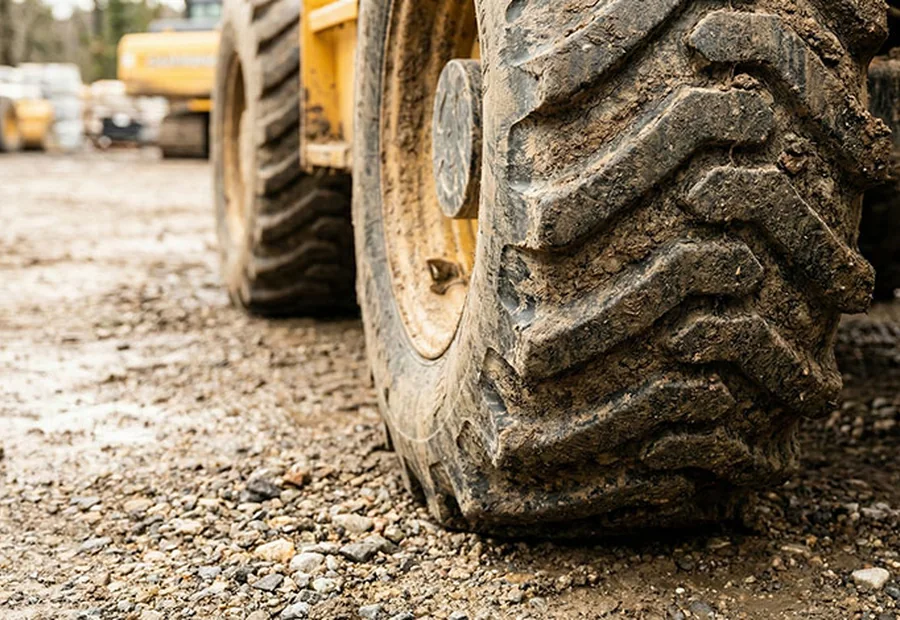
Engine power and drive system are important, but tires are one of the first things I check for rainy-season construction sites.
The tire is where the machine meets the ground.
If the tire pattern does not match the surface, the forklift can lose traction, dig into the ground, or become harder to control when loaded. A buyer may think the machine lacks power, but the real problem may be poor ground contact.
For wet construction sites, I normally ask:
- Is the surface mostly mud, gravel, clay, sand, or mixed ground?
- Does the site need deeper tread for traction?
- Will the forklift also work on harder roads?
- Will tires be damaged by sharp stones, steel scraps, or debris?
- Does the buyer need stronger tires for longer outdoor shifts?
The best answer is not always "the most aggressive tire." It depends on the route. A tire that works well in soft ground may wear differently on hard surfaces. A tire that is good on compacted roads may not bite enough in wet soil.
This is why tire choice should be discussed together with the route, not after the order is already confirmed.
4WD Helps, But It Is Not A Magic Answer
For rainy-season construction sites, 4WD is often part of the discussion.
But I try not to sell 4WD as a magic answer.
4WD can help the forklift get better traction than a simple indoor-type machine, especially on uneven outdoor ground. But if the load is too far forward, the ground is too soft, the slope is too steep, the tire is wrong, or the operator must turn in a narrow muddy area, 4WD alone cannot solve everything.
A practical buyer should check:
| Buyer Question | What I Want To Know |
|---|---|
| Is 4WD enough? | Ground depth, tire type, route slope, load weight, and turning space |
| Do I need more capacity? | Actual load weight, load center, and working margin |
| Will it handle rainy season? | How the route changes after rain and truck traffic |
| Should I choose bigger tires? | Ground clearance, traction need, tire wear, and site debris |
| Can one machine do all work? | Main load, future attachments, travel distance, and daily hours |
If you want to compare drive systems more clearly, our guide on forklift drive types explained gives a broader view. For rainy sites, though, I would still bring the conversation back to the ground and route.
Do Not Ignore Load Center And Lifting Height
Rainy ground makes the forklift's job harder, but the load still matters.
OSHA's powered industrial truck guidance treats load composition, load center, and stability as important selection and operation issues. In practical supplier language, that means a compact pallet close to the mast is different from a long, uneven, forward-positioned load.
On a wet construction site, this difference becomes more obvious.
For example:
- Cement bags on a neat pallet behave differently from loose building materials.
- Long steel or timber can move the load center forward.
- Wet packaging can change handling behavior.
- A pallet placed on soft ground may be hard to enter cleanly.
- Lifting high on uneven ground needs extra caution.
This is why I ask buyers not to choose only by rated capacity. Rated capacity is useful, but rainy-season work often needs more real-world margin.
If the job also involves long forks, side shifters, buckets, clamps, or other front-end changes, review rough terrain forklift attachments and configurations before finalizing the order.
Route Planning Can Save More Time Than A Bigger Machine
Some rainy-season problems are not solved by buying a larger forklift.
They are solved by planning the route.
Before the buyer orders, I like to know:
- Where is the main material storage area?
- Where do trucks unload during rain?
- Which part of the route stays firm?
- Where does water collect?
- Can the route be improved with gravel or temporary boards?
- Does the forklift need to cross the same muddy section many times per day?
- Can the site avoid turning with a heavy load in the softest area?
If the forklift must always travel through the worst route, even a suitable machine will work harder. The buyer may see more tire wear, more fuel use, slower cycle time, and more stress on operators.
For this reason, a good construction-site forklift discussion should include the machine and the site. If the buyer only sends the required capacity and asks for a quick quote, important details may be missed.
Maintenance Matters More During Wet Seasons
Rainy-season construction work is harder on a forklift.
Mud, water, and debris can increase the need for inspection and cleaning. Operators may notice mud around tires, axles, steps, underbody areas, and the mast. Electrical connections, lubrication points, filters, and daily service access all become more important.
I do not like telling buyers only about the front-end performance.
I also ask:
- Who will inspect the machine each day?
- Can operators clean mud from key areas?
- Are basic filters and wear parts planned?
- Is there a local mechanic or dealer?
- Will the machine work long hours during rainy season?
- Does the buyer need spare parts support before the machine arrives?
This is where ownership cost becomes real. A forklift that is hard to inspect and service may create more downtime during the season when the buyer needs it most.
The article some forklifts look powerful until they work 10 hours outdoors explains this point from another angle. Outdoor work tests more than the first lift.
What To Send Before Asking For A Recommendation
If you want a more useful recommendation for a rainy-season construction site, do not only send the load capacity.
Send this information:
| Information | Why It Helps |
|---|---|
| Load weight and dimensions | Confirms capacity, load center, and fork requirement |
| Ground photos after rain | Shows the real route condition |
| Short route video | Helps judge mud depth, slope, ruts, and turning space |
| Lifting height | Affects mast selection and stability discussion |
| Daily working hours | Affects configuration, maintenance, and spare parts planning |
| Tire damage risks | Stones, steel, debris, or concrete edges affect tire choice |
| Destination country | Helps plan documentation, service, and shipping details |
| Future attachment needs | Avoids choosing a machine with too little margin |
This information does not make the buying process slower.
It makes the recommendation more realistic.
Many forklift problems start before the machine arrives because the supplier did not fully understand the site. I wrote about that in most forklift problems actually start before the machine arrives.
My Practical Recommendation
For rainy-season construction sites, do not buy from one number.
Do not choose only by rated capacity.
Do not choose only because the forklift says 4WD.
And do not choose only from a clean product photo.
Instead, check the full working condition:
- ground after rain
- tire type
- route width
- slope and turning area
- load weight and load center
- lifting height
- daily working hours
- maintenance access
- spare parts plan
- future attachments
A rough terrain forklift can be a strong solution for wet construction work, but the right result depends on matching the forklift to the actual site.
Before order, send us your working condition with photos or videos of the route after rain. We can review the load, ground, tires, mast, and configuration before production.
References
- OSHA Powered Industrial Trucks eTool: operating, traveling, and maneuvering guidance: https://www.osha.gov/etools/powered-industrial-trucks/operating-forklift/traveling-maneuvering
- OSHA Powered Industrial Trucks eTool: load composition, load center, capacity, and stability considerations: https://www.osha.gov/etools/powered-industrial-trucks/load-handling/load-composition
- OSHA 29 CFR 1910.178: powered industrial trucks, including operating rules and capacity-related requirements: https://www.osha.gov/laws-regs/regulations/standardnumber/1910/1910.178