
The photo usually arrives after the forklift has already stopped.
One front wheel is buried. The load is still on the forks. The operator has tried to move forward, reverse, turn, and push through the mud. Now the buyer asks a simple question:
"Do I need a rough terrain forklift?"
From my side as a supplier, I never answer that question from the photo alone. A forklift stuck in mud is not only a traction problem. It can also be a route problem, load problem, tire problem, ground clearance problem, or working-method problem.
So before I recommend a model, I try to understand why the machine got stuck in the first place.
The Short Answer
If a forklift gets stuck in mud, do not look only at four-wheel drive. First check the soil, route, load weight, load center, tire pattern, ground clearance, turning area, travel distance, slope, and daily working conditions.
A rough terrain forklift may be the correct direction for outdoor work, especially where a standard warehouse forklift cannot keep traction on soft ground. But the right configuration still depends on the site.
For dealers, importers, construction buyers, farm buyers, and rental fleets, this check is important. Otherwise, the buyer may replace the wrong problem with a stronger-looking machine that still struggles on the same route.
The Mud Is Only The First Evidence
Mud tells us the machine is working beyond a clean indoor floor.
It does not tell us enough.
Some muddy routes are only wet on the surface. Some have soft clay underneath. Some look flat in photos but have wheel ruts after one loaded trip. Some sites are acceptable in the dry season and almost unusable after several days of rain.
Before talking about capacity, I usually ask the buyer to send:
- a photo of the loading point;
- a photo of the unloading point;
- a short video of the full loaded travel route;
- the wet-season ground condition;
- the deepest mud or rut area;
- the slope or ramp if there is one;
- the normal load and the heaviest load;
- the lift height and turning space.
Those details make the recommendation much more honest.
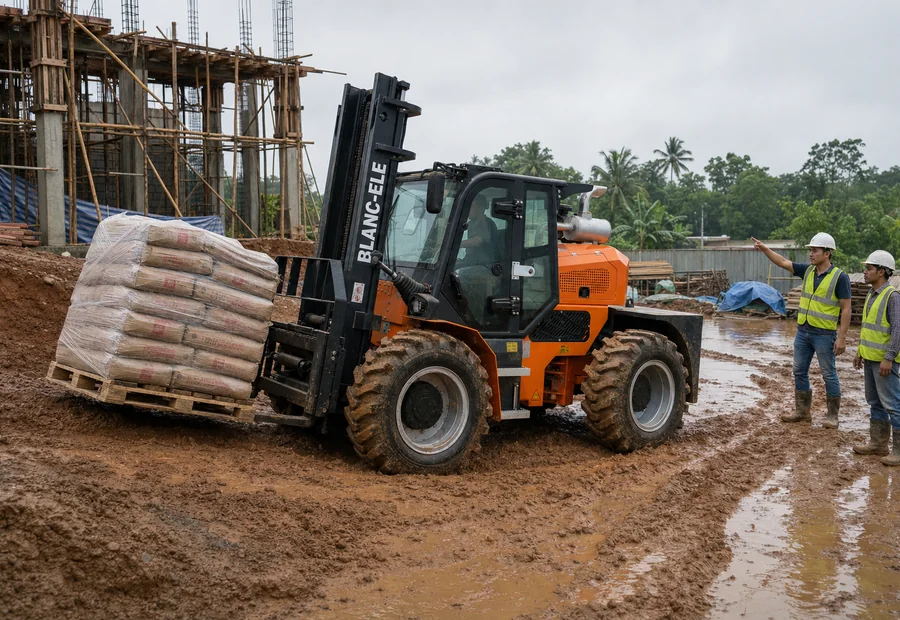
A Typical Case I See
A buyer says his forklift is always getting stuck near the storage yard entrance.
At first, the problem sounds like the machine is too weak. After checking the photos, the real issue becomes clearer. The route from the truck unloading area to the storage yard is short, but it passes through one soft turning point. The forklift is usually loaded when it reaches that point, then the operator turns while the front wheels are already cutting into the mud.
In that kind of situation, a stronger outdoor forklift can help. But the buyer should still think about the whole route:
- Can the turning point be widened?
- Can the worst mud area be filled with gravel or compacted material?
- Is the forklift carrying the load too far forward?
- Is the pallet too long or unstable?
- Is the route used during heavy rain or only after the ground settles?
- Does the operator need to stop and turn in the softest area?
This is why I do not like answering "yes, use 4WD" too quickly. Four-wheel drive is useful, but the site still decides the result.
Route Condition Comes Before Model Size
Many buyers begin with capacity.
"Can a 3.5 ton forklift work here?"
"Should I choose 5 ton?"
Capacity matters, of course. But if the route is too soft, narrow, sloped, or badly prepared, a bigger machine may simply create deeper ruts. More rated capacity does not automatically solve poor ground.
For muddy sites, I prefer to divide the route into three parts:
- the pick-up point, where the forklift receives the load;
- the travel path, where traction and stability matter most;
- the drop-off point, where turning, braking, and lift height become important.
If only one small area is bad, route preparation may be part of the answer. If the whole route is soft, long, and uneven, then the forklift selection becomes more serious.
The buyer should not choose a machine from the cleanest photo. The machine should be chosen from the worst normal working condition.
Tires Help, But They Are Not Magic
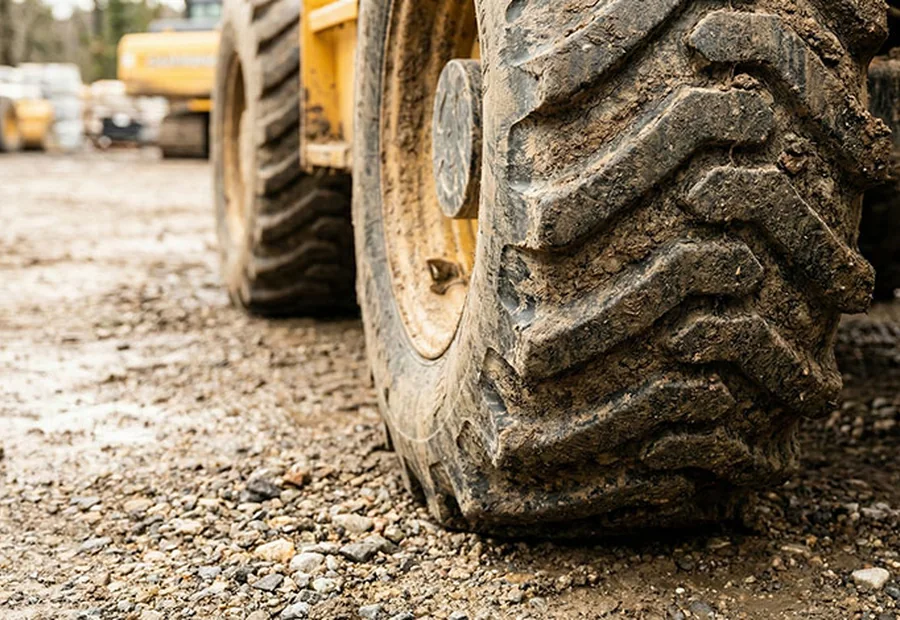
Tire pattern is one of the first things I check for muddy work.
A standard industrial tire is designed for a different world. On wet soil, loose gravel, farm paths, or construction mud, it can lose grip quickly. A deeper off-road tire pattern gives the forklift a better chance to bite into the surface and clear mud from the tread.
But tires alone cannot fix every site.
If the ground is too soft, the load is too heavy, the operator turns sharply while loaded, or the route has deep ruts, even a better tire will have limits. Tire selection should be discussed together with axle layout, ground clearance, load center, turning radius, and the actual work cycle.
Ground Clearance Is Easy To Forget
When a forklift is stuck in mud, buyers often focus on wheel slip.
I also look at what the chassis is doing.
If the machine has low ground clearance, it may drag on uneven ground, ruts, broken surfaces, stones, or compacted mud. Once the bottom of the machine touches the ground, wheel traction alone cannot do all the work.
This is one reason outdoor buyers compare standard forklifts with rough terrain forklifts. A rough terrain design usually gives more attention to uneven routes, outdoor tires, clearance, and traction than a warehouse forklift.
Still, final suitability depends on the site. If the buyer is working in deep mud, badly broken roads, or a temporary construction route, I would rather see photos and videos before making a recommendation.
When A 3.5 Ton Rough Terrain Forklift May Fit
For many mixed outdoor applications, the 3.5 ton class is a practical starting point.
The BLANC-ELE 3.5 ton 4WD rough terrain forklift is positioned for construction sites, farms, yards, and rental fleets. Its product page lists a rated load of 3,500 kg, 4WD drive, and several mast-height options from 3.5 m to 6 m, with the final configuration confirmed according to the working condition.
This direction can make sense when the buyer handles common pallets, farm supplies, building materials, or outdoor yard loads, and the site needs more traction than a standard forklift.
But I would still check the load center carefully. If the buyer handles long steel, timber, oversized pallets, stone, bricks, or unstable loads, the rated capacity number alone is not enough.
When A 5 Ton Machine Should Be Compared
If the buyer works with heavier materials, rougher routes, or more demanding daily use, a 5 ton model may need to be compared.
The BLANC-ELE RT50 5 ton 4WD rough terrain forklift is positioned for heavy outdoor use such as brick yards, construction sites, stone yards, farms, and uneven material-handling routes. The product page lists 5,000 kg rated capacity, 4WD traction, 330 mm minimum ground clearance, 3-6 m mast options, and rear-wheel or front-wheel steering choices.
Those details are useful, but they are not a shortcut.
A 5 ton machine still needs enough route width, turning space, ground preparation, operator discipline, and loading control. If the site is narrow or extremely soft, the buyer should not choose only by a larger number.
Do Not Ignore Load Center
A forklift may get stuck more easily when the load pushes the machine outside its comfortable working range.
For example, a compact pallet with a normal load center is different from a long bundle, wide crate, loose material, or an attachment that moves the load forward. The forklift may still be within a simple weight number, but stability, traction, steering feel, and front-wheel pressure can all change.
Before recommending a rough terrain forklift for muddy work, I like to know:
- load weight;
- load dimensions;
- pallet type;
- normal lift height;
- whether the load is long or forward-heavy;
- whether long forks, side shift, fork positioner, clamp, bucket, or other attachments are needed;
- how far the forklift travels while loaded.
This is where many export inquiries become clearer. The buyer does not only need "a forklift that can drive in mud." The buyer needs a machine that can carry a real load through a real route every working day.
A Dealer Should Ask Different Questions
For a dealer or importer, the problem is slightly different.
The end customer may only say, "My forklift gets stuck in mud." If the dealer answers only with capacity and price, the conversation stays weak. A better sales conversation starts with working conditions.
I would ask the end customer:
- Is the forklift currently a warehouse forklift or an outdoor forklift?
- Where exactly does it get stuck?
- Does it get stuck unloaded, loaded, or only while turning?
- Is the problem seasonal or all year?
- What is the heaviest load?
- How far does it travel with the load?
- Is the site construction, farm, plantation, brick yard, stone yard, or rental use?
- Does the buyer need spare parts prepared with the shipment?
These questions help the dealer look more professional. They also reduce the risk of selling a machine that looks correct on paper but does not match the customer site.
For a broader outdoor selection discussion, this earlier article on why 4WD alone is not enough for a rough terrain forklift is also useful. If the issue becomes worse during rainy months, the rainy season construction-site checklist can help structure the route questions.
My Practical Recommendation
If your forklift is stuck in mud, do not rush to blame only the machine.
Start with the route. Then check the load, tire pattern, ground clearance, turning point, travel distance, lift height, and daily working cycle. After that, compare the forklift class and configuration.
For lighter mixed outdoor work, a 3 ton or 3.5 ton rough terrain forklift may be enough. For heavier construction, brick, stone, farm, or rough-yard use, a 5 ton machine may need to be compared. For any model, the final recommendation should come from site photos, route videos, load details, lift height, attachment needs, and destination-market requirements.
If you want BLANC-ELE to review a muddy-site forklift inquiry, send us the working condition with photos, videos, load information, lift height, route details, and target use. We can then suggest a more realistic rough terrain forklift direction instead of guessing from one stuck-wheel photo.