
A warehouse yard can look simple from a distance.
Flat building, open gate, pallets outside, trucks coming in and out.
But once a forklift starts working there every day, the yard usually becomes more complicated than the buyer expected.
Some parts are concrete. Some parts are gravel. The truck loading area may have a small slope. After rain, the route beside the warehouse may become soft. Pallets may be stored outside for several days. Drivers may need to turn between trucks, containers, walls, stacked goods, and drainage channels.
That is why I usually do not treat an outdoor warehouse yard forklift as a normal indoor forklift question.
For many dealers, importers, warehouse owners, rental fleets, and construction-supply yards, the real question is not only:
"How many tons do I need?"
The better question is:
"Can this forklift work safely and steadily on the real route between the warehouse, the storage yard, and the truck loading point?"
The Yard Route Matters More Than the Name of the Warehouse
In many export inquiries, the buyer says the forklift will work in a warehouse.
Then, after a few more questions, the working condition becomes clearer:
- loading and unloading trucks outside the warehouse;
- moving pallets between indoor storage and an outdoor yard;
- driving over concrete, gravel, packed soil, or broken pavement;
- handling blocks, bagged material, pipes, timber, feed, fertilizer, or construction supplies;
- working after rain or during dusty dry seasons;
- turning in a narrow yard while trucks are waiting.
That is no longer a clean indoor warehouse job.
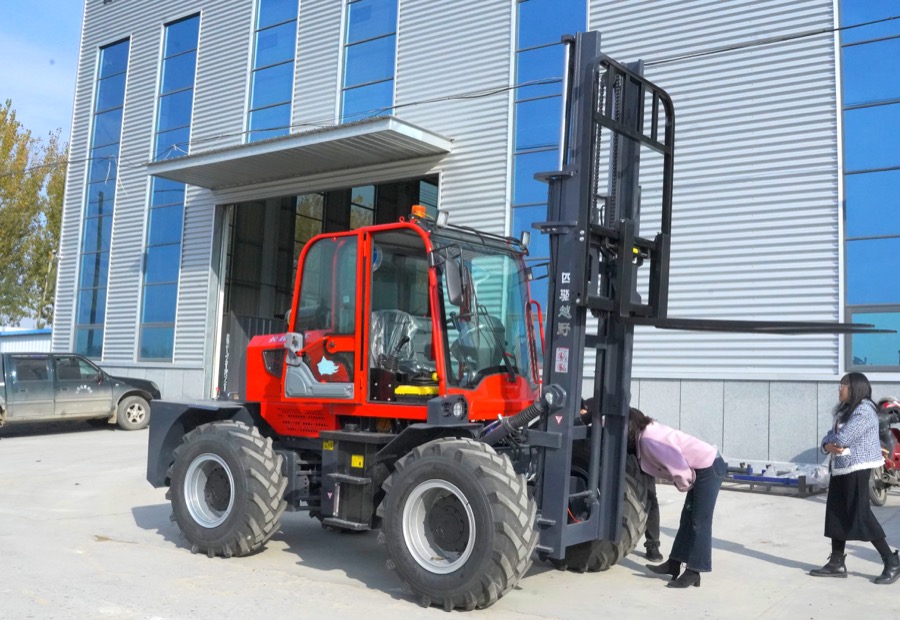
It is a mixed indoor-outdoor handling route. In that situation, a standard warehouse forklift may still be useful indoors, but it may struggle once the route becomes uneven, wet, loose, or narrow.
For this type of job, I normally ask the buyer to compare a rough terrain forklift or 4WD forklift before confirming the model.
A Typical Case: The Forklift Was Fine Indoors, but Not Outside
One common case starts like this:
A buyer already has a normal forklift for indoor pallet handling. It works well on the warehouse floor, so the buyer wants to use a similar machine outside for truck loading and yard transfer.
At first, that sounds reasonable.
But after checking the working route, the problem is not the pallet weight alone. The route includes a concrete warehouse floor, a short uneven outdoor section, a truck waiting area with worn pavement, and a gravel storage corner. During the dry season, dust is the main issue. During the rainy season, the same route becomes slippery and soft in places.
If the buyer only chooses by rated capacity, the machine may look correct on paper but still become difficult to use outside.
The operator may slow down every time the forklift crosses the yard. The mast may shake more than expected. Tires may slip when the load is raised too early. A small rut or pothole may become a daily problem. If the yard is busy, every slow turn near trucks also affects loading time.
This is why I prefer to check the whole working route before talking about the final model.
What I Ask Before Recommending a Forklift for an Outdoor Warehouse Yard
For an outdoor warehouse yard, I usually ask for simple information first. A few phone photos or a short video often saves a lot of guessing.
The most useful details are:
- the heaviest normal load, not only the maximum occasional load;
- the pallet size, load length, and whether the load is stable or loose;
- the route surface: concrete, gravel, packed soil, mud, sand, or mixed ground;
- the longest one-way travel distance;
- the narrowest turning point;
- the slope near the truck loading area or warehouse gate;
- whether the forklift must enter containers, trucks, sheds, or low doors;
- how many hours the machine works per day;
- whether the buyer needs side shift, fork positioning, fork extensions, bucket, clamp, or another attachment.
These details are not paperwork. They decide whether the forklift will feel practical after delivery.
If a dealer or importer sends only "5 ton forklift price" or "warehouse forklift needed," I can reply quickly, but the first quotation may still miss the real application. If the buyer sends route photos and load details, the recommendation becomes much more accurate.
Do Not Judge the Machine by Capacity Alone
Rated capacity is important, but it is not the whole answer.
A 3 ton load on smooth concrete is very different from a 3 ton load moving across wet gravel. A long pallet is different from a compact block pallet. A short transfer route is different from repeated long-distance travel between an outdoor stock area and a loading bay.
For outdoor warehouse yards, I look at capacity together with:
- ground contact and tire pattern;
- ground clearance;
- wheelbase and turning space;
- mast height and lowered mast height;
- load center and load stability;
- attachment weight;
- route condition after rain;
- operator visibility.
This is especially important for buyers who move construction materials, agricultural supplies, bricks, stone, metal goods, bagged material, or mixed cargo outside the warehouse.
The load may be within the forklift's rated capacity, but the ground can still be the real reason the machine feels weak.
When a 4WD Rough Terrain Forklift Makes More Sense
Not every outdoor warehouse yard needs a 4WD forklift.
If the ground is flat concrete, the load is light, the route is short, and the forklift mainly works indoors, a normal forklift may still fit the job.
But I start to recommend comparing a 4WD rough terrain forklift when the buyer describes:
- gravel or packed soil sections;
- rain-season operation;
- small slopes around truck loading points;
- outdoor pallet storage;
- uneven paving or broken concrete;
- dusty yards with potholes;
- heavier construction or agricultural cargo;
- repeated travel between warehouse and yard.
The goal is not to sell a bigger machine than the buyer needs.
The goal is to avoid a machine that works well only on the quotation sheet.
For heavier outdoor yard applications, the BLANC-ELE 5 ton rough terrain forklift is one model buyers often compare. Its product page lists a 5,000 kg rated capacity, 4WD traction, 330 mm minimum ground clearance, standard 3,000 mm lift height, and optional mast heights from 3.5 m to 6 m. Final suitability still depends on the load, route, mast, attachment, steering layout, and destination requirements.
Tires and Ground Contact Are Not Small Details
Many buyers look at engine power and mast height first.
I understand that. Those numbers are easy to compare.
But for outdoor warehouse yards, the tire and ground contact often decide how the machine feels during real work.
Deep-tread tires are useful when the forklift needs more bite on loose ground, gravel, mud, or construction-yard surfaces. Ground clearance matters when the yard has ruts, stones, uneven concrete edges, drainage areas, or temporary road plates. A forklift with low clearance may touch the ground or slow down too much in places that look harmless in a photo.
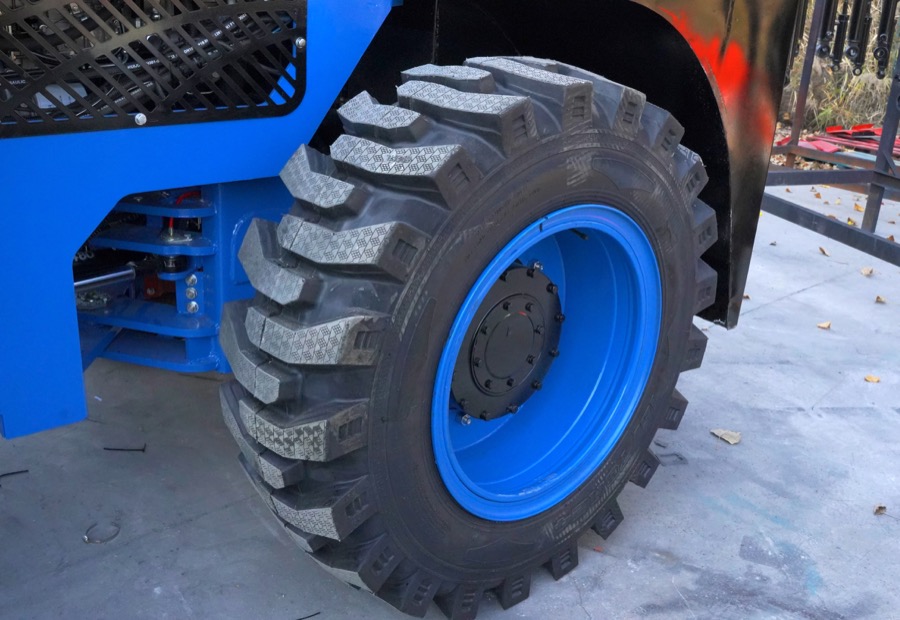
For a buyer, this means the site photos should include the ground, not only the load.
I like to see the surface near the warehouse gate, the outdoor storage area, the truck waiting area, and the route after rain if possible. A short video of the current forklift route is even better.
Turning Space Can Limit the Real Forklift Choice
Warehouse yards often have one problem that does not appear in a simple specification request:
turning space.
The buyer may have enough open space in one part of the yard, but the forklift still needs to turn near a truck, wall, gate, container, goods stack, or loading dock. If the route is narrow, the steering layout and turning radius become important.
This is why I ask for the narrowest route width, not just the overall yard size.
For example, a yard may look large in photos, but the forklift may need to reverse between two rows of stored goods. Another buyer may have a wide open yard, but trucks park very close to the warehouse door during loading. In both cases, the forklift must be selected around the actual operating route.
On some BLANC-ELE rough terrain forklift configurations, steering layout can be discussed according to site needs. For the RT50 Series, the product page lists rear-wheel and front-wheel steering layouts with different turning radius figures. The right choice should be confirmed around route width, turning area, operator preference, and load type.
Attachments Can Change the Practical Capacity
For warehouse yards, standard forks are not always enough.
A side shifter can help the operator adjust pallet position near truck beds or stacked goods. Fork extensions may help with longer loads, but they also change how the load behaves. Fork positioning can help dealers or yards handling different pallet widths. A bucket, clamp, or other attachment may be useful in some applications, but it should not be added casually.
The attachment is not only an accessory.
It changes weight, load center, visibility, and sometimes the required mast or hydraulic setup.
If the buyer is not sure, I usually suggest reading more about side shifters, fork positioners, and standard forks for rough terrain forklifts before finalizing the order.
A Warehouse Yard Forklift Should Be Ordered Around the Daily Routine
The best way to choose an outdoor warehouse yard forklift is to describe the daily routine.
For example:
- unload trucks in the morning;
- move pallets to outdoor stock;
- bring goods back into the warehouse;
- load customer trucks in the afternoon;
- work on mixed concrete and gravel;
- operate during rainy season;
- handle 3 to 5 ton loads with occasional long pallets.
That description is much more useful than one short sentence like "need 5 ton forklift."
From the supplier side, the daily routine helps us check the model, mast, fork length, tire, attachment, steering layout, spare parts, and shipping preparation more realistically.
This is similar to how I approach route planning for construction sites. If your site has mixed loading points and changing ground conditions, this construction site forklift route checklist may also help you prepare the inquiry.
Spare Parts and Service Access Should Be Planned Before Shipping
For export buyers, the machine does not stop only because of large failures.
Small wear parts, filters, hoses, sensors, tires, seals, and electrical items can also stop work if the buyer does not plan ahead.
In an outdoor warehouse yard, the forklift may work in dust, water, mud, heat, and repeated start-stop loading cycles. This makes basic maintenance planning more important than many buyers expect.
Before shipment, I normally suggest confirming:
- recommended wear parts with the order;
- filter and fluid maintenance plan;
- tire arrangement;
- basic troubleshooting support;
- manuals, parts diagrams, and video support channels;
- warranty and spare-parts terms in the formal order documents.
Remote after-sales support is usually handled through email, WhatsApp, manuals, videos, and parts diagrams. For overseas buyers, this should be discussed before the forklift leaves the factory, not after the first problem appears.
My Practical Recommendation
If your forklift will only work on a clean indoor floor, do not overcomplicate the choice.
But if the machine will move between warehouse, truck loading point, outdoor storage area, and mixed ground, treat it as an outdoor yard application from the beginning.
Send the supplier the real route.
Show the ground.
Show the load.
Show the tightest turning point.
Tell them the working hours, rain-season condition, and attachment needs.
Then compare whether a normal forklift is enough, or whether a rough terrain forklift is the more practical choice.
For dealers, importers, and warehouse-yard buyers, this approach usually makes the inquiry clearer and reduces the chance of ordering a machine that looks correct but works poorly after delivery.
If you are comparing a forklift for uneven warehouse ground, outdoor storage yards, construction-supply warehouses, farms, logistics yards, or mixed truck-loading routes, BLANC-ELE can review your load, route photos, working condition, and destination requirements before recommending a rough terrain forklift configuration.