
A construction site rarely gives a forklift a clean, permanent road.
That is the first thing I try to understand before recommending a construction site forklift.
Many buyers begin with a simple question: "Do I need 3.5 tons or 5 tons?" Capacity matters, of course. But on a real jobsite, the route often decides more than the number on the brochure. A forklift may have enough rated capacity and still become difficult to use if the path is soft, narrow, sloped, unfinished, or constantly blocked by materials.
So before talking about model size, I usually ask the buyer to show me the route.
The Short Answer
For construction site forklift selection, do not start only from rated capacity. Start from the route, loading point, ground condition, load shape, turning space, lift height, and support plan.
If the machine will work on compacted yard ground, move palletized blocks, and turn in a clear area, a smaller rough terrain forklift may be enough. If it will carry heavier pallets, steel, stone, molds, or mixed building materials across uneven outdoor routes, a heavier 4WD rough terrain forklift may be the more practical choice.
For buyers comparing outdoor forklifts, the BLANC-ELE rough terrain forklift range is built around diesel 4WD machines for construction, farms, mining support, yards, gravel, mud, sand, and uneven ground. But the right model still depends on the site.
Start With The Route, Not The Forklift
On many jobsites, the route changes every few days.
One week the forklift is moving cement blocks from the entrance to a storage area. The next week the same path is half covered by rebar, temporary pipes, or rain-softened soil. Sometimes the loading point is close to a truck. Sometimes the forklift has to travel between a material stack, a crane area, and a half-finished building.
That is why I ask for simple photos or a short phone video before giving a recommendation. I want to see:
- whether the route is compacted or loose;
- whether the forklift must cross mud, sand, gravel, grass, or broken concrete;
- whether the route is flat, sloped, or uneven;
- whether there is enough space to turn with the load;
- whether trucks can unload in the same place every time.
These details are not paperwork. They directly affect tire choice, ground clearance, steering layout, mast height, attachment choice, and the machine size we should discuss.
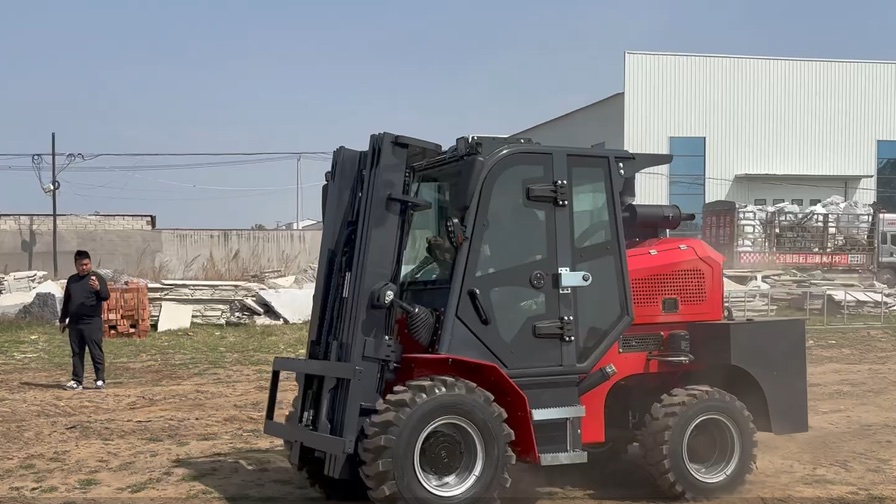
The Loading Point Is Often The Real Bottleneck
A forklift can travel across the site, but still fail to work efficiently if the loading point is poorly planned.
For example, some buyers only mention "pallets of building materials." Later we find that the pallets are not always the same. One shipment may be cement blocks. Another may be long steel parts. Another may be stone, formwork, pipes, or mixed materials from different suppliers.
The forklift selection changes when the load changes.
A short, compact pallet is different from a long, flexible load. A heavy block pallet is different from a light but oversized insulation pallet. A container unloading area is different from a site storage yard. If the load center is longer than expected, the practical handling feeling can be very different from the rated capacity printed on the machine.
This is also why I do not like recommending a machine from only one sentence in a message. A better inquiry includes the load weight, load dimensions, lifting height, ground condition, and a photo of the loading point. I covered a similar checklist in this guide on what information to send before asking for a rough terrain forklift quote.
A Typical Site Case
A typical inquiry looks like this:
The buyer is working on a building site outside the city. Trucks deliver blocks, steel, and construction materials to the entrance. The storage point is not far away, but the route is not a finished road. It is a temporary path with packed soil, gravel, small ruts, and open space in some areas. The buyer first asks for a machine "around 3.5 tons."
From a capacity view, that may sound reasonable.
But after checking the photos, the question becomes different. How often will the forklift carry the heaviest pallet? How wide is the turning point beside the storage area? Does the operator need to enter between stacks? Will the site become muddy after rain? Is the forklift only moving pallets, or will it also handle longer materials?
In this kind of case, I may still discuss a 3.5 ton machine if the load is regular and the route is manageable. But if the buyer expects heavier pallets, rougher routes, longer travel, or more mixed material handling, I would also compare a 5 ton machine before the order is confirmed.
This is not about selling a bigger machine. It is about avoiding a machine that looks acceptable on paper but feels small on the jobsite.
Where A 3.5 Ton Machine Can Make Sense
A 3.5 ton rough terrain forklift can be a good fit when the construction site has moderate loads, relatively controlled routes, and limited space.
For dealers and importers, this size can also be easier to position for mixed customers: small construction projects, farms, outdoor yards, rental fleets, and general material movement. The BLANC-ELE 3.5 ton series includes rear-wheel and front-wheel steering options, so the steering layout should be matched to the site instead of chosen only by habit.
I normally look at a 3.5 ton option when:
- loads are within a realistic working range with a suitable load center;
- the forklift does not need to move heavy blocks all day;
- the route is rough but not extreme;
- the buyer values maneuverability in tighter outdoor areas;
- the application is mixed, not only heavy construction material.
If the site has many narrow turning points, photos are very useful. A machine that turns well in an open yard may still need careful checking in a tight material storage area.
Where A 5 Ton Machine Becomes More Practical
The 5 ton question usually appears when the work is more demanding.
The BLANC-ELE RT50 5 ton 4WD rough terrain forklift is positioned for heavier outdoor work such as brick yards, construction sites, stone yards, farms, and uneven material-handling routes. Its product page also highlights rear-wheel or front-wheel steering choices, 4WD traction, 330 mm ground clearance, and 3-6 m mast options.
For construction buyers, I would consider this direction when:
- the load is often close to the upper working requirement;
- the site handles blocks, stone, steel, molds, or dense materials;
- the route is uneven or longer than expected;
- the forklift needs better stability margin for regular outdoor use;
- the buyer wants one machine to cover several heavier site tasks.
A 5 ton machine is not automatically the right answer. It also needs enough turning room, suitable route width, and a clear loading plan. If the site is narrow and the actual load is not heavy, a smaller machine may still be more convenient.
Do Not Ignore Turning Space
Turning space is one of the easiest details to forget.
Buyers often send the load weight and lifting height, but not the turning area. Then the machine arrives and the operator finds that the forklift can lift the material, but cannot move comfortably between stacks, walls, temporary roads, or truck positions.
The BLANC-ELE RT50 page, for example, separates rear-wheel steering and front-wheel steering because the right choice depends on route layout, turning space, and operator preference. That is a practical point for construction sites. Some sites need tighter maneuvering. Others have open routes where a more familiar steering layout is acceptable.
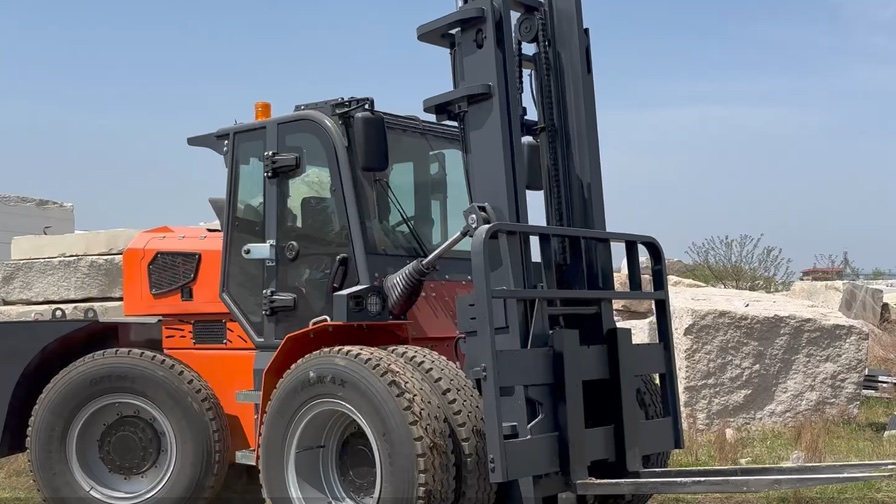
Rainy Season Changes The Answer
In many target markets, construction sites are not dry all year.
A route that looks fine in a sunny video may become soft after rain. Soil, clay, gravel, and unfinished ground behave differently when the forklift is loaded. I do not treat 4WD as a magic solution. It helps, but the site still needs a reasonable route, suitable tire choice, operator judgment, and a realistic load plan.
If the site regularly works after rain, the buyer should check:
- whether temporary roads are compacted enough;
- whether water collects in low areas;
- whether the forklift must turn on soft ground;
- whether loaded travel distance is long;
- whether slopes are part of the normal route.
For this specific issue, this earlier article on rough terrain forklift use during rainy-season construction may help buyers prepare better photos and site details before ordering.
Attachments Can Change The Whole Recommendation
Construction buyers sometimes treat attachments as something to decide later.
I prefer to discuss them before the order. Fork extensions, fork positioning, clamps, buckets, or other handling tools may change the load center, stability feeling, mast choice, and working method. Even if the forklift body is suitable, the wrong attachment plan can make the whole machine feel less efficient.
For example, a buyer handling regular pallets may only need standard forks. A buyer handling long materials may need a different discussion. A buyer moving loose material, bags, or irregular site goods should explain the real load shape instead of only saying "construction materials."
If attachments are likely, I ask the buyer to send photos of the actual materials. It saves time later.
What I Ask Before Recommending A Construction Site Forklift
For a serious recommendation, I usually ask for these details:
- maximum load weight and normal daily load weight;
- load size and load center, not only total weight;
- lifting height and doorway or overhead limits;
- route photos from truck unloading point to storage point;
- ground condition in dry and wet weather;
- turning space at the loading point;
- expected daily working hours;
- destination country and emission or documentation requirements;
- whether spare parts should ship together with the machine.
This does not need to be complicated. A few photos and a short video often explain more than a long message.
My Practical Recommendation
If you are buying a construction site forklift for export, do not ask only for a model and price. Ask whether the machine matches the route.
For lighter mixed work and tighter outdoor spaces, a 3.5 ton rough terrain forklift may be the better starting point. For heavier pallets, block yards, stone yards, and rougher material routes, a 5 ton rough terrain forklift may deserve serious comparison. For either case, the final choice should be confirmed against the real load, route, lifting height, steering preference, attachment plan, and destination-market requirements.
If you want BLANC-ELE to help review a construction-site application, send us your working condition with site photos, load details, lifting height, and the route from unloading point to working point. We can then suggest a more realistic configuration instead of giving a model from a single number.