
An off road forklift inquiry usually looks simple from the buyer's side.
"We need one forklift for outdoor work."
That sentence is a starting point, not a specification.
After working with overseas dealers, importers, construction buyers, farm buyers, and rental fleets, I have learned to slow the discussion down before recommending a model. The buyer may be using the words "off road forklift," "all terrain forklift," "4WD forklift," or "rough terrain forklift," but the real question is always the same: what kind of ground, load, route, and support plan will the machine face after it arrives?
This checklist is how I would review the order before moving to configuration.
The Short Answer
For an off road forklift order, do not choose by capacity alone. Check the ground, travel route, load size, lift height, tire requirement, steering preference, attachments, spare parts, and destination-market requirements before confirming the machine.
If the job is light mixed outdoor handling, a mid-size rough terrain forklift may be enough. If the work involves heavier pallets, stone, blocks, steel, long travel, soft ground, or rental fleet abuse, the discussion should be more careful.
The BLANC-ELE rough terrain forklift range is focused on diesel 4WD machines for outdoor work such as construction sites, farms, yards, mud, sand, gravel, and uneven ground. But the product range is only the starting point. The final selection still has to match the job.
Start With The Ground And Route
I like to see the ground before I talk too much about the forklift.
This may sound basic, but it prevents many wrong recommendations. A clean concrete yard, a compacted gravel road, a muddy farm path, a brick yard, a construction entrance, and a loose sand area are all "outdoor" places. They do not ask the same thing from a forklift.
Before choosing an off road forklift, the buyer should check:
- whether the route is compacted, loose, muddy, sandy, grassy, or mixed;
- whether the forklift must travel loaded for a long distance;
- whether there are slopes, ruts, water collection points, or broken ground;
- whether trucks always unload in the same place;
- whether the turning point is open or blocked by materials;
- whether the same route changes after rain.
This is why I often ask for a short phone video from the unloading point to the working point. A video shows things that a load chart cannot show.
A Typical Dealer Case
A dealer may contact us and say, "My customer wants an off road forklift for construction and farm use. Around 3.5 tons should be fine."
That may be true.
But after a few questions, the real picture often becomes wider. The customer may handle palletized blocks on one project, fertilizer bags on another site, and occasional steel materials in a yard. The ground may be dry for most of the year, but soft during rainy months. The buyer may also expect the same machine to work for several customers because it will enter a rental fleet.
In that situation, I would not only ask about rated capacity. I would ask:
- What is the normal load, not only the heaviest load?
- How large is the pallet or material?
- Is the load center longer than a standard pallet?
- How high does the operator need to lift?
- How rough is the loaded travel route?
- Will the machine work every day, or only when needed?
- Should spare wear parts ship with the machine?
This is not making the buying process difficult. It is how a supplier avoids recommending a machine that looks acceptable in a quotation but feels wrong on the customer's site.
Capacity Is Only Useful With Load Information
Many buyers start from "3 ton," "3.5 ton," or "5 ton." I understand why. Capacity is easy to compare.
But the useful question is not only how heavy the load is. It is how the load is shaped and how the forklift will carry it.
A compact pallet near the standard load center is one situation. Long steel, oversized bags, brick pallets, stone materials, timber, mold parts, or irregular farm loads are different situations. The load center, attachment, mast height, ground slope, and operator visibility all affect the practical result.
For export buyers, I suggest preparing a simple load note before asking for a recommendation:
- maximum load weight;
- normal daily load weight;
- load length, width, and height;
- pallet type or material shape;
- lifting height;
- indoor or outdoor loading point;
- whether a side shifter, fork positioner, clamp, bucket, or longer forks may be needed.
This also makes the quotation more useful. If the inquiry only says "send me off road forklift price," the supplier has to guess too much. A better inquiry lets the supplier recommend a machine and configuration with fewer assumptions. I shared a related checklist in this guide on what information to send before asking for a rough terrain forklift quote.
4WD Helps, But It Is Not The Whole Answer
For outdoor work, 4WD is important. It improves traction compared with a normal indoor forklift, especially on rougher ground.
But I do not treat 4WD as a magic answer.
The tire pattern, tire condition, ground clearance, weight distribution, steering layout, operator habit, and route preparation still matter. A 4WD forklift can still struggle if the site is too soft, the load is too far forward, the route is narrow, or the buyer expects the machine to work like a wheel loader.
This is also why the words "off road forklift" should be connected to real working conditions. If the buyer is not sure about the terminology, this earlier article on off-road, all-terrain, and rough terrain forklift naming may help. But after the naming is clear, the buying decision should move back to ground, load, and route.
Tires, Clearance, And Steering Change The Result
When I review an outdoor forklift application, I pay close attention to tires and steering.
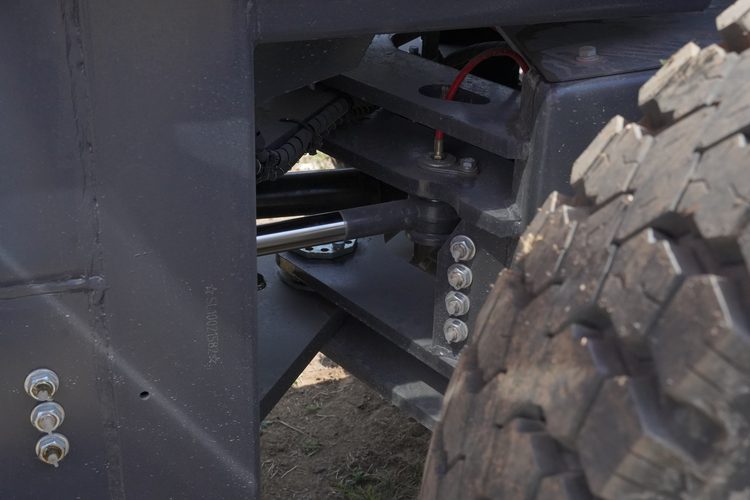
Deep-tread tires may help on softer outdoor ground, but the site still needs a workable route. Ground clearance matters when the forklift crosses uneven areas, ruts, or broken yard surfaces. Steering layout matters when the operator must turn near trucks, storage rows, walls, temporary roads, or crop rows.
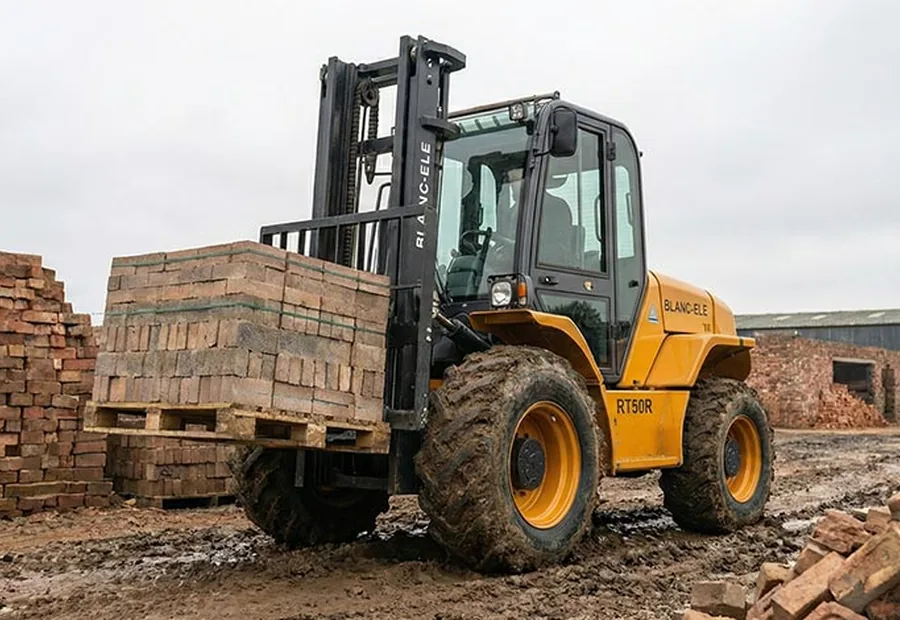
For example, the BLANC-ELE RT50 5 ton 4WD rough terrain forklift is positioned for heavier outdoor work such as brick yards, construction sites, stone yards, farms, and uneven material-handling routes. The product page highlights 4WD traction, 330 mm ground clearance, 3-6 m mast options, and rear-wheel or front-wheel steering choices.
Those details are not decoration. They should be matched to the job.
Where A 3.5 Ton Off Road Forklift Often Fits
A 3.5 ton rough terrain forklift can be a practical choice when the buyer needs more working reserve than a small machine but still wants manageable size for mixed outdoor applications.
The BLANC-ELE 3.5 ton 4WD rough terrain forklift is aimed at construction sites, farms, yards, and rental fleets. I usually consider this size when:
- the normal load is moderate;
- the route is outdoor but not extreme;
- turning space is limited;
- the customer handles mixed pallets rather than only heavy stone or blocks;
- the dealer wants a machine that can fit several customer types.
For a dealer, this can be an easier size to explain to customers who need outdoor ability but are not buying for heavy industrial work every day.
Where A 5 Ton Machine Deserves Comparison
A 5 ton rough terrain forklift becomes more relevant when the work is heavier, the load changes often, or the buyer wants more reserve for construction, brick, stone, farm, or yard applications.
I would compare a 5 ton machine when:
- the daily load is often heavy;
- the buyer handles dense materials such as blocks, stone, steel, molds, or large pallets;
- the travel route is longer or rougher;
- the operator needs more stability margin for regular outdoor use;
- the customer wants one machine to cover several demanding jobs.
This does not mean every buyer should move up to 5 ton. A bigger machine also needs enough turning space, suitable route width, and a realistic working plan. The right answer should come from the application, not from a simple "bigger is safer" idea.
Export Buyers Should Check Support Before Shipment
For importers and dealers, support planning matters as much as the machine itself.
An off road forklift may work far from the supplier's factory. Once the machine arrives, downtime can come from small parts, unclear maintenance habits, missing filters, wrong tire expectations, or a configuration that was not confirmed carefully before shipment.
Before order, I suggest checking:
- whether the final model and configuration match the written specification;
- whether the data plate and documents match the order;
- whether recommended wear parts should ship together;
- whether manuals, videos, parts diagrams, and remote after-sales support are available;
- whether the buyer has confirmed destination-market documentation or emission requirements;
- whether the operator understands the daily inspection and maintenance points.
I do not see this as extra paperwork. For overseas orders, these checks protect the buyer after the forklift leaves the factory.
What To Send Before Asking For A Recommendation
If you want a useful recommendation, send practical information, not only a model name.
The most useful inquiry usually includes:
- one or two photos of the working ground;
- a short route video from unloading point to working point;
- normal load weight and maximum load weight;
- load dimensions and material type;
- lifting height;
- turning space or aisle width if the area is tight;
- daily working hours;
- attachment needs;
- destination country;
- whether the machine is for end use, resale, or rental fleet use.
With this information, BLANC-ELE can review the application against the rough terrain forklift product range instead of guessing from one keyword.
My Practical Recommendation
If you are buying an off road forklift for export, use the keyword to start the conversation, but do not let the keyword finish the decision.
For moderate mixed outdoor work, a 3.5 ton rough terrain forklift may be a sensible starting point. For heavier construction, brick, stone, farm, yard, or fleet applications, a 5 ton rough terrain forklift may need to be compared. In both cases, the right choice depends on the real load, ground, route, lift height, steering preference, attachment plan, support plan, and destination requirements.
If you want us to review your application, send BLANC-ELE your working condition with site photos, load details, lifting height, route information, and destination country. We can then suggest a configuration based on the job instead of recommending from one capacity number.