
A forklift route can look simple on a phone video.
That is the trap.
In many construction site forklift inquiries, the buyer shows the load clearly but not the road. I can see the pallet, the steel bars, the blocks, or the bags. But I cannot see the soft corner after rain, the broken concrete near the unloading area, the small ramp beside the building, or the narrow turn around the truck.
For a warehouse forklift, that missing information may not change much.
For a construction site forklift, it can change almost everything.
The Short Answer
Before choosing a forklift for a construction site, do not start only with rated capacity.
Start with the route.
A construction site forklift must be judged by:
- where the forklift will actually drive
- how soft or uneven the ground becomes after rain
- whether the route includes slopes, ramps, broken concrete, sand, mud, gravel, or compacted soil
- how far the forklift travels with a load
- whether the machine must turn beside trucks, containers, scaffolding, walls, or stacked materials
- how often the route changes as the project moves
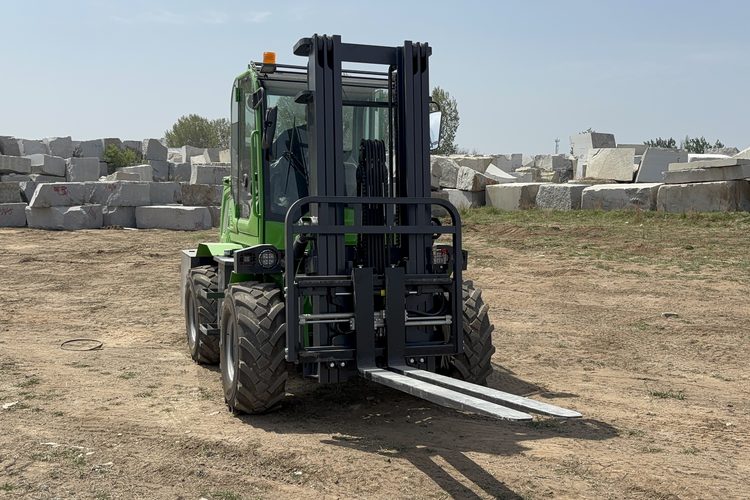
That is why many buyers who first ask for a normal forklift later move toward a BLANC-ELE rough terrain forklift range after we discuss the real working route.
The machine is not only lifting.
It is traveling, turning, braking, climbing, stopping, and aligning under conditions that are much less controlled than an indoor warehouse.
Why The Route Matters More Than Buyers Expect
A construction site is not one fixed floor.
It may be flat in the morning and muddy in the afternoon. It may look compact near the gate but become soft near the material storage area. It may have a short ramp that nobody mentions because the truck can pass it easily. But a loaded forklift feels that ramp differently.
From the supplier side, I usually separate the work into three questions:
- Can the forklift lift the load?
- Can the forklift travel with the load?
- Can the forklift repeat that work every day without creating downtime?
Many buyers answer only the first question.
That is not enough for construction work.
A Typical Case: The Load Was Clear, The Route Was Not
A typical buyer may say:
"We need a forklift for a construction project. It will handle pallets of materials and move them from the truck to the site."
The load sounds normal. The distance sounds short. The project sounds simple.
Then we ask for more details and the picture changes:
- the truck stops outside the main working area
- the forklift must cross compacted soil
- one corner becomes soft after rain
- there is broken concrete near the unloading point
- the machine must turn close to stacked steel bars
- the route may change after each stage of construction
In this kind of situation, the buyer is not only buying a forklift.
The buyer is buying enough working margin for a changing construction site.
This is also why I do not like making a recommendation from one load photo only. A load photo tells me what the forklift must lift. A route video tells me how the forklift will suffer.
What Looks Fine Before Work And What Appears Later
| Buyer assumption | What the site may reveal later |
|---|---|
| "The distance is short." | The short route still crosses mud, ruts, gravel, or a small slope. |
| "The forklift only carries pallets." | Pallets may be uneven, damaged, wet, or loaded off-center. |
| "The ground is mostly hard." | The working area may be hard near the gate but soft near storage. |
| "A normal forklift can lift this weight." | Lifting ability does not prove travel, traction, or turning ability. |
| "The site has only a small ramp." | A small ramp with a load can affect control and working margin. |
For buyers who have already seen forklifts struggle in mud, this related guide explains the same problem from a traction angle: why standard forklifts get stuck in mud.
Ground Condition Changes The Whole Recommendation
I ask buyers to describe the ground in plain words, not technical words.
For example:
- dry compacted soil
- wet clay
- loose sand
- stone yard ground
- gravel road
- broken concrete
- mixed indoor and outdoor route
- muddy entrance after rain
These details help decide whether the buyer should treat the job as warehouse handling, outdoor yard handling, or rough terrain work.
If the forklift only works on clean concrete, the discussion is different. But once the route includes soil, rain, uneven ground, slopes, or long outdoor travel, the conversation should become more careful.
That does not mean every site needs the biggest machine.
It means the recommendation should match the real work.
Drive, Tires, And Steering Are Not Small Details
Buyers often ask about lifting capacity first, then engine, then budget or delivery time.
I understand that. These are important.
But on construction sites, the parts touching the ground often decide how the machine feels in daily work.
Tires, drive system, ground clearance, steering behavior, and underbody strength all matter because the forklift is not protected by a flat warehouse floor.
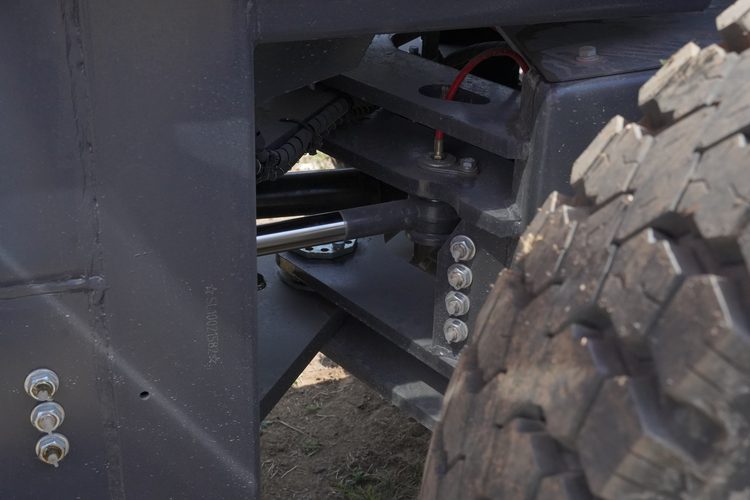
If the route is narrow, steering and turning space become important.
If the route is muddy, traction becomes important.
If the route has debris, tire damage and ground clearance become important.
If the route has a slope, the buyer should combine machine selection with safe operating practice. For a deeper safety angle, see our article on working safely with a forklift on inclined surfaces.
Do Not Forget The Load Shape
Construction materials are not always clean, square pallets.
The forklift may handle:
- blocks
- cement bags
- steel bars
- pipes
- timber
- stone products
- formwork
- mixed site materials
The load may be long, unstable, wet, or not perfectly centered.
That changes how the forklift should be configured. Fork length, attachment choice, visibility, mast requirement, and load center should be discussed before order.
If the job may need side shift, fork positioner, long forks, bucket work, or other attachments, it is better to discuss that early. Our guide to rough terrain forklift attachments and configurations explains why attachment planning should not be left until the end.
The Questions I Ask Before Recommending A Construction Site Forklift
Before I recommend a machine for construction work, I usually want the buyer to answer these questions:
| Question | Why it matters |
|---|---|
| What is the normal load and maximum load? | Capacity must match the real daily work, not only the best-looking load. |
| What is the load size and shape? | Long or uneven materials can change fork and attachment needs. |
| What ground will the forklift drive on? | Soil, gravel, mud, sand, and broken concrete affect tires and traction. |
| Does the route include slopes or ramps? | Inclines require more careful selection and operation. |
| How far will the forklift travel with a load? | Long travel increases heat, tire wear, and operator fatigue. |
| How much turning space is available? | Narrow site routes may require different steering and planning. |
| Does the site change during the project? | Construction layouts often move, so the machine needs practical flexibility. |
| Who will maintain the forklift locally? | Export buyers should consider downtime and spare parts support. |
These questions may feel basic, but they prevent expensive misunderstandings.
What Photos Or Videos Should A Buyer Send?
The best inquiry is not long.
It is clear.
For a construction site forklift, I like to see:
- the normal load
- the heaviest load
- the travel route from truck to storage area
- the worst ground condition after rain
- any slope, ramp, ditch, curb, or uneven crossing
- the narrowest turning area
- the storage or unloading point
- the maintenance situation on site
A 20-second route video can be more useful than a long message.
It helps the supplier see what the forklift must actually do, not only what the buyer hopes the site will be like.
My Practical Recommendation
If your forklift works only inside a clean warehouse, treat it as a warehouse forklift decision.
If it works outside on construction ground, treat it as a route decision first.
For construction sites, I would rather spend more time confirming the route before order than spend weeks later explaining why the machine is slipping, bottoming out, wearing tires too quickly, or stopping work in a muddy corner.
The better question is not:
"Can this forklift lift my load?"
The better question is:
"Can this forklift lift my load, travel my route, turn in my space, and keep working under my real site conditions?"
That question leads to a much better recommendation.
Final Thought
Construction site forklift selection should not begin with a catalog page only.
It should begin with the ground.
If you are choosing a forklift for construction, outdoor material handling, a mixed warehouse and site route, or a developing-market project where the ground may change quickly, send us your working condition, load details, route photos, and route video.
You can send us your working condition and we will help review the route before recommending a suitable configuration.
References
- BLANC-ELE: Rough terrain forklift product range
- OSHA: Powered Industrial Trucks
- OSHA: Forklift safety guidance