
When buyers ask me about a 4WD rough terrain forklift, they usually pay attention to the engine, capacity, mast, and delivery schedule.
Tires are often mentioned late.
But after seeing more outdoor job sites over the years, I have learned something very practical:
A 4WD forklift with the wrong tire can still perform badly.
It may slip on wet soil.
It may dig into soft ground.
It may wear too quickly on sharp gravel.
It may feel unstable when the load is heavy and the ground is uneven.
So when I recommend a rough terrain forklift for construction sites, farms, plantations, stone yards, or outdoor warehouses, I do not treat tire choice as a small detail.
I ask about the ground first.
If your site already has mud problems, this related article may help: why standard forklifts get stuck in mud.
4WD Helps, But Tires Decide How The Power Reaches The Ground
Many buyers think:
"If the forklift is 4WD, it should handle outdoor ground."
That is only partly true.
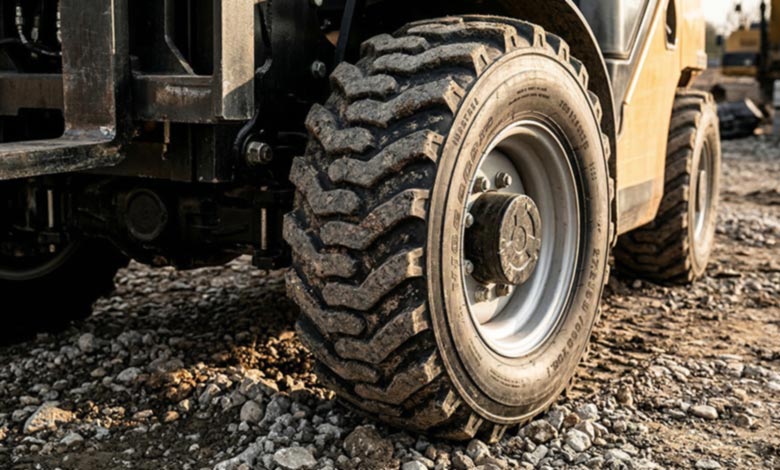
4WD helps distribute driving force, but the tire is the part that actually contacts the ground.
If the tire pattern, size, condition, or pressure does not match the site, the forklift may still struggle.
In real work, tire performance affects:
- Traction
- Steering control
- Braking feel
- Ground pressure
- Operator confidence
- Fuel use
- Tire wear
- Downtime
This is why I do not like recommending a forklift only by saying "4WD."
The better question is:
"4WD with which tire, on which ground, carrying which load?"
Start With Ground Condition, Not Tire Appearance
Some tires look strong in photos.
But the right tire depends on where the forklift will work.
Before choosing the tire, confirm:
- Is the site soil, mud, sand, gravel, concrete, or mixed ground?
- Does rain change the road?
- Are there sharp stones or construction debris?
- Does the forklift also work indoors?
- Does the site have slopes?
- Are there deep truck ruts?
- Is the ground soft during harvest or rainy season?
- Will the forklift turn with a load?
For rough terrain forklifts, the same tire may behave differently on different sites.
A tire that works well on dry compacted soil may not be the best choice for deep mud.
A tire that gives strong traction outdoors may wear faster if the forklift spends much of its time on hard concrete.
That is why site photos and short videos are useful before order.
Dive Deeper: A Typical Rainy Job-Site Tire Problem
A typical case looks like this.
At first, the buyer says:
"The site is outdoors, but it is not too difficult."
After more discussion, the real condition becomes clearer:
- The road is compacted soil, not concrete.
- Trucks enter the site every day.
- After rain, the road becomes soft and uneven.
- The forklift carries palletized materials across the site.
- The operator sometimes turns while carrying a load.
- Some areas have small slopes.
In this situation, the tire is not only supporting the machine.
It is deciding whether the forklift can get traction, keep direction, avoid excessive slipping, and move the load with enough control.
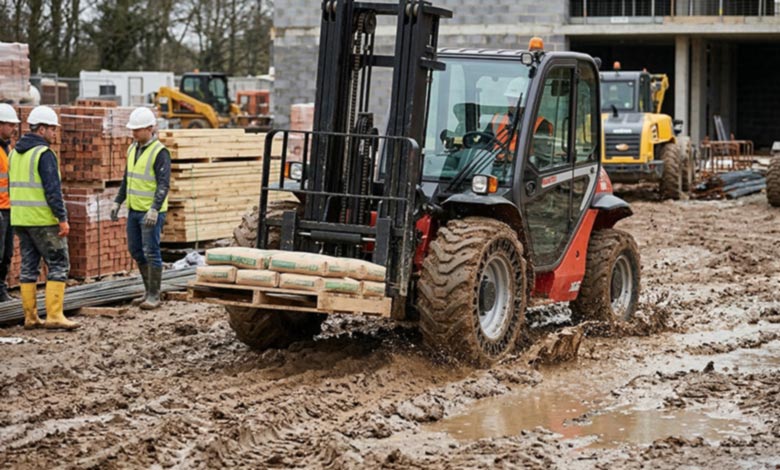
If the tire is not matched to the ground, the buyer may think the machine is weak.
But sometimes the real issue is not only the machine.
It is the tire choice, tire condition, and site route.
What Looks Fine Before Work And What Appears Later
| Before buying | What appears during outdoor work |
|---|---|
| "The tire looks big enough" | Tread pattern does not clear mud well |
| "The site is only a little wet" | Rain changes the whole route |
| "4WD should solve it" | Tire-ground contact still limits traction |
| "The load is within capacity" | Soft ground makes travel much harder |
| "The road is mostly gravel" | Sharp stones increase tire wear risk |
| "The forklift also uses concrete" | Aggressive tread may wear faster on hard surface |
This is why tire discussion should happen before shipping.
Not after the forklift has already arrived at the site.
Muddy Ground Needs More Than General Outdoor Tires
Mud is one of the hardest conditions for forklifts.
The problem is not only that the forklift may get stuck.
Mud can also affect steering, braking, turning, and operator control.
For muddy sites, buyers should confirm:
- How deep the mud becomes
- Whether the mud is seasonal or daily
- Whether the road can be improved
- Whether the forklift must cross soft areas with a load
- Whether there are ruts from trucks
- Whether the operator can choose a safer route
No tire can turn a very bad road into a perfect road.
Sometimes the best solution is a better route, road preparation, and a tire that matches the normal working condition.
For slope or incline work, tire discussion should also be combined with safe operating practice. You can read more in our guide on working safely with a forklift on inclined surfaces.
Sandy Ground Has A Different Problem
Sand is different from mud.
The forklift may not slip in the same way, but it can sink or lose momentum.
On sandy ground, the buyer should think about:
- Whether the sand is loose or compacted
- Whether the forklift carries heavy loads across sand
- Whether the route includes slopes
- Whether tire pressure and ground pressure become an issue
- Whether the site also includes hard surfaces
In some sandy regions, buyers ask for an "all terrain forklift" or "off road forklift" because they are trying to solve this exact problem.
The supplier should not answer only with a model name.
The supplier should ask what the sand is really like.
Gravel And Stone Yards Need Durability
Gravel and stone yards create another type of tire problem.
The forklift may have enough traction, but tire damage and wear become more important.
On these sites, buyers should check:
- Sharp stone edges
- Broken concrete
- Metal debris
- Tire sidewall risk
- Turning frequency
- Load weight
- Working hours per day
If the tire wears or gets damaged too often, the buyer loses time even if the forklift itself is strong.
For stone yards and material yards, I usually ask the buyer to send close photos of the ground, not only photos of the forklift route from far away.
Mixed Indoor And Outdoor Use Needs A Balanced Choice
Many buyers do not use the forklift only in one place.
The machine may work outdoors, then enter a warehouse, shed, or loading area.
This creates a tradeoff.
A very aggressive tread may help outdoors, but it may not be ideal for every indoor surface.
A smoother tire may work better on hard surfaces, but it may struggle on wet soil or loose ground.
So before ordering, the buyer should estimate:
- How much time is spent outdoors
- How much time is spent on concrete
- Whether the indoor floor must be protected
- Whether the route changes during rainy season
- Whether the forklift carries loads between indoor and outdoor areas
The best tire is usually not the most aggressive tire.
It is the tire that matches the real working mix.
Tire Condition Is Part Of Daily Safety
Tire selection is important, but tire condition is just as important.
OSHA's powered industrial truck pre-operation guidance includes tire condition and pressure as part of the inspection items, including cuts and gouges.
That is practical for outdoor forklifts.
On rough ground, tires work hard every day.
Before operation, the team should check:
- Tire pressure if applicable
- Cuts
- Gouges
- Uneven wear
- Loose or damaged wheel parts
- Embedded stones or debris
- Serious cracks or sidewall damage
A good tire can become a bad tire if it is ignored.
For overseas buyers, this matters even more because replacement parts may not arrive quickly.
Load And Tire Performance Are Connected
Tire performance cannot be separated from the load.
A forklift carrying light materials on firm ground is one thing.
A forklift carrying heavy or forward-positioned loads on soft ground is another.
OSHA's load composition guidance explains that load size, position, and weight distribution affect forklift capacity and stability. In outdoor use, that principle becomes even more practical because the ground is not always flat and firm.
Before choosing tires, the supplier should know:
- Normal load weight
- Maximum load weight
- Load dimensions
- Load center
- Whether attachments or long forks are used
- Whether the load is carried across mud, sand, gravel, or slopes
If the load is heavy and the ground is soft, tire selection becomes much more important.
Ask These Questions Before Choosing Tires
| Question | Why it matters |
|---|---|
| What is the main ground type? | Soil, mud, sand, gravel, and concrete need different thinking |
| Does rain change the route? | Dry photos may hide the real tire problem |
| Are there sharp stones or debris? | Tire durability may matter more than tread depth alone |
| Is the work mixed indoor/outdoor? | The tire should match both surfaces |
| Will the forklift work on slopes? | Tire, load, and route must be considered together |
| What is the normal load? | Load affects tire pressure on the ground |
| Are attachments used? | Attachments can move the load center and change handling |
| Can replacement tires be sourced locally? | Overseas downtime can become expensive if tires are not planned |
What Information Should You Send To BLANC-ELE?
If you want a more accurate tire and forklift recommendation, send:
- Country and job type
- Ground photos in dry condition
- Ground photos after rain if possible
- Short video of the forklift route
- Main cargo and load weight
- Whether the forklift works on mud, sand, gravel, concrete, or mixed ground
- Whether slopes or ramps are involved
- Working hours per day
- Attachment requirements
- Local tire replacement situation if known
You can also start from the BLANC-ELE rough terrain forklift range and then send us your working condition for configuration advice.
Conclusion
For outdoor forklifts, tires are not a small accessory.
They are part of the machine's real performance.
4WD helps, but the tire decides how that power reaches the ground.
If the tire does not match mud, sand, gravel, slopes, mixed surfaces, load weight, and working hours, the buyer may not get the performance they expected.
After working with overseas rough terrain forklift buyers, I have learned that many tire problems can be avoided if the buyer sends real site information before order.
If your forklift will work outdoors, send BLANC-ELE your ground photos, route video, load details, working hours, and tire concerns. We will help you check the suitable rough terrain forklift configuration before order.
References
- OSHA eTool, Powered Industrial Trucks - Pre-Operation: https://www.osha.gov/etools/powered-industrial-trucks/operating-forklift/pre-operation
- OSHA eTool, Powered Industrial Trucks - Traveling and Maneuvering: https://www.osha.gov/etools/powered-industrial-trucks/operating-forklift/traveling-maneuvering
- OSHA eTool, Powered Industrial Trucks - Load Composition: https://www.osha.gov/etools/powered-industrial-trucks/load-handling/load-composition
- BLANC-ELE rough terrain forklift product and specification documents. Final configuration should be confirmed before order.