
A clean warehouse floor can hide the real problem.
Many forklift buyers compare machines by capacity, mast height, and engine power first. Those details matter, but they do not tell the whole story.
In my work with overseas buyers, I often see one mistake: a forklift that looks suitable inside a warehouse is expected to do the same work in an outdoor yard.
At first, the job sounds similar.
Move pallets. Load trucks. Shift materials. Work several hours a day.
But the ground changes everything.
An indoor warehouse usually has a flat concrete floor, controlled traffic routes, clearer pallet positions, and predictable turning space. An outdoor yard may have gravel, compacted soil, mud, broken concrete, rainwater, slopes, dust, containers, trucks, uneven pallets, and long travel routes.
That is why I do not ask only what the forklift must lift.
I ask where the forklift must drive after the warehouse floor ends.
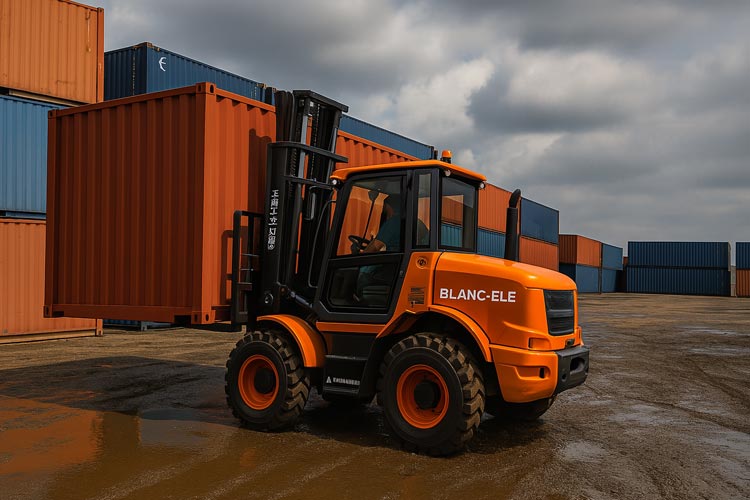
The Short Answer
Outdoor yards need different forklifts because the forklift must handle more than load weight.
It must deal with:
- uneven ground
- tire traction
- ground clearance
- drive system
- slope and turning space
- dust, rain, mud, or gravel
- longer travel distance
- operator visibility
- pallet condition
- maintenance access
- local service ability
An indoor warehouse forklift can be excellent in the right place. But if it is moved into a rough outdoor yard, the buyer may quickly see slipping, bouncing, tire damage, slow travel, poor stability, or unexpected downtime.
For outdoor work, the question is not:
"Can this forklift lift the pallet?"
The better question is:
"Can it lift, travel, turn, brake, and repeat the job on the real ground?"
If the answer is uncertain, a rough terrain forklift or another outdoor configuration should be discussed before order.
A Typical Outdoor Yard Situation
A buyer may tell me:
"We have a warehouse and an outside storage yard. The forklift only needs to load pallets and containers."
That sounds simple.
Then I ask for photos or videos.
The warehouse floor looks good. But outside, the route is different:
- trucks leave ruts after rain
- containers are parked on uneven concrete
- pallets are stored near gravel edges
- the forklift must cross a small slope
- the turning area is shared with workers and trucks
- some pallets are wrapped, some are loose, and some are damaged
- the machine may work in heat, dust, and long shifts
In this situation, the forklift is no longer doing pure warehouse work.
It is doing yard work.
That is a different selection problem.
If a buyer is still comparing standard forklifts and rough terrain forklifts, this related guide is a useful starting point: rough terrain forklifts vs standard forklifts.
Indoor Warehouse Work Is Controlled
Inside a warehouse, many conditions help the forklift.
The floor is usually flat. The route is usually planned. The pallet size is often more consistent. Operators may work in aisles, racks, loading bays, or production areas where the ground condition is known.
That allows the forklift to focus on:
- lifting height
- aisle width
- turning radius
- pallet handling speed
- battery or fuel choice
- indoor emission and noise requirements
- floor protection
- warehouse traffic rules
For this kind of work, a compact warehouse forklift can be very efficient.
But those advantages do not automatically transfer to outdoor yards.
A smaller tire that works well on concrete may struggle in loose gravel. Low ground clearance may become a problem near ruts or yard edges. A machine that feels stable on flat ground may feel uncomfortable when carrying a load across a broken surface.
The forklift did not suddenly become a bad forklift.
It was just used outside its natural working condition.
Outdoor Yard Work Is Less Forgiving
Outdoor yards create problems slowly, then all at once.
One day the ground is dry and firm.
The next day, after rain and truck traffic, the same route becomes soft, muddy, and uneven.
One pallet is square and balanced.
The next pallet is loose, wide, or sitting on a damaged base.
One loading area is flat.
The next requires the forklift to turn while the front wheels are near a rut or broken concrete edge.
This is why many outdoor forklift problems are blamed on the machine too late. The real issue started with the working condition.
For buyers who have seen forklifts get stuck after rain, this article explains the same issue from a mud and traction angle: why standard forklifts get stuck in mud.
What Usually Changes Outside?
The difference between indoor and outdoor work is not just "rough ground."
It is a group of small differences that affect the whole machine.
| Selection Point | Indoor Warehouse | Outdoor Yard |
|---|---|---|
| Ground | Flat concrete | Gravel, soil, broken concrete, mud, slopes |
| Tire focus | Floor protection and turning | Traction, damage resistance, ride comfort |
| Travel route | Shorter and controlled | Longer and less predictable |
| Load condition | More consistent pallets | Mixed pallets, wrapped loads, loose materials |
| Visibility | Aisles and planned routes | Trucks, containers, workers, stacks, dust |
| Maintenance risk | Cleaner environment | Dust, impact, water, debris |
| Main mistake | Overlooking aisle/rack limits | Overlooking ground and route condition |
This is why I like to discuss the yard before discussing the final configuration.
The ground does not appear on a simple capacity chart, but it decides how the forklift feels every day.
1. Tire Choice Becomes More Important
Tires are one of the first things I check for outdoor yard use.
On smooth concrete, tire choice may be mainly about floor condition, turning, comfort, and operating cost.
Outside, tire choice becomes more serious.
Buyers should consider:
- wet or dry ground
- gravel size
- broken concrete
- sharp metal or stone
- mud depth after rain
- travel distance with load
- whether the forklift often turns in a tight place
- how easy replacement tires are to source locally
A forklift with the wrong tire may slip, bounce, damage the ground, damage the tire, or make the operator slow down all day.
For outdoor yards, I usually do not treat tires as a small detail. Tires are part of the working system.
2. Drive System And Traction Matter More Than Buyers Expect
Indoor forklifts often work on ground where traction is predictable.
Outdoor yards are different.
Loose gravel, wet concrete, soil, mud, and slopes can change the machine's behavior. A forklift may be able to lift the load, but still lose efficiency because it cannot travel smoothly.
This is where many buyers begin to consider a 4WD forklift or rough terrain forklift.
But I also want to be careful here: 4WD is not magic.
It helps with traction, but it does not remove the need for a suitable route, correct tire choice, sensible loading, operator training, and regular inspection.
For buyers comparing outdoor options, the BLANC-ELE rough terrain forklift range is usually the right product family to review, but the final choice should still match the site photos, load size, lifting height, and working schedule.
3. Ground Clearance Can Decide Whether Work Feels Smooth
Ground clearance is not something every warehouse buyer thinks about.
Inside, it may not matter much because the floor is flat.
Outside, it can matter a lot.
If the forklift crosses ruts, stones, uneven concrete, yard edges, or drainage areas, low clearance can slow the operator down or increase the risk of contact with the ground.
This does not mean every buyer needs the biggest machine.
It means the buyer should check the actual route:
- Where does the forklift pick up the load?
- Where does it place the load?
- Does it cross a road edge, slope, or drainage channel?
- Are there raised tracks made by trucks?
- Is the yard repaired regularly?
A simple video of the forklift route can sometimes prevent a wrong purchase.
4. Turning Space Is Often Different Outside
Outdoor yards look open, but they are not always easy to operate in.
Containers, stacked materials, trucks, temporary buildings, workers, and uneven ground can make turning more difficult than expected.
In a warehouse, the aisle may be measured and marked.
In an outdoor yard, the operator may need to turn around a truck, avoid soft ground, approach a pallet from one side, or carry a load across a route that changes during the day.
Before choosing the forklift, buyers should check:
- road width
- turning area
- truck loading position
- pallet approach direction
- whether the forklift must turn while loaded
- whether the route is shared with other machines
- whether the ground is firm enough in the turning area
This is especially important for dealers and importers. If the end user says "general yard work," that is not enough information. The yard layout matters.
5. Dust, Water, And Debris Affect Downtime
Outdoor forklifts usually see more dust, water, and impact risk than indoor machines.
Dust can affect filters and cooling. Mud and water can make inspection harder. Gravel, broken brick, or scrap metal can damage tires or hoses. Repeated vibration can expose small problems earlier.
This is where easy maintenance access becomes part of the buying decision.
For long outdoor shifts, buyers should think about:
- air filter access
- radiator cleaning
- grease points
- hose protection
- tire inspection
- daily visual checks
- spare parts planning
- local mechanic ability
A forklift that is easy to inspect and maintain will usually be easier to keep working in a developing-market outdoor yard.
For a related ownership-cost angle, this article is worth reading: why some rough terrain forklifts become expensive to maintain.
A Simple Rule I Use With Buyers
If the forklift works only on smooth concrete, treat it as a warehouse selection problem.
If the forklift must leave the concrete, treat it as an outdoor working-condition problem.
That one change makes the discussion more practical.
Instead of asking only for capacity and lifting height, I ask for:
- photos of the ground
- video of the travel route
- pallet size and maximum weight
- lifting height and truck height
- daily working hours
- wet-season condition
- turning space
- slope or ramp details
- local service ability
- whether the buyer needs forks, side shift, fork positioner, bucket, clamp, or other attachments
If attachments are part of the work, configuration should be discussed early. This guide may help: rough terrain forklift attachments and configurations.
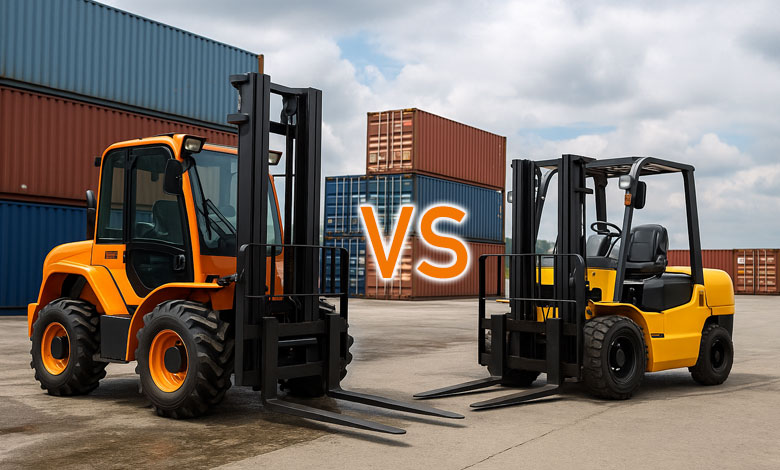
Buyer Assumption Vs Real Outdoor Work
Here is the difference I often see during early discussions.
| Buyer Assumption | What I Usually Check |
|---|---|
| "The pallet is not very heavy." | Is the pallet stable, wide, wet, loose, or far from the mast? |
| "The yard is almost flat." | What happens after rain and truck traffic? |
| "A normal forklift can work outside sometimes." | How often is "sometimes," and on what ground? |
| "The route is short." | Is it smooth, or does the forklift cross ruts, gravel, or slopes? |
| "We only load trucks." | What is the truck height, approach angle, and turning space? |
| "The operator can handle it." | Is the operator trained for outdoor loaded travel and inspection? |
This is not about making the selection complicated.
It is about preventing the wrong machine from arriving at the site.
What I Recommend Before Order
Before an outdoor yard buyer confirms a forklift, I recommend preparing a small working-condition package.
It should include:
- 3 to 5 photos of the yard surface
- 1 short video of the loaded travel route
- pallet dimensions and maximum load weight
- truck loading height
- required lifting height
- daily working hours
- rainy-season or dusty-season conditions
- turning area photos
- maintenance and spare parts expectations
- any attachment requirement
With this information, a supplier can give a much better recommendation.
Without it, the buyer may receive a forklift that looks fine on paper but feels wrong from the first week.
This is also why I do not like rushing the quote stage. A few extra questions before order can save many service questions after delivery.
Final Thought
An indoor warehouse forklift and an outdoor yard forklift may both lift pallets, but they do not solve the same problem.
Inside, the floor helps the machine.
Outside, the ground challenges the machine.
So if your forklift needs to work in a construction yard, container yard, brick yard, farm, plantation, stone yard, mining support area, or mixed outdoor warehouse, do not choose only by rated capacity.
Send the real working condition first.
If you are not sure whether a standard forklift, 4WD forklift, or rough terrain forklift is the better fit, you can send us your working condition. I would rather help check the route, load, ground, and configuration early than solve the wrong-machine problem after shipment.