
A yard full of bricks, blocks, steel, and cement bags is rarely as simple as it looks on a quotation.
From the buyer side, the request often sounds straightforward: "We need a forklift for building materials." But from the supplier side, I usually need to slow the conversation down before recommending a model.
Building materials are not one type of load. A pallet of cement bags, a stack of concrete blocks, bundled rebar, long timber, stone slabs, steel pipe, roof panels, and mixed project cargo can all create different problems for the same forklift. The machine may have enough rated capacity on paper, but still feel unstable, slow, hard to steer, or expensive to maintain once it starts working on a real yard.
That is why I do not like choosing a forklift only by tonnage for building material yards. The better question is: what materials are being moved, across what route, with what pallet condition, and how often each day?
The First Question Is Not Tonnage
Rated capacity matters, of course. But in building material work, capacity is only the beginning.
I have seen buyers compare forklifts by asking whether a machine can lift 3 tons, 5 tons, or 7 tons. That question is useful, but incomplete. A compact pallet of cement bags is different from a wide pallet of concrete blocks. A bundled pipe load is different from a square pallet. A short move on flat concrete is different from a 120 meter route across dirt, gravel, broken pavement, and rainwater.
Before I recommend a rough terrain forklift, I usually want to understand:
- the maximum load weight;
- the load size and load center;
- whether the load is palletized, bundled, loose, wrapped, or clamped;
- the route surface;
- the travel distance per trip;
- the turning space near loading and unloading points;
- the required lift height;
- whether the same forklift must work inside a warehouse as well as outside;
- the daily working hours;
- the spare parts and maintenance plan after delivery.
Those details decide whether a buyer needs a standard industrial forklift, a rough terrain forklift, a heavier 4WD model, special forks, a side shifter, a fork positioner, or another attachment discussion.
A Typical Building Material Yard Inquiry
A common inquiry starts like this: a dealer or project buyer wants one forklift for a construction material yard. The machine needs to unload trucks, move bricks and cement, carry steel bars, and sometimes send materials closer to a building site.
At first, the buyer may ask for a simple 3 ton or 5 ton forklift. After a few questions, the real work becomes clearer.
The yard is partly compacted soil and partly broken concrete. During dry weather, a standard forklift can move slowly in some areas. After rain, the route becomes soft near the storage area. Some pallets are stable, but some brick pallets are rough, uneven, or damaged. The buyer also wants longer forks for wider loads, but the load center has not been checked yet.
In that situation, the forklift itself is not the only issue. The buyer needs to review route preparation, fork length, pallet condition, tire type, ground clearance, turning area, and whether the selected capacity still makes sense after the attachment and load center are considered.
This is why building material yards can create disappointment when the selection is made too quickly. The forklift may be "strong enough" in a brochure, but not matched to the real work.
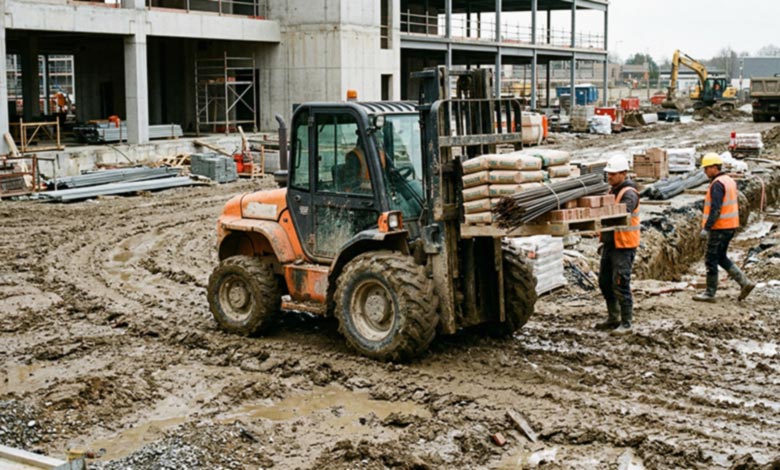
Separate The Load Types Before Choosing The Forklift
For building material buyers, I like to separate the work into load groups first.
Palletized cement bags are usually compact, but the pallet condition matters. If the pallet is weak, wet, broken, or overloaded, the forklift driver may need to approach slowly and keep the load low.
Concrete blocks and bricks can be heavy for their size. The load may look neat when wrapped, but the bottom pallet may not always be strong. If the forklift route is rough, the load can shift or crack if the machine bounces too much.
Steel rebar, pipes, and timber create another issue: length. The machine may lift the weight, but turning space, fork length, load balance, and visibility become more important than the rated capacity alone.
Stone slabs or heavy blocks may need clamps, special forks, or a different handling method. I am careful with this part, because attachment choice changes the load center and can affect usable capacity.
Mixed project cargo is the hardest group. If a buyer says, "We move everything," I normally ask for photos or videos. One forklift can cover many jobs, but it should not be selected blindly for every possible material.
Pallets, Bricks, And Blocks Punish The Wrong Machine
Building materials are not gentle on forklifts.
Dust enters small gaps. Mud builds around tires. Broken brick chips and sharp gravel punish the route. Uneven pallets make loads sit badly on the forks. Operators may drive across temporary paths because the yard changes every week.
For a local buyer, these problems may only slow the work. For an overseas buyer, they can become a bigger issue. If the machine is far from the supplier, a small part, damaged tire, poor maintenance access, or wrong attachment can stop the whole material flow.
This is one reason I prefer to discuss maintenance and spare parts early. It is not an after-sales topic only. It is part of the buying decision.
Long Steel, Pipe, And Timber Need A Different Discussion
Long materials are a common reason buyers feel the forklift is less stable than expected.
The load may not be extremely heavy, but it is long, flexible, or difficult to keep centered. This can affect turning, visibility, and safety around workers. Longer forks may help for some loads, but they also change load center and handling behavior.
If the buyer handles steel pipe, timber, scaffolding material, or long bundles every day, I usually ask:
- How long is the longest load?
- Is it lifted from one side or from the center?
- Is the load bundled tightly?
- Does the forklift need to turn inside a narrow yard?
- Will the load be placed on racks, trucks, or ground storage?
- Does the operator need a side shifter or fork-positioning function?
For related attachment decisions, this guide is useful: side shifter, fork positioner, or standard forks.
Ground And Route Decide More Than Many Buyers Expect
In many building material yards, the route is not one surface.
There may be concrete near the warehouse, gravel near the storage area, dirt around new buildings, soft spots after rain, and broken pavement near truck loading points. This mixed route is where standard warehouse forklifts often struggle.
For this kind of work, 4WD traction, tire choice, ground clearance, and steering layout become more important. They do not make every bad route safe, and they do not replace basic site preparation, but they can make the machine more suitable for outdoor work than a warehouse forklift.
The construction-site route checklist is related here, because many building material yards fail at the route level before they fail at the forklift level.
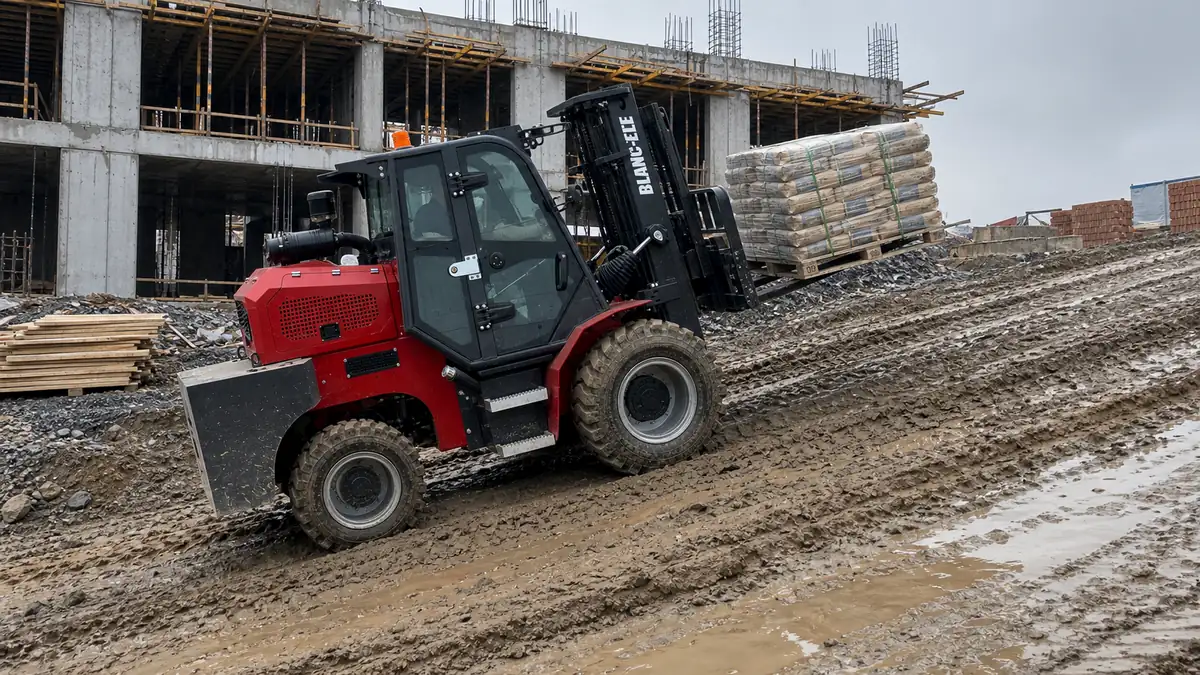
When A 5 Ton Rough Terrain Forklift Starts To Make Sense
For many building material yards, a 5 ton class rough terrain forklift becomes worth comparing when the loads are heavier, the route is mixed, and the buyer does not want the machine working at its limit every day.
The BLANC-ELE RT50 5 ton 4WD rough terrain forklift page lists 5,000 kg rated capacity, 4WD traction, 330 mm minimum ground clearance, and mast options from 3 m to 6 m according to the selected configuration.
Those figures are useful, but they should not be read alone. In real work, load center, mast height, attachment, route condition, and operator practice all affect how suitable the machine is.
A 5 ton model may be considered when the buyer regularly handles:
- palletized cement or blocks;
- heavier outdoor material loads;
- mixed yard routes;
- construction-site supply work;
- outdoor loading and unloading where a standard forklift struggles with the surface.
But if the buyer handles very heavy stone, oversized loads, long steel, or special attachments, I would rather review the full job before assuming 5 tons is enough.
When A 7 Ton Class Machine Should Be Compared
Some building material yards need more reserve capacity because the loads are heavy, the route is rough, or the forklift must work with large attachments.
The BLANC-ELE RT70 7 ton 4WD rough terrain forklift page lists a 7,000 kg rated capacity class, 4WD traction, 330 mm ground clearance, and 4,000 mm standard lift height. It also notes that the final specification should be confirmed according to chassis, steering layout, engine, mast, and destination-market requirements.
For building materials, I normally compare a 7 ton class machine when:
- the load is heavy and frequent;
- the buyer wants more reserve capacity;
- stone, large blocks, or dense materials are common;
- an attachment will move the load center forward;
- the route is rough enough that stability and machine weight become important;
- the buyer is buying for a fleet, rental yard, or dealer customer group with varied jobs.
Again, the goal is not to recommend the biggest forklift every time. The goal is to avoid under-selecting a machine that will spend its life overloaded, slow, or unstable.
Attachments Should Be Chosen With The Load, Not After Delivery
Attachments are often discussed too late.
For building materials, the most common questions involve longer forks, fork extensions, side shift, fork positioning, clamps, and sometimes bucket-style handling for loose material. Each option can be useful, but each option also changes how the forklift behaves.
Longer forks can help support wide pallets, but they may increase the load center. A side shifter can save time near trucks and storage rows, but it still needs to match the load and mast. A clamp can be useful for some stone or block work, but it must be reviewed carefully because it is not suitable for every load.
My practical rule is simple: send the load photo before choosing the attachment.
If the buyer only says "standard forks are fine," but later the actual job includes wide pallets, unstable blocks, or long steel, the forklift may arrive with the wrong setup.
Maintenance Access Matters In Dusty Material Yards
Building material yards are hard on machines. Dust, mud, cement residue, gravel, and stop-start operation all make maintenance more important.
I usually ask buyers how they plan to handle:
- daily inspection;
- tire wear;
- filter replacement;
- hydraulic hose checks;
- grease points;
- brake and steering checks;
- spare parts storage;
- operator training;
- remote support communication.
For export buyers, I also recommend confirming a basic spare-parts package with the machine when the site is remote. A filter, hose, seal, sensor, tire issue, or small wear part can create more downtime than buyers expect.
This does not mean the buyer needs to overbuy parts. It means the buyer should know which parts are likely to stop work if they are not available locally.
What I Ask Buyers To Send Before Recommending A Configuration
If a buyer wants a serious recommendation for building material handling, I normally ask for a few simple details first.
The most useful information is:
- photos or videos of the yard route;
- maximum load weight;
- load dimensions;
- pallet size and pallet condition;
- the heaviest daily material type;
- the longest material type;
- lift height requirement;
- truck loading height;
- route distance per trip;
- slope or soft-ground areas;
- expected working hours per day;
- destination country or port;
- whether the buyer wants one unit, dealer stock, or fleet purchase.
This information is often enough to decide whether the buyer should compare a standard forklift, a 5 ton rough terrain forklift, a 7 ton class rough terrain forklift, or a more specialized material-handling solution.
My Practical View
A forklift for building materials should be selected from the yard backward, not from the catalog forward.
Start with the material. Then check the pallet, route, load center, turning space, lift height, attachment, maintenance plan, and spare parts. Only after that does the rated capacity become meaningful.
For dealers, importers, construction companies, and building material yards, this approach also makes the inquiry clearer. Instead of asking for a general forklift, the buyer can ask for a configuration that matches bricks, blocks, cement, steel, stone, or mixed construction materials.
That usually leads to a better quotation, fewer misunderstandings before shipment, and a machine that is closer to the real job when it arrives.