
A lower purchase price does not automatically mean lower total risk, and a new machine is not automatically the correct machine for every buyer. When an overseas buyer compares a new and used rough terrain forklift, the useful question is: which option provides enough evidence for this exact load, site, destination and ownership plan?
Short Answer: Compare Evidence Before Condition Labels
A used rough terrain forklift can be reasonable when the buyer can inspect the actual machine, verify its hours and service history, confirm the data plate and load chart, test it under a representative load, and obtain parts support for its exact serial number. A new machine is usually easier to specify when the buyer needs a defined mast, forks, attachment, engine configuration, current documentation and repeatable units for a fleet. In either case, "new" or "used" is only a condition label. The decision should follow verified configuration, condition, safety information, import requirements and the cost of correcting gaps after delivery.
Why Overseas Buyers Ask This Question
We see both sides of the decision in real inquiries. One buyer asked BLANC-ELE for used 4x4 forklifts. Another procurement request explicitly required a new genuine-OEM machine rather than a refurbished or reconditioned unit. These requests do not prove that one choice is universally better. They show that condition and traceability can be part of the buying requirement, not just a price discussion.
BLANC-ELE manufactures and supplies new diesel 4WD rough terrain forklifts. We do not present this article as an inspection certificate for a used machine or as a promise that every new machine fits every job. The purpose is to show what an importer, dealer or fleet buyer should make comparable before choosing.
Start With the Work, Not the Asking Price
Before comparing machines, define the application in the same format for both options:
- maximum load weight and load dimensions;
- load center and weight distribution;
- required lift height and mast type;
- fork length, fork section and attachment;
- ground condition, gradients, turning space and access width;
- daily duty pattern and expected operating environment;
- destination country and engine or emission requirements;
- shipping, unloading and receiving constraints;
- local maintenance capability and parts plan.
If the two machines are not suitable for the same work, their purchase prices are not a valid comparison. A low-cost unit that needs a different mast, new tyres or an unavailable attachment may be a different procurement project.
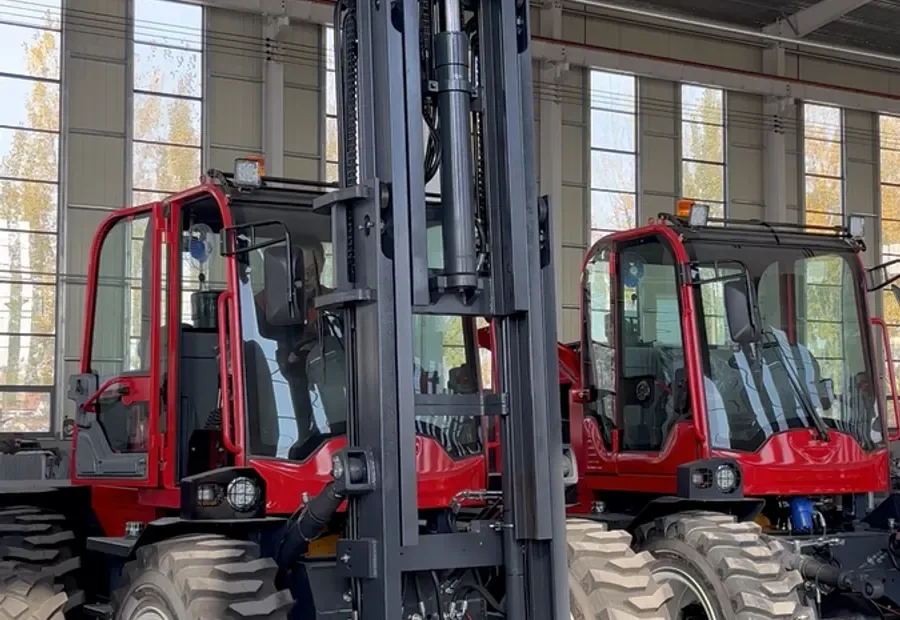
Real BLANC-ELE rough terrain forklifts in the factory. For a new-machine order, the buyer should connect the quoted configuration to the production and pre-shipment evidence for the actual unit.
Use This Eight-Part New-vs-Used Evidence Matrix
Use the following as a buyer decision tool, not as a substitute for a competent local inspection.
- Identity - For a used machine, verify the serial number, model, year, data plate and seller ownership. For a new machine, verify the exact model, manufacturer, quotation configuration and final machine identity.
- Operating record - For a used machine, request the meter reading, service logs, repair history and previous application. For a new machine, request production and pre-shipment records for the ordered configuration.
- Capacity basis - For a used machine, confirm that legible capacity information matches the fitted mast, forks and attachment. For a new machine, confirm the capacity information for the final mast, forks, attachment and load center.
- Physical condition - For a used machine, inspect the forks, mast, chains, carriage, hydraulics, leaks, chassis, steering, brakes and tyres. For a new machine, verify assembly condition, option installation, fluid checks and pre-shipment inspection evidence.
- Functional test - For a used machine, request a cold start plus safe steering, braking, lifting, tilting, attachment and representative-load checks. For a new machine, request a function test and configuration confirmation before shipment.
- Engine and compliance - For a used machine, verify engine identity, age, condition, available records and destination eligibility. For a new machine, confirm the engine model and emission configuration quoted for the destination market.
- Parts and documents - For a used machine, identify serial-specific manuals, parts and a local supply route. For a new machine, confirm current manuals, parts information and recommended shipment spares where agreed.
- Commercial record - For a used machine, record sale terms, exclusions, inspection findings and accepted defects. For a new machine, reconcile the final quotation, configuration schedule, warranty and spare-parts terms in the sales contract.
Any blank cell is not automatically a rejection. It is a risk item that needs a cost, an owner and a decision before payment.
Used Machines Need Unit-Specific Evidence
A used listing describes one existing machine. Its actual condition matters more than a generic model brochure.
First, reconcile the serial number and data plate with the invoice, photos and inspection report. OSHA's powered industrial truck guidance notes that the nameplate contains information such as truck weight and capacity, and that an attachment must be reflected in the capacity information. A missing or unreadable plate is therefore not a cosmetic detail.
Second, treat the hour meter as one input, not a complete history. Ask for dated service records, major repair records and evidence that the meter belongs to the machine being offered. If the records are incomplete, price and plan the uncertainty rather than describing the history as verified.
Third, arrange an independent inspection when the value and logistics justify it. The inspector should examine the actual unit, document defects and operate it safely. OSHA's pre-operation guidance includes fluid levels, leaks, visible defects, hydraulic hoses, mast chains, tyres, forks, safety decals and nameplates among the items to check. A buyer's inspection should also confirm the functions and load conditions relevant to the planned job.
Do not ask an untrained person to perform a risky demonstration. A representative load test must be planned and conducted by competent personnel within the machine's stated capacity and site rules.
New Machines Still Need Configuration Proof
New condition removes some history questions, but it does not remove the need to specify the machine correctly.
A quotation should identify the model, rated capacity and load center, lift height, mast, fork dimensions, attachment, tyre arrangement, cabin or canopy, engine and other options that matter to the work. If the order changes, the final configuration and applicable capacity information should be reconfirmed.
For an export order, ask the supplier to connect three records:
- the signed quotation or contract configuration;
- photos, videos or inspection records for the actual machine before shipment;
- the packing, shipping and receiving information used to identify the delivered unit.
Emission configurations are quoted according to destination-market requirements. Do not assume that a model name or engine brand alone proves eligibility for a particular market.
Compare the Cost of Closing Evidence Gaps
Purchase price is only one line. The useful comparison is the cost and consequence of closing each gap.
For a used machine, this may include inspection, transport to the inspection point, repairs, tyres, hoses, forks, missing documents, parts identification and downtime before the unit can enter service. For a new machine, it may include optional equipment, destination-specific engine requirements, spare-parts planning, shipping and commissioning preparation.
Do not invent a fixed percentage for these items. Their impact depends on the exact unit, destination, job and local service capability. Put each known gap in the comparison sheet with one of four statuses: verified, costed, contract condition or unresolved.
When a Used Machine May Be Reasonable
A used rough terrain forklift may fit when:
- the buyer can inspect the actual unit before committing;
- its configuration already matches the load and site;
- records and capacity information are legible and consistent;
- parts for the exact model and serial range are obtainable;
- the buyer has local repair capability;
- the condition risks and corrective work are accepted in writing.
This is a procurement judgment, not a guarantee of condition or remaining life.
When a New Machine May Be Easier to Control
A new rough terrain forklift may be the more controllable route when:
- the mast, forks, attachment or cabin must be specified for the job;
- the destination requires a defined engine or emission configuration;
- the buyer wants current production and pre-shipment records;
- a dealer or fleet needs repeatable units rather than one-off condition;
- serial-specific parts and document handover must be arranged with the order;
- remote import makes pre-purchase inspection of a used unit difficult.
New condition still does not excuse a poor application match. Capacity, load center, lift height, attachment and route conditions must be checked before the model is selected.
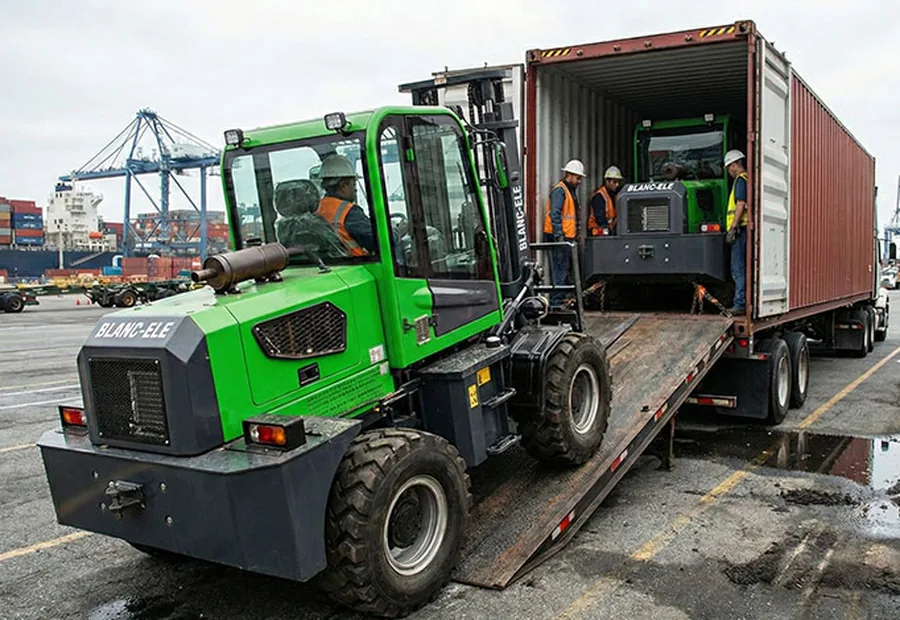
A real BLANC-ELE machine during export preparation. Shipping evidence should connect the ordered configuration to the machine the buyer will receive.
What to Send for a New-Machine Recommendation
If the controlled-configuration route fits your project, review the 3.5 ton 4WD rough terrain forklift, 5 ton rough terrain forklift and 7 ton 4WD rough terrain forklift after the job inputs are defined.
Send the load weight and dimensions, lift height, fork and attachment requirements, ground conditions, gradients, access limits, destination and expected quantity. Our rough terrain forklift quotation checklist explains the inputs that reduce back-and-forth.
Request an FOB or CIF quotation from BLANC-ELE. We will recommend a new diesel 4WD configuration based on the stated application and confirm the commercial, warranty and spare-parts arrangements in the formal quotation and sales contract.
References
- BLANC-ELE anonymized inquiry archive, new-machine quotations, product source sheets and real factory/export image archive, reviewed October 20, 2026.
- OSHA Powered Industrial Trucks eTool: Nameplate.
- OSHA Powered Industrial Trucks eTool: Pre-Operation Inspection.
Last reviewed: October 20, 2026.