
When buyers ask me about forklifts for construction sites, many of them start with a simple question:
"Can this forklift work on mud?"
That question sounds simple, but the real answer is not only about whether the forklift has 4WD.
Rainy-season construction sites are different from dry outdoor yards. The same road can be firm in the morning, soft after one hour of rain, and deeply rutted after trucks pass through it all day. A forklift that feels acceptable on dry ground may start slipping, sinking, or struggling once the site becomes wet.
So when I help an overseas buyer choose a rough terrain forklift for a rainy construction site, I do not only ask for rated capacity.
I ask about the road, the load, the slope, the tire, the turning area, the lifting height, and how the machine will be supported after delivery.
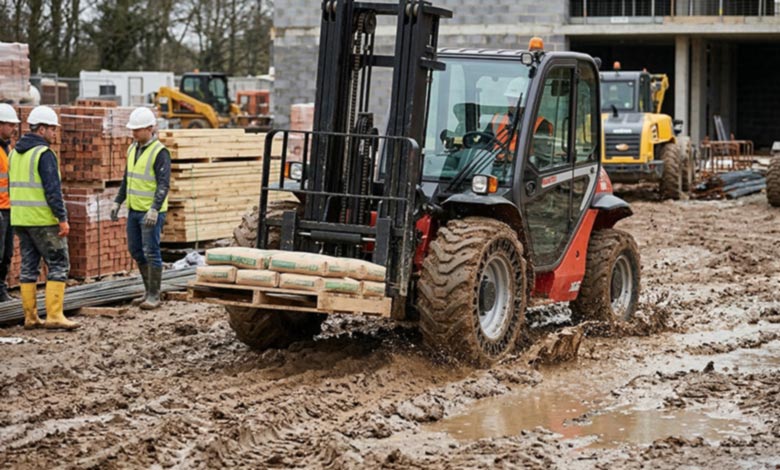
If the site already has mud and soft ground problems, you may also find this related article useful: why standard forklifts get stuck in mud.
Why Rainy-Season Construction Sites Need A Different Selection Method
On paper, a buyer may only compare:
- Rated load
- Engine power
- 2WD or 4WD
- Lifting height
- Delivery time
Those details matter.
But on a rainy construction site, the bigger question is:
"Can the forklift keep working with enough traction, stability, and working margin when the ground changes?"
Rain can change everything:
- Soil becomes soft.
- Gravel roads become uneven.
- Ruts become deeper.
- Slopes become more difficult.
- Operators need more time to turn and brake.
- Loads swing more easily when the machine moves over uneven ground.
This is why I usually tell buyers not to choose a construction-site forklift only from a clean product photo.
The forklift must match the real job site.
Start From The Route, Not The Forklift Model
Many buyers begin by asking:
"Do I need a 3 ton or 3.5 ton rough terrain forklift?"
That is a normal question, but I prefer to start one step earlier:
"Where will the forklift drive every day?"
The daily route often tells us more than the rated load.
Before choosing the model, confirm:
- Is the road concrete, compacted soil, sand, gravel, or mixed ground?
- Does water stay on the road after rain?
- Are there deep tire tracks from trucks?
- Does the forklift need to cross unfinished areas?
- Are there slopes near the loading point?
- Does the forklift need to turn with a load?
- Is the turning area narrow or open?
For outdoor construction work, the route is part of the machine selection.
A forklift may have enough rated capacity, but if the daily route is soft, narrow, or sloped, the wrong configuration can still create problems.
For a broader construction-use angle, see our article on how rough terrain forklifts improve efficiency on construction sites.
Dive Deeper: A Typical Rainy-Season Construction Case
A typical case looks like this.
At first, the buyer says:
"Our site is not too bad. It is just an outdoor construction site."
But after asking more questions, the site condition becomes clearer:
- The project is in a rainy region.
- The road is compacted soil, not concrete.
- Trucks enter the site every day and leave deep tracks.
- The forklift needs to move palletized materials from the unloading point to different work areas.
- Some parts of the route have a slight slope.
- The operator sometimes needs to turn while carrying a load.
In this situation, the forklift is not only lifting.
It is dealing with traction, soft soil, uneven ground, slope, load movement, and operator control at the same time.
The buyer may think the answer is simply:
"Use 4WD."
But 4WD is only one part of the answer.
The real selection should also consider tire pattern, ground clearance, load center, mast height, turning space, maintenance access, and whether the operator has a practical route to follow during rain.
What Looks Fine Before Rain And What Appears Later
| Before rain | During rainy-season operation |
|---|---|
| The road looks firm | The surface becomes soft after repeated truck movement |
| The load is within rated capacity | Soft ground increases working difficulty |
| The forklift can drive during a short test | Long working hours expose traction and cooling problems |
| The route looks wide enough | Turning with a load becomes harder in mud |
| Standard tires seem acceptable | Tire pattern becomes a daily performance issue |
| The slope looks mild | Braking, steering, and load control become more sensitive |
This is why I prefer seeing site photos or videos before recommending a model.
Short videos of the actual route are especially useful. They show the supplier whether the forklift is working on firm ground, loose soil, gravel, mud, or mixed terrain.
4WD Helps, But It Is Not A Magic Solution
For rainy construction sites, 4WD is often a better direction than a normal warehouse forklift.
But I do not like saying:
"4WD solves everything."
It does not.
4WD can improve traction, but the forklift still depends on:
- Tire pattern
- Ground clearance
- Weight distribution
- Load center
- Operator speed
- Turning method
- Road preparation
- Maintenance condition
If the ground is too soft, even a 4WD forklift can sink or struggle.
If the load center is too far forward, the machine can become harder to control.
If the operator turns too quickly on a wet slope, the risk increases.
So the correct question is not:
"Is it 4WD?"
The better question is:
"Is the whole configuration suitable for this rainy job site?"
If you are comparing different drive systems, remember that the drive type should be judged together with tire, route, load, and ground condition.
Tire Choice Becomes More Important In Wet Ground
Tires are one of the easiest details to underestimate.
On dry ground, many tire differences are not obvious to the buyer.
In rain and mud, the difference becomes clear very quickly.
For rainy construction sites, tire selection should consider:
- Traction on wet soil
- Self-cleaning ability of tread pattern
- Resistance to cuts from stones or construction debris
- Ground pressure
- Mixed use on soil, gravel, and hard road
- Availability of replacement tires in the buyer's market
The wrong tire may still work on the first day.
But after several weeks of rain, the buyer may see the real problem:
- More slipping
- More rutting
- More fuel consumption
- More operator fatigue
- More time lost during material handling
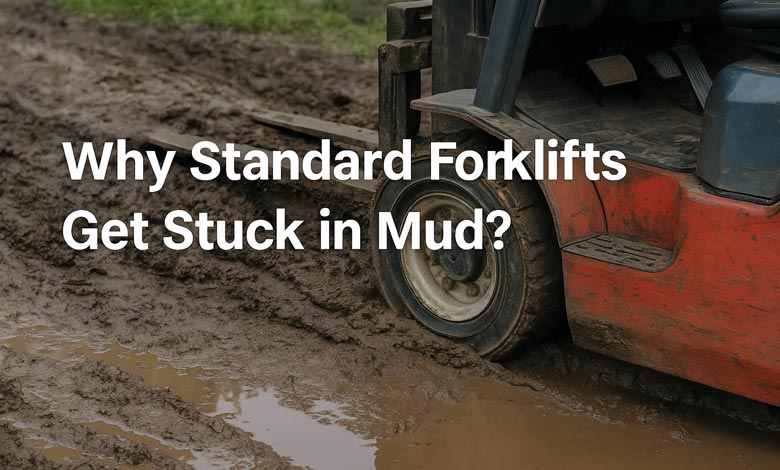
This is why tire discussion should happen before shipping, not after the forklift arrives.
Check Load Weight And Load Center In Real Conditions
Many buyers say:
"My load is about 3 tons."
That may be true, but for rainy construction sites, I want to know more:
- What is the normal daily load?
- What is the maximum load?
- Is the load long, wide, or uneven?
- Is the load center close to the mast or far forward?
- Will the buyer use long forks?
- Will attachments be used later?
Wet ground makes the forklift's job harder. A load that is acceptable on firm concrete may feel very different when the machine is turning on uneven soil.
OSHA's forklift guidance also emphasizes that load size, weight distribution, and load center affect forklift capacity and stability. That is why the rated capacity should not be treated as the only selection point.
For buyers who are not sure about attachments or long forks, this guide may help: rough terrain forklift attachments and configurations.
Be Careful With Slopes, Ramps, And Turning Areas
Rainy construction sites often have small slopes that buyers do not mention at first.
Sometimes the slope is not part of the main job.
It is just near the unloading area, the storage area, or the temporary road.
But once the forklift carries a load, even a small incline can become important.
Before choosing the forklift, confirm:
- Does the route include slopes or ramps?
- Is the slope straight or does the operator need to turn?
- Is the slope compacted, gravel, or soil?
- Does rainwater flow across the route?
- Will the forklift carry loads uphill or downhill?
- Is there enough space to turn before entering the slope?
For slope-related work, buyers should avoid absolute thinking.
Do not ask only:
"What slope can this forklift handle?"
Ask:
"What slope can it handle with my load, my ground condition, my tire, and my operator's daily route?"
For more on this topic, see how to work safely with a forklift on inclined surfaces.
Ground Clearance And Undercarriage Protection Matter More Than Buyers Expect
In rainy construction sites, the forklift may need to pass:
- Ruts
- Stones
- Temporary steel plates
- Small piles of soil
- Uneven transitions between road sections
- Drainage channels or broken ground
If the forklift has poor ground clearance for the route, it may scrape the underside or get stuck more often.
But higher ground clearance alone is not enough either.
The buyer should also think about stability, load height, tire size, steering control, and the actual route.
In my experience, the best result usually comes from matching the forklift to a prepared working route, not forcing the machine to solve every site problem by itself.
Do Not Ignore Mast Height And Site Access
Rainy-season construction buyers often focus on traction.
That is understandable.
But the forklift still needs to enter the work area, lift to the required height, and handle materials safely.
Before production, confirm:
- Maximum lifting height
- Mast lowered height
- Site entrance height
- Temporary shed or warehouse clearance
- Truck loading height
- Container loading or unloading plan
- Turning radius near storage zones
For example, if the machine needs to unload materials from trucks and then enter a low temporary warehouse, mast selection becomes important.
If the buyer only talks about mud and 4WD, they may forget the height problem until the machine arrives.
For buyers comparing different capacity ranges, final mast and dimension details should always be confirmed from the specification sheet before order.
Operator Habits Can Decide Whether The Machine Performs Well
Even with the right forklift, operator habits matter a lot in rainy conditions.
On wet ground, operators should avoid:
- Fast turning with a load
- Sudden braking
- Driving with the load raised
- Turning on a slope
- Entering deep mud without checking the route
- Using the forklift as if it were on dry concrete
Good rainy-season operation is usually slower, smoother, and more planned.
The route should be checked.
The load should be kept low during travel.
The operator should understand where the ground becomes soft after rain.
The site team should also decide when the road needs repair or temporary reinforcement. A forklift is a working machine, not a replacement for basic site preparation.
Maintenance Planning Is Part Of Rainy-Season Selection
Wet construction sites are harder on machines.
Mud, water, and construction debris can create daily maintenance pressure.
Before ordering, buyers should ask about:
- Daily inspection points
- Grease points
- Air filter and fuel filter access
- Brake inspection
- Tire inspection
- Hydraulic hose inspection
- Electrical protection and cleaning precautions
- Common spare parts
- Remote support and parts identification
This matters more for overseas buyers because the supplier is far away.
Small issues should be handled early. If the operator ignores mud buildup, leaking hoses, loose pins, or dirty filters, downtime can grow quickly.
For overseas buyers, this maintenance planning is part of choosing the right machine, not something to think about only after the forklift arrives.
A Practical Selection Checklist For Rainy Construction Sites
| What to confirm | Why it matters |
|---|---|
| Ground type | Soil, gravel, sand, and mixed roads need different expectations |
| Rainy-season road condition | Dry photos may not show the real working problem |
| Load weight and load center | A forward or irregular load changes handling |
| Tire pattern | Wet soil and mud make tire choice more important |
| 4WD configuration | Helps traction, but must be matched with tire and route |
| Ground clearance | Important for ruts, stones, and uneven temporary roads |
| Slope and turning route | Rain makes slope work more sensitive |
| Mast height | Prevents site-access and lifting-height problems |
| Attachment needs | Buckets, clamps, long forks, or side shift can change capacity and handling |
| Spare parts plan | Helps overseas buyers reduce downtime later |
What Information Should You Send Before Asking For A Recommendation?
If you want a more accurate recommendation, send these details before choosing the forklift:
- Country and job-site location
- Rainy season duration if known
- Ground photos in dry and wet conditions
- Short video of the forklift route
- Maximum load and normal daily load
- Load dimensions
- Required lifting height
- Slope or ramp details
- Turning area photos
- Tire preference if known
- Attachment requirements
- Working hours per day
- Destination port and emission requirement if known
You can also start from the BLANC-ELE rough terrain forklift range and then send us your working condition for configuration advice.
Conclusion
Choosing a rough terrain forklift for a rainy-season construction site is not only about choosing 4WD.
The real decision should include ground condition, road route, tire pattern, load center, mast height, slope, turning space, operator habits, and maintenance support.
After working with more outdoor forklift buyers, I have learned that many rainy-site problems can be avoided before production if the buyer and supplier discuss the real conditions clearly.
If your construction site has mud, slopes, soft soil, or long rainy seasons, send BLANC-ELE your site photos, route video, load details, lifting height, and destination country. We will help you check the suitable rough terrain forklift configuration before order.
About This Guide
This guide was prepared from BLANC-ELE's supplier-side experience with overseas rough terrain forklift buyers, construction-site applications, and configuration discussions. Product specifications and final configuration should always be confirmed with the final BLANC-ELE specification sheet before order.
Last reviewed: May 28, 2026.
References
- OSHA, Powered Industrial Trucks: https://www.osha.gov/powered-industrial-trucks
- OSHA eTool, Powered Industrial Trucks - Ramps and Grades: https://www.osha.gov/etools/powered-industrial-trucks/workplace/ramps-grades
- OSHA eTool, Powered Industrial Trucks - Traveling and Maneuvering: https://www.osha.gov/etools/powered-industrial-trucks/operating-forklift/traveling-maneuvering
- OSHA eTool, Powered Industrial Trucks - Load Composition: https://www.osha.gov/etools/powered-industrial-trucks/load-handling/load-composition
- BLANC-ELE rough terrain forklift product and specification documents. Final configuration should be confirmed before order.