
Port work can make a forklift look smaller than it is.
I do not mean the machine becomes weak.
I mean the job around the forklift is often bigger than the buyer first describes: longer routes, mixed cargo, rougher yard surfaces, truck waiting time, wet ground near loading areas, and pressure to keep moving when vessels, containers, or project cargo schedules change.
That is why I am careful when a buyer asks for a "forklift for port operations."
The right answer depends on what the forklift will actually do inside or near the port.
First, Define The Port Job Clearly
A rough terrain forklift is not a container handler.
If the buyer needs to lift loaded shipping containers, stack containers, or handle container rows like a reach stacker, that is a different equipment discussion.
But many port-side jobs are not container lifting. They are outdoor material-handling jobs around the port, such as:
- moving palletized cargo from storage yard to truck loading point
- handling construction materials, steel parts, pipes, spare parts, or project cargo
- supporting warehouse-to-yard transfer where the ground is not clean concrete
- moving cargo around customs yards, bonded warehouses, or temporary storage areas
- loading and unloading smaller cargo near containers, trailers, or open yards
- supporting contractors working inside a port project area
For those jobs, a rough terrain forklift may be worth comparing, especially when standard warehouse forklifts struggle with ground clearance, tires, traction, or outdoor routes.
The first step is not choosing a tonnage.
The first step is describing the work honestly.
A Typical Port-Side Inquiry
A common message from an overseas buyer sounds like this:
"We need a forklift for port operations. It will move pallets and heavy materials outdoors. The ground is partly concrete, partly gravel, and sometimes wet."
That sounds simple, but I usually slow the conversation down.
I ask:
- What exactly will the forklift lift?
- Is the cargo palletized, bundled, long, loose, wet, or uneven?
- What is the normal load weight and the heaviest load?
- How far does the forklift travel in one cycle?
- Is the route clean concrete, gravel, broken pavement, compacted soil, or mixed ground?
- Does the machine work near container doors, trailers, ramps, or narrow lanes?
- Is the work one shift, two shifts, or only during truck loading windows?
- Does the buyer need side shift, fork positioner, long forks, or another attachment?
Without those answers, the words "port operations" are too broad.
The forklift might be perfect for one port-side yard and wrong for another.
Do Not Buy Only By Rated Capacity
Port-side buyers often start with a capacity number.
That is understandable. Heavy cargo is visible. The tonnage feels like the most important decision.
But rated capacity alone can hide several problems:
- long loads can move the load center forward
- attachments add weight and change the real lifting discussion
- high lift height can reduce usable working margin
- soft or uneven ground can make the same load harder to handle
- tight lanes can make a large forklift slow or difficult to position
- repeated truck loading can punish tires, brakes, and operators
This is why I prefer to confirm load shape, route, and working pattern before recommending a model.
For many port-side yards, the decision is not simply "5 ton or 7 ton."
It is whether the forklift has enough reserve capacity for the real load, while still fitting the route, turning space, mast height, and maintenance situation.
When A 5 Ton Rough Terrain Forklift May Fit
A 5 ton class rough terrain forklift can be considered when the buyer handles heavier palletized materials, construction supplies, stone, block, timber, steel parts, or mixed outdoor cargo where a smaller forklift does not have enough working margin.
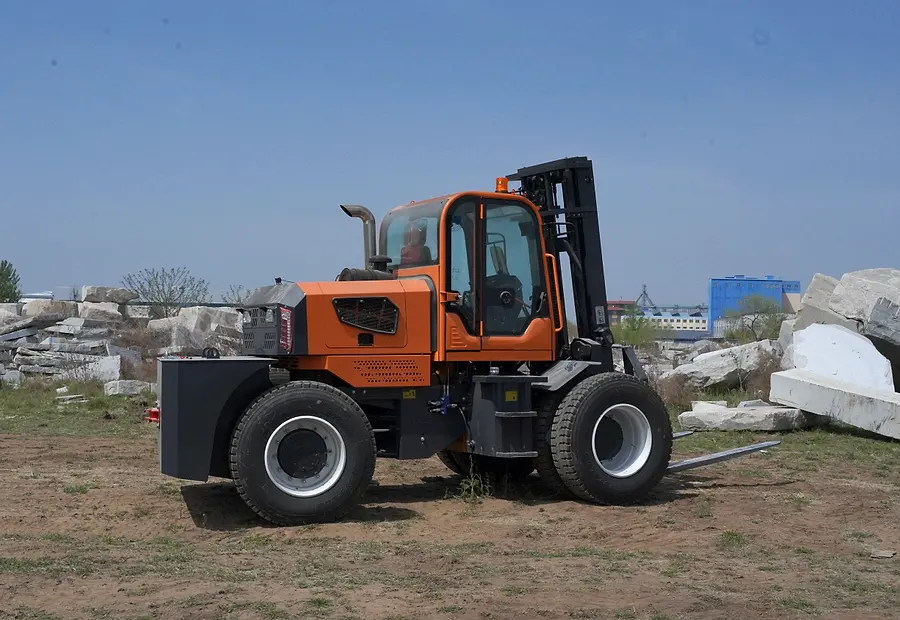
The BLANC-ELE RT50 5 ton 4WD rough terrain forklift page lists 5,000 kg rated capacity, 4WD traction, 330 mm minimum ground clearance, 3-6 m mast options, and rear-wheel or front-wheel steering choices.
Those facts are useful, but they still need to be checked against the job.
For example, a buyer may say the load is "around five tons." If the load is compact and stable, that is one discussion. If the load is long, uneven, lifted high, carried over broken pavement, or handled with an attachment, the supplier needs more detail before confirming the final recommendation.
In port-side work, reserve capacity and route condition often matter more than the first number in the inquiry.
When A 7 Ton Class Machine Should Be Compared
Some port-side buyers handle heavier project cargo, bundled materials, stone, machinery parts, or dense palletized goods. In those cases, a 7 ton class machine may need to be compared.
The BLANC-ELE RT70 7 ton 4WD rough terrain forklift page describes it as a 7 ton class 4WD rough terrain forklift. The page also lists 4WD traction, 330 mm minimum ground clearance, a 4,000 mm standard lift height, and other mast requirements such as 4.5 m, 5 m, and 6 m that can be reviewed according to the load and site.
For port-side jobs, that review matters.
A heavier machine can help when the cargo and duty cycle justify it, but the buyer should still confirm:
- turning width around trailers and storage lanes
- floor or ground condition near loading points
- mast lowered height if the forklift works near doors or covered areas
- attachment needs and residual capacity
- tire wear risk on mixed concrete, gravel, and broken pavement
- transport and shipping preparation
The correct model should match the job, not just the biggest cargo the buyer remembers.
Route Surface Is A Port-Side Detail Buyers Underestimate
Some port areas have clean paved roads.
Some do not.
The forklift may move from a concrete warehouse apron to gravel, wet ground, broken pavement, container-side lanes, or temporary storage surfaces. Even if the main road is good, the last 20 meters near the loading point can create the problem.
This is where a rough terrain forklift may make sense.
For outdoor port-side handling, I would check:
- surface type in the main route
- surface type at the pickup point
- surface type at the unloading point
- water accumulation after rain
- slope near ramps or loading docks
- holes, debris, steel plates, rails, or uneven transitions
- route width when trucks are parked
A forklift that feels stable on flat concrete may feel very different when the operator has to turn with a heavy load on rough ground.
For a related route-based discussion, this construction-site checklist may help: check the route and loading point before order.
Tire Choice And Ground Clearance Are Not Small Details
Port-side yards can be hard on tires.
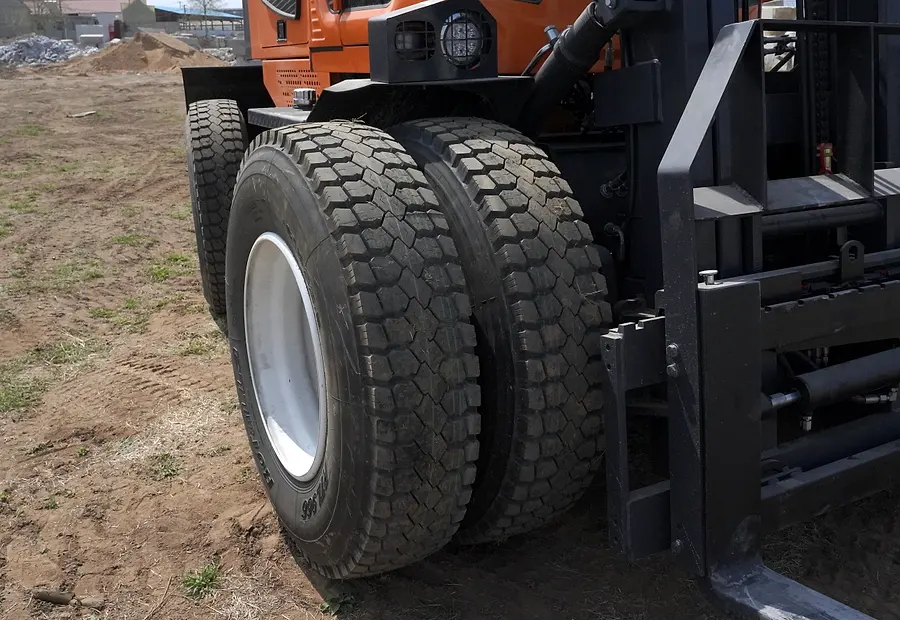
Even when the ground looks paved, the forklift may meet gravel, steel scraps, broken concrete edges, pallet nails, water, mud, or sharp debris. If the buyer only asks for rated capacity and ignores tires, the machine may arrive with the wrong expectation.
This is why I connect tire choice with the route.
Questions I like to ask include:
- Is the forklift mostly on concrete or mixed outdoor ground?
- Are there sharp materials, stones, steel pieces, or broken pallets on the route?
- Does the forklift need to cross wet or muddy areas?
- Are tires easy to service locally?
- Will the buyer keep spare tires or repair materials available?
Ground clearance also matters when the forklift moves through uneven transitions. It does not make the machine suitable for every surface, but it helps prevent the type of underbody contact that a warehouse forklift may face outdoors.
Attachments Should Be Discussed Early
Port-side handling often includes mixed cargo.
One day the forklift may move palletized goods. Another day it may handle long materials, machinery parts, crates, or irregular cargo. If the buyer later adds long forks, a side shift, fork positioner, clamp, or other attachment, the real load center and working capacity discussion can change.
That is why I do not like leaving attachments until the end.
Before choosing the forklift, confirm:
- normal fork length
- maximum cargo length
- pallet width range
- whether side shift is needed for truck loading
- whether fork positioner helps with different cargo sizes
- whether any clamp or special attachment is required
- whether the attachment changes visibility or route width
For a deeper attachment discussion, this guide may help: Side shifter, fork positioner, or standard forks.
Maintenance And Spare Parts Matter In Port Work
Port-side work can include long idle time, dust, water, salt air in some locations, heavy loads, and repeated start-stop movement.
I do not promise that one machine can ignore those conditions. No forklift should be treated that way.
Instead, I prefer to plan maintenance from the beginning.
For export buyers, I would discuss:
- air filter and fuel filter access
- oil, hydraulic, and cooling inspection routine
- tire wear and tire repair plan
- hoses, seals, belts, and common wear parts
- parts diagrams and remote support method
- operator daily inspection checklist
- recommended wear parts that can ship with the machine
If a forklift stops in a port-side yard, the buyer often loses more than repair time. Truck schedules, cargo movement, and customer delivery plans may all be affected.
That is why a practical spare parts plan belongs in the purchase discussion, not only after the first problem.
Information To Send Before Asking For A Recommendation
If you need a forklift for port operations or port-side outdoor yards, send more than a capacity number.
I would ask for:
| Information | Why it matters |
|---|---|
| Cargo type | Pallets, steel, stone, machinery parts, pipes, crates, or mixed cargo all behave differently |
| Normal and maximum load weight | Helps compare 5 ton and 7 ton class options |
| Load dimensions | Long or wide cargo changes load center and route planning |
| Route distance | Long cycles affect productivity, fuel planning, and operator fatigue |
| Ground condition | Concrete, gravel, wet ground, broken pavement, and slopes change the recommendation |
| Turning space | Port yards can become narrow when trailers and cargo are parked |
| Lift height | Confirms mast choice and residual capacity review |
| Attachment needs | Side shift, fork positioner, long forks, or clamps should be discussed early |
| Working hours | Helps judge duty cycle, maintenance, and spare parts planning |
| Destination port | Helps prepare configuration-based export quotation and shipping review |
Photos or videos of the route are especially useful.
One short video of the loading point can prevent a wrong recommendation.
My Practical View
A forklift for port operations should not be chosen from the word "port" alone.
Some jobs need a warehouse forklift. Some need a container handler or another dedicated machine. Some need a diesel 4WD rough terrain forklift because the work is outside, the route is mixed, the cargo is heavy, and the ground is not always clean or flat.
For BLANC-ELE buyers, I would first define the real job:
- what cargo is moved
- how heavy and large it is
- where the forklift travels
- how often it works
- whether the ground is clean or rough
- whether the route is tight or open
- whether attachments are needed
- how maintenance and spare parts will be handled
Only after that would I compare the 5 ton and 7 ton class rough terrain forklift options.
That approach may feel slower at the beginning, but it usually saves time later.
The goal is not to sell the largest forklift.
The goal is to choose a machine that fits the port-side job before the order is confirmed.