
A 5 ton rough terrain forklift is not simply a 3.5 ton machine with a larger capacity number. Start with the 3.5 ton class when the real load stays comfortably within its confirmed capacity, the route is tighter, transport size matters, and attachments or long load centers are limited. Compare the 5 ton class when loads are consistently heavier, the work involves dense construction or stone materials, or the buyer needs more capacity margin after the mast and attachment are defined. The final choice still depends on load dimensions, load center, lift height, attachment weight, ground condition and the approved capacity information for the final configuration.
This comparison is for dealers, importers, contractors and fleet buyers deciding whether a 3.5 ton model is enough or whether the site justifies moving to a 5 ton class machine. It uses representative BLANC-ELE RT35R and RT50R rear-wheel-steering configurations. Other steering, engine, mast and attachment choices can change the final specification.
The Useful Comparison Starts With More Than Rated Capacity
The visible difference is 1,500 kg of rated capacity: 3,500 kg for the RT35R and 5,000 kg for the RT50R representative configurations. That number matters, but it is not the complete buying decision.
The larger machine also changes overall size, operating weight, ground clearance, tyres and turning space. These differences affect site access, transport planning and the kind of outdoor route the buyer should prepare.
| Representative rear-wheel-steering configuration | RT35R 3.5 ton class | RT50R 5 ton class | Why it matters |
|---|---|---|---|
| Rated capacity | 3,500 kg | 5,000 kg | The nameplate difference is only the starting point. |
| Drive system | 4WD | 4WD | Both are intended for outdoor route discussions, but ground suitability still needs site review. |
| Operating weight | About 4,400 kg | About 5,700 kg | The larger machine places more demand on the route and transport plan. |
| Overall dimensions (L × W × H) | 3,700 × 1,800 × 2,450 mm | 3,900 × 2,080 × 2,650 mm | Width, height and access can decide the model before capacity does. |
| Minimum ground clearance | 240 mm | 330 mm | More clearance may help on rough routes, but it does not replace route preparation. |
| Turning radius | 3,600 mm | 3,900 mm | The 5 ton configuration needs more maneuvering room. |
| Standard lift height | 3,000 mm | 3,000 mm | A higher mast must be reviewed separately for lowered height and usable capacity. |
| Fork length | 1,220 mm | 1,220 mm | The same fork length does not mean the same load geometry or usable capacity. |
These figures come from the current BLANC-ELE RT35R technical sheet and the RT50 product/quotation specification records used for this review. They describe representative configurations, not a universal promise for every option.
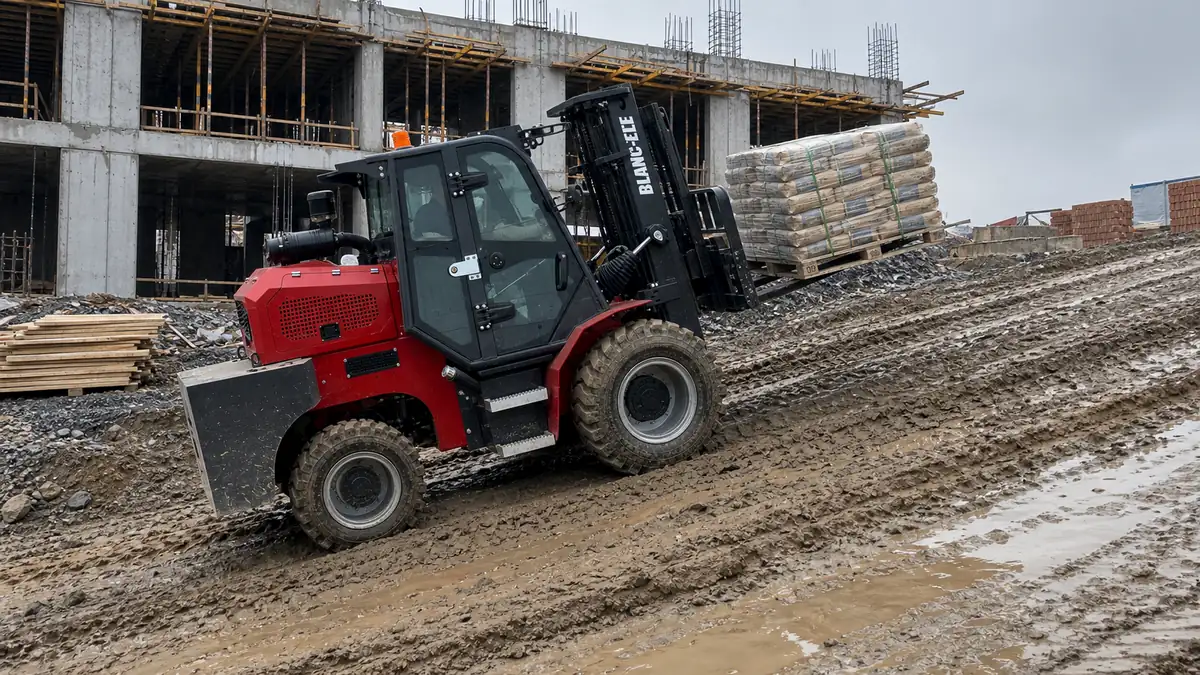
A real BLANC-ELE RT35R carrying palletized materials at an outdoor construction site. Load, route and final machine configuration should be confirmed before order.
Start With 3.5 Ton When The Job Is Controlled
The BLANC-ELE 3.5 ton rough terrain forklift can be a practical starting point when the buyer has a controlled load and a route that rewards a more compact machine.
The 3.5 ton class deserves serious consideration when:
- the heaviest regular load remains comfortably below the confirmed usable capacity;
- pallets are compact and the load center stays close to the mast;
- the buyer uses standard forks or a light attachment that has been reviewed by the supplier;
- yard gates, sheds, truck access or turning areas are limited;
- road transport, container preparation or unloading space favors a narrower and lighter machine;
- the machine will handle mixed farm, construction-supply or general outdoor-yard work rather than frequent heavy loads.
I would not choose it simply because the purchase cost is lower. I would choose it because the real work fits the machine with enough confirmed margin.
Compare 5 Ton When Heavy Work Is Regular, Not Occasional
The BLANC-ELE RT50 5 ton rough terrain forklift becomes the more relevant comparison when heavier handling is part of normal production.
That may include palletized blocks, dense building materials, stone-yard loads, heavy project cargo or a fleet buyer who repeatedly receives jobs above the comfortable range of a 3.5 ton model.
The 5 ton class should be compared when:
- the real load is often close to or above the 3.5 ton class boundary;
- the load is long, deep or irregular and moves the load center forward;
- a side shift, fork positioner, clamp, bucket or longer forks are planned;
- the required mast or lifting height needs a separate usable-capacity review;
- the route has enough width, turning room and surface support for the larger machine;
- the buyer prefers to standardize heavier jobs on one machine instead of frequently operating a smaller forklift near its limit.
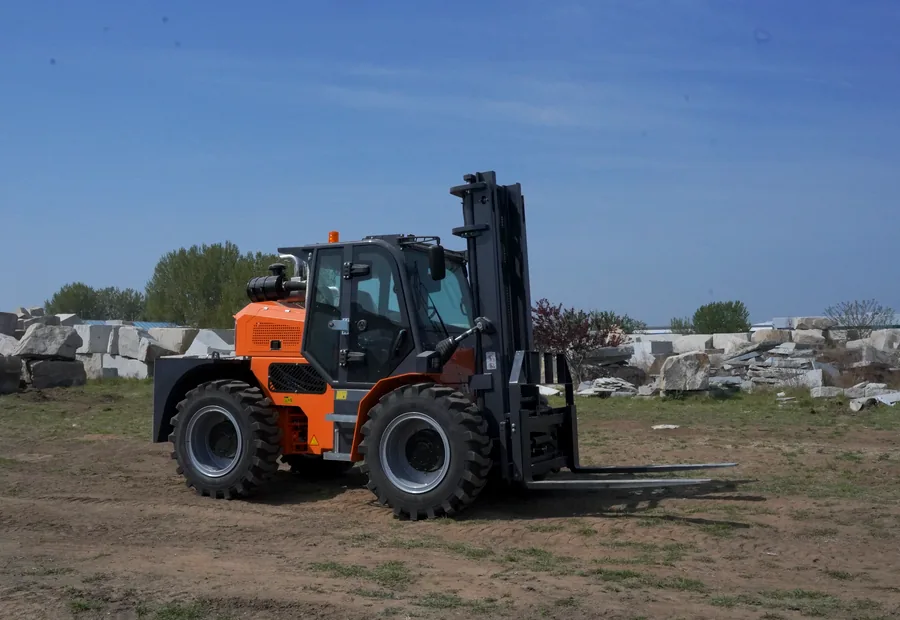
A real BLANC-ELE RT50R in an outdoor stone-yard setting. The larger chassis needs enough route width, turning room and ground support.
Load Center And Attachments Can Change The Answer
Rated capacity applies under defined conditions. A compact pallet close to the mast is different from long timber, steel, a deep crate or an attachment-mounted load.
Moving the load forward increases the load moment. Adding an attachment also introduces its own weight and can move the effective load center. A higher mast can create another capacity boundary. For that reason, this article does not publish a guessed residual-capacity number.
Before choosing between 3.5 ton and 5 ton, send the supplier:
- maximum real load weight;
- load length, width and height;
- how far the load center sits from the fork face;
- fork length;
- attachment type and attachment weight if known;
- required lift height;
- whether the load must be carried while traveling on uneven ground.
If attachments are part of the job, review our guide to forklift attachment planning before capacity selection. The final model and capacity should be confirmed with the approved specification, load information and attachment configuration.
Check Whether The Larger Machine Can Reach The Job
The representative RT50R is wider, taller and heavier than the RT35R. Those differences are commercially important.
A buyer may want more capacity but still have a 2.5 m doorway, a narrow loading lane, a light bridge, a tight truck approach or a soft yard edge. A larger forklift that cannot reach the loading point is not an upgrade.
Measure these points before confirming the order:
- Narrowest gate or passage width.
- Lowest overhead clearance along the full route.
- Turning area at pickup and drop-off points.
- Ramp width and edge clearance.
- Surface condition under the expected loaded machine weight.
- Truck, container or local transport limits.
- Available unloading method at destination.
The BLANC-ELE rough terrain forklift range provides the broader model path, but the final quotation should use the selected steering layout, mast, attachment and destination requirements rather than a generic catalog row.
A Simple Buyer Decision Matrix
Use this matrix to decide which quotation should be prepared first. It is a screening tool, not a substitute for the final capacity review.
| Buyer input | Start with 3.5 ton comparison | Add 5 ton comparison |
|---|---|---|
| Regular load weight | Comfortably within the confirmed 3.5 ton configuration | Repeatedly approaches or exceeds the smaller class boundary |
| Load shape | Compact pallet close to the mast | Long, deep, irregular or forward-positioned load |
| Attachments | Standard forks or reviewed light option | Heavier attachment, long forks, clamp, bucket or multi-function plan |
| Lift height | Standard or moderate height with confirmed capacity | Higher mast or heavy load at height needs more review |
| Route | Tight gate, limited turning space, controlled surface | Wider route and stronger ground can support the larger chassis |
| Duty pattern | Mixed lighter work with occasional peaks | Frequent heavy work where reserve matters every day |
| Buyer type | Compact dealer stock or general outdoor user | Construction, stone, building-material or heavier rental/project fleet |
What We Need Before Recommending RT35R Or RT50R
Send one complete working-condition message instead of asking only for “3.5 ton price” or “5 ton price.” Include:
- load weight and dimensions;
- photos of the load and pallet;
- route photos or a short video;
- gate width, overhead clearance and turning space;
- ground type and seasonal condition;
- required lift height;
- fork and attachment requirements;
- daily working hours;
- destination country and port;
- quantity and dealer/fleet purpose.
BLANC-ELE can then prepare a configuration-based FOB or CIF quotation. Emission configurations are quoted according to destination-market requirements. Warranty terms, spare-parts arrangements and final specifications are confirmed in the formal quotation and sales contract.
If you are deciding between these two capacity classes, send us the working condition and ask for an RT35R/RT50R comparison based on the same mast, attachment and destination assumptions.
References
- BLANC-ELE RT35R Rough Terrain Forklift Technical Specifications, reviewed 2026-08-11.
- BLANC-ELE RT50 5 Ton Rough Terrain Forklift product page, reviewed 2026-08-11.
- BLANC-ELE RT50 formal quotation specification fields, reviewed without publishing customer identity, price or private commercial terms.