
The attachment question often comes too late.
From my side as a rough terrain forklift supplier, many buyers first ask for a 3 ton, 5 ton, or 7 ton machine. Only after the capacity discussion do we discover the real job: longer loads, mixed pallet sizes, stone blocks, hay bales, loose material, pipe bundles, or a yard where the operator has very little turning space.
That is the wrong order.
A forklift attachment is not just something added to the front of the mast. It can change load center, visibility, hydraulic requirements, mast choice, tire pressure on the ground, route planning, spare-parts planning, and even which model should be quoted.
For outdoor work, I prefer to discuss the attachment before confirming the forklift capacity.
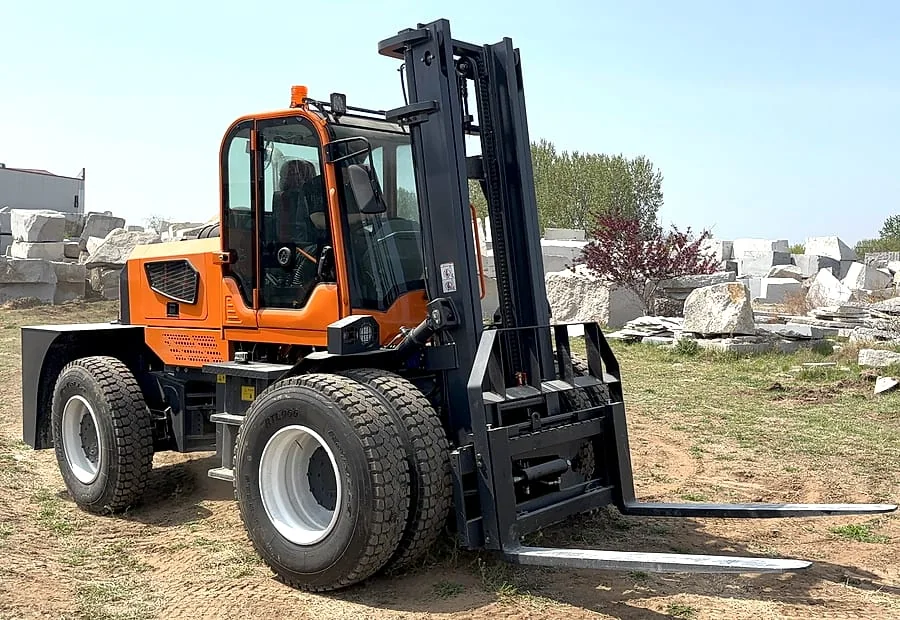
The Attachment Changes the Order More Than It Looks
On paper, a forklift may look strong enough.
In real work, the attachment changes how that strength is used. A standard fork pair, a fork positioner, a side shifter, long forks, a clamp, a bucket, and a crane jib all put different demands on the machine.
That is especially true for rough terrain forklifts used on construction sites, farms, stone yards, outdoor warehouses, plantations, and project yards. The ground is rarely perfect. The route may include bumps, soft soil, slopes, turning points, and temporary loading areas. A small mistake in attachment planning can become a daily operating problem.
I have seen buyers focus only on rated load and then realize later that the load is longer than expected, the pallet opening is not standard, or the driver cannot align the forks easily in a tight outdoor yard.
At that point, the issue is no longer only forklift capacity. It becomes a configuration problem.
A Typical Case: The Load Was Not a Simple Pallet
A common inquiry starts like this:
"We need a forklift for 5 tons."
Then I ask what the machine will actually lift.
Sometimes the answer is bricks or blocks. Sometimes it is steel pipe, timber, cement bags, fertilizer, fruit crates, stone, or farm materials. The weight may be clear, but the shape is not. The load may be wide, long, uneven, fragile, or difficult to enter with standard forks.
In one typical discussion, the buyer first described the job as pallet handling. After checking photos, the real challenge was not only pallet weight. The yard had different pallet widths, some damaged pallets, and a narrow loading point near a wall. In that case, the attachment discussion became more important than adding more rated capacity.
A side shifter or fork positioner may help the operator place the forks with less repeated turning. Long forks may help with deep loads, but they also change the load center. A clamp may be useful for certain materials, but it must be discussed together with the load shape and the machine's final rated capacity.
This is why I do not like confirming the forklift model too early.
Load Center Should Be Checked Before Capacity Feels Comfortable
Rated capacity is usually based on a specified load center. Buyers often know the weight of the material, but they do not always know how far the load center moves after the attachment or load shape changes.
Long forks are a good example. They can look simple, and many buyers ask for them as if they are just longer steel. In practice, longer forks may move the load center forward. That can reduce the usable capacity compared with the number buyers see on the first model list.
The same logic applies to heavy clamps, buckets, and lifting jibs. The attachment has its own weight, thickness, geometry, and working position. These details must be reflected in the final specification, data plate, and jobsite operation plan.
If a buyer tells me, "The load is around 4 tons, but the material is long and the route is uneven," I do not treat it the same as a clean 4-ton pallet on flat concrete.
For outdoor work, capacity is only one part of the answer. Load center, attachment type, lift height, route, tire choice, mast configuration, and hydraulic requirements must be checked together.
Common Attachments Need Different Questions
The right attachment depends on the problem the operator is trying to solve.
Side Shift and Fork Positioner
Side shift and fork positioners are often discussed when the buyer handles different pallet sizes, narrow loading points, or tight yard layouts.
They may help reduce small steering corrections, especially where the operator cannot easily reposition the whole machine. But they should not be treated as decoration. The supplier still needs to confirm mast compatibility, hydraulic lines, carriage type, visibility, and whether the buyer really needs side movement, fork spacing adjustment, or both.
For buyers comparing these options, our article on side shifter, fork positioner, or standard forks gives a more focused explanation.
Long Forks
Long forks can be useful for deeper loads, wider materials, or some building-material handling jobs.
But long forks also create one of the most common misunderstanding points in export forklift discussions. The buyer may think the forklift capacity stays exactly the same because the machine model has not changed. In reality, the usable capacity must be confirmed with the final load center and specification.
If the load is long, heavy, or irregular, I prefer to ask for photos and dimensions before confirming long forks. Our guide on adding long forks to a rough terrain forklift explains the buyer checks in more detail.
Clamps, Buckets, and Crane Jibs
Clamps, buckets, and crane jibs are more specialized.
A clamp may be useful for bales, blocks, or other materials where gripping is part of the handling process. A bucket may help in some loose-material jobs, but a forklift with a bucket is not the same as a wheel loader. A crane jib may be useful for occasional lifting work, but the lifting point, attachment weight, and working radius must be checked carefully.
For a broader list of options, our rough terrain forklift attachments and configurations guide is still a good starting point.
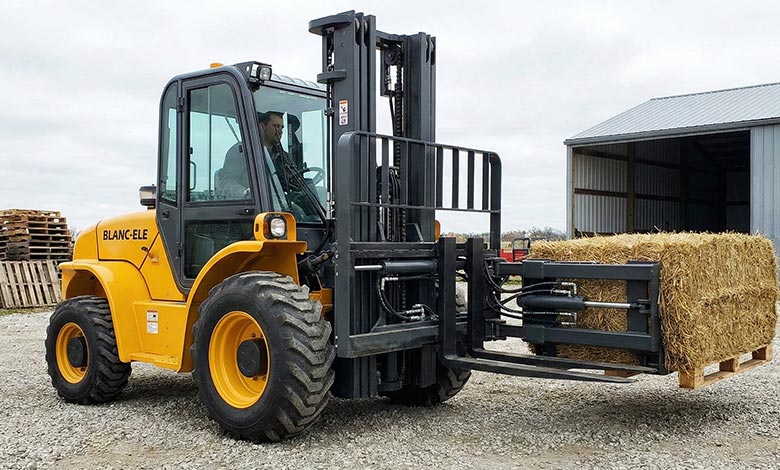
The Site Route Still Has a Vote
Attachment planning should not stop at the load.
The route matters just as much.
A forklift working with standard pallets on compacted ground has a different job from a forklift carrying long materials across a rough yard. A forklift using a clamp on a farm route faces a different question from a forklift loading blocks in a stone yard.
Before I recommend a configuration, I usually want to know:
- Is the ground compacted, gravel, soil, mud, sand, or mixed?
- Is the route flat, sloped, temporary, or narrow?
- Does the forklift need to turn with the load raised slightly?
- Is the loading point beside a truck, inside a shed, near a wall, or on open ground?
- Will the operator handle the same load every day, or many different materials?
These questions can change the choice between a compact model and a heavier machine.
They can also change the attachment recommendation.
Information I Like to Confirm Before Quoting
For a serious attachment discussion, I prefer buyers to send practical jobsite information, not just a model name.
The useful details are simple:
- Load weight and load dimensions
- Photos or video of the material
- Pallet size, if pallets are used
- Required lift height
- Ground condition and route length
- Truck or container loading height, if relevant
- Whether the attachment is used every day or only sometimes
- Destination-market requirements for emission configuration
- Spare parts that should be supplied with the shipment
This does not make the buying process slower. It usually makes the quotation clearer.
For dealers and importers, this also helps avoid a problem after resale. If the end user later asks why the forklift feels less stable with a special attachment, the answer often goes back to the first configuration conversation.
Where 5T and 7T Discussions Usually Start
Many attachment discussions move toward 5T or 7T rough terrain forklifts, especially for construction materials, stone yards, timber, heavy pallets, pipe bundles, and mixed outdoor work.
That does not mean every buyer should choose a larger machine.
It means the supplier should check the actual load, attachment, and route before deciding. A 5 ton rough terrain forklift may fit many outdoor handling jobs where the load is heavy but still manageable in size and route. A 7 ton 4WD rough terrain forklift may need to be discussed when the work involves heavier materials, stronger site demands, or bigger attachment requirements.
The final answer should come from the full working condition, not from the tonnage label alone.
My Practical Recommendation
Before choosing forklift capacity, confirm the attachment plan.
If you are buying for resale, rental, construction, farming, or outdoor yard work, do not only ask for "a 5 ton forklift" or "a 7 ton forklift." Send the supplier the load photos, material dimensions, route condition, lift height, and attachment idea first.
Then the forklift model, attachment, mast, hydraulics, tire choice, spare-parts package, and final data plate can be discussed together.
That is usually where a better rough terrain forklift order starts: not from a bigger capacity number, but from a clearer working-condition picture.
For BLANC-ELE buyers comparing outdoor forklift configurations, you can start from our rough terrain forklift product range and then send your material photos and route details through the contact page.