
Many forklifts seem perfectly fine on dry ground, but once they enter muddy areas, rainy construction sites, or soft terrain, they quickly begin slipping, sinking, and sometimes even need recovery equipment to pull them out.
From my experience, forklifts usually get stuck in mud not simply because of weak engines, but because of traction, tire design, ground clearance, weight distribution, and operator behavior1. Forklifts that perform well in mud are usually designed more carefully in these areas.
[image placeholder]
After visiting enough muddy job sites, I realized most mud problems are not caused by insufficient power, but by the machine’s inability to maintain traction continuously.
Why Do Many Buyers Underestimate Muddy Ground Conditions?
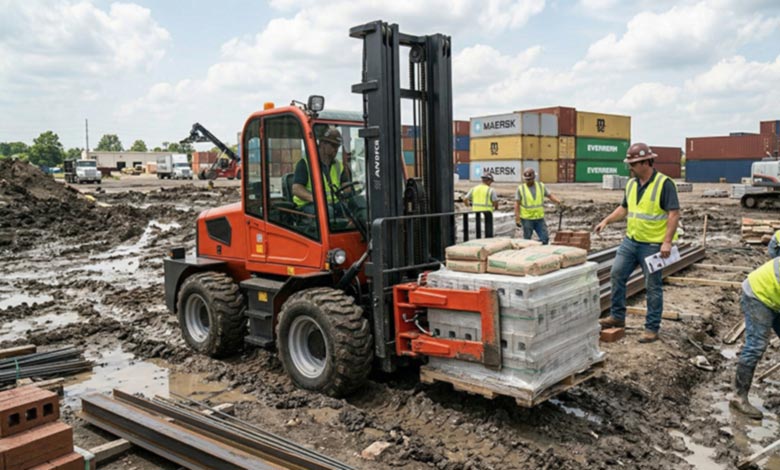
Many job sites look completely normal during dry weather, but once heavy rain or repeated loading begins, ground conditions can change very quickly2.
Ground that appears stable at first can rapidly become the easiest place for forklifts to lose traction and sink.
Dive Deeper
I once visited a construction site where the customer originally believed a standard forklift would be sufficient because the ground looked relatively firm after leveling work.
But after several days of rain, large areas became soft very quickly.
Especially:
- Temporary roads
- Backfilled areas
- Soil transport zones
The forklift started slipping even during simple turning movements.
The real problem was not that the machine could not work, but that once it became stuck, the entire job site workflow slowed down.
This is actually very similar to something I discussed earlier in Why Buyers Often Realize Ground Clearance Problems Too Late
Many terrain problems remain hidden until forklifts enter truly difficult outdoor conditions.
Common Muddy Terrain Risks
| Ground Condition | Typical Problem |
|---|---|
| Wet soil3 | Easy sinking |
| Backfilled ground4 | Poor stability |
| Temporary roads | Deep ruts |
| Clay surfaces | Severe wheel slipping |
In many cases, the real issue is not whether the forklift can enter muddy ground, but whether it can get back out smoothly.
Why Are Two-Wheel Drive Forklifts More Likely to Get Stuck?
Many buyers assume four-wheel drive5 simply means “more power.”
But once forklifts enter muddy terrain, the difference becomes much more obvious.
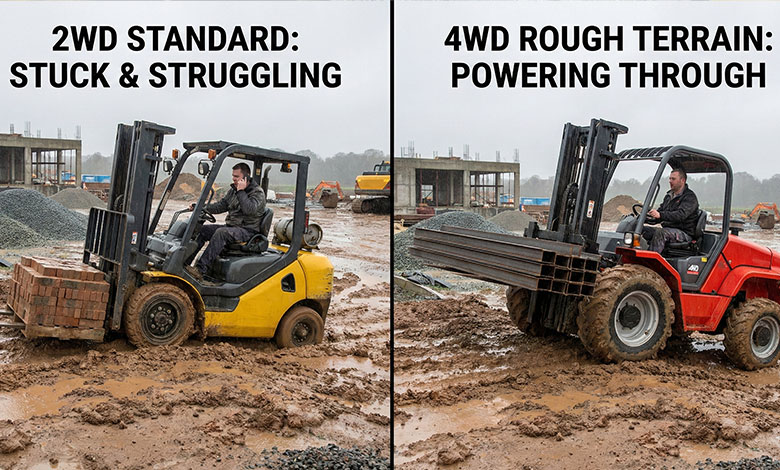
The real advantage of four-wheel drive is not just power — it is the ability to distribute traction across more wheels.
Dive Deeper
I have seen many two-wheel drive forklifts work perfectly fine on flat concrete.
But once they enter:
- Muddy areas
- Wet slopes
- Soft construction sites
problems appear very quickly.
Especially under heavy load, once the drive wheels begin slipping6, recovery becomes increasingly difficult.
Many operators instinctively press the accelerator harder7.
But usually, this only causes the machine to sink deeper.
2WD vs 4WD in Mud
| Feature | 2WD Forklift | 4WD Rough Terrain Forklift |
|---|---|---|
| Traction | Weaker | Stronger |
| Mud Performance | Poorer | Better |
| Recovery Ability | Difficult | Easier |
| Stability | Lower | Higher |
Over time, I realized muddy environments do not mainly test engine power. They test whether the machine can continuously maintain traction.
This is actually very similar to what I discussed earlier in Why Some Rough Terrain Forklifts Work in Stone Yards — But Not for Long
Because difficult outdoor conditions constantly expose weaknesses in traction and chassis stability.
Why Are Tires More Important Than Many People Think?
Many buyers focus heavily on engine specifications and lifting capacity while paying little attention to tires.
But in muddy terrain, tires often determine whether the forklift can continue moving at all.
Tire tread, width, and contact area directly affect grip and sinking resistance.8

Dive Deeper
I have seen smaller forklifts outperform larger machines simply because they used more suitable tires.
Machines with:
- Deeper tread patterns
- Wider tires
- Larger contact areas
often move through muddy terrain much more effectively.
Meanwhile, narrow tires tend to sink quickly once the ground softens.
This difference becomes especially obvious while turning in muddy conditions.
Tire Factors That Affect Mud Performance
| Tire Feature | Effect |
|---|---|
| Deep tread | Better traction |
| Wider tire | Reduced sinking |
| Semi-solid structure | Improved durability |
| Larger contact area | Better flotation |
Today, I pay much more attention to whether tires are truly suitable for outdoor rough terrain work.
Especially under long-term heavy-duty operation, tires affect not only mobility, but also long-term machine stability.
This is also very similar to the tire wear issues I discussed earlier in Why Some Rough Terrain Forklifts Work in Stone Yards — But Not for Long
Why Does Low Ground Clearance Cause So Many Problems?
Many buyers pay close attention to lifting capacity and engine specifications.
But at muddy job sites, I repeatedly see another issue being overlooked:
Ground clearance.
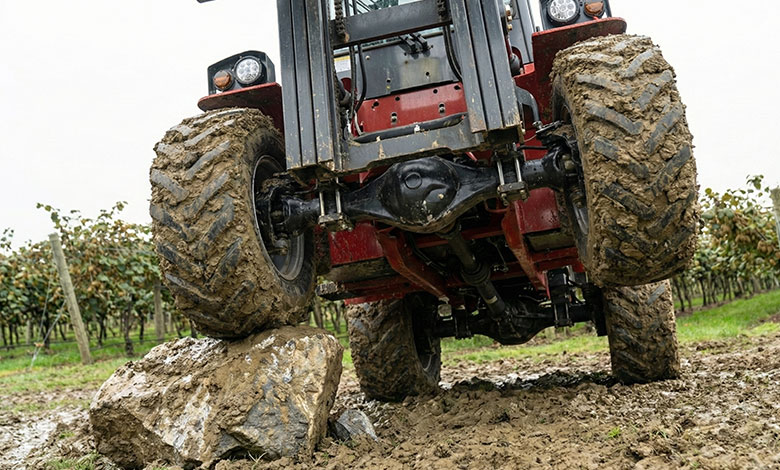
Once mud, ruts, or uneven terrain appear, insufficient clearance can cause the chassis to drag against the ground9 and reduce mobility dramatically.
Dive Deeper
I have seen forklifts move successfully at first, only to fail once mud depth increased slightly.
As mud builds underneath the machine, the chassis gradually begins resting on the surface.
Once the chassis starts sitting on mud, the tires can continue spinning without producing meaningful traction10.
Problems Caused by Low Ground Clearance
| Problem | Result |
|---|---|
| Chassis dragging | Reduced traction |
| Mud accumulation | Heavier steering |
| Bottom impact | Component damage |
| Poor mobility | Higher risk of getting stuck |
Many times, true off-road performance depends not only on tires, but also on the overall chassis height.
This is also closely related to something I analyzed earlier in Why Real Ground Clearance Often Differs from Specifications
Why Do Some Operators Make Mud Problems Worse?
I have seen this happen many times on real job sites.
A forklift may begin with only minor slipping, but incorrect operation quickly makes the situation much worse.
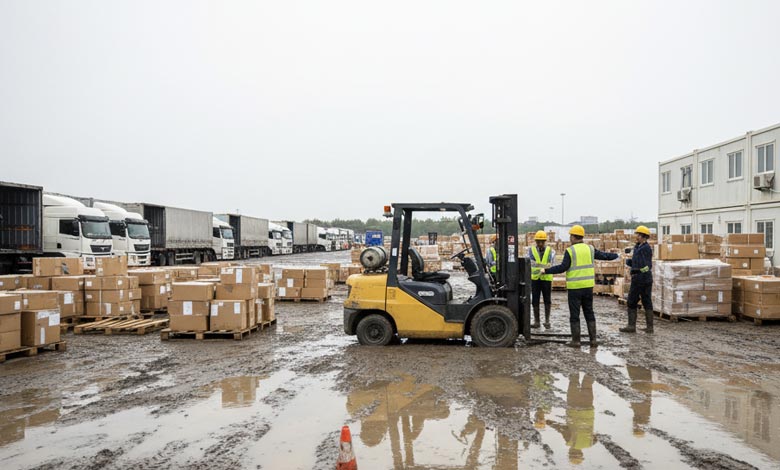
Aggressive throttle input in muddy terrain usually increases wheel spin rather than helping recovery.
Dive Deeper
Many operators instinctively react to slipping by applying more throttle.
But in reality, high wheel speed quickly digs the tires deeper into the mud.
This becomes especially obvious with two-wheel drive forklifts.
Experienced operators usually respond differently:
- Gentle throttle control
- Small steering corrections
- Maintaining continuous traction
Good vs Bad Recovery Behavior
| Operator Action | Result |
|---|---|
| Aggressive throttle | Sinks deeper |
| Gentle acceleration | Easier recovery |
| Sharp steering | Increased resistance |
| Smooth operation | Better traction |
In muddy terrain, the biggest danger is often not insufficient power, but sudden traction loss.
And in many cases, this also increases operator fatigue.
Frequent slipping and steering correction make machines much more tiring to operate.11
This is actually closely related to something I discussed earlier in Why Some Forklifts Become More Tiring to Operate Over Time
What Makes a Forklift Better for Muddy Terrain?
Over the years, I’ve developed a much clearer understanding of what truly matters in muddy environments.
A forklift suitable for mud requires much more than simply having four-wheel drive.
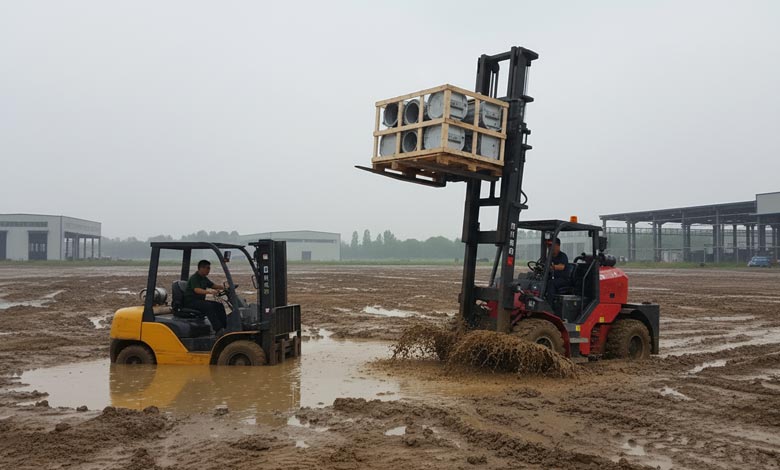
The best rough terrain forklifts12 for muddy conditions combine four-wheel drive, suitable tires, ground clearance, balanced weight distribution, and long-term structural stability.
Dive Deeper
Today, when evaluating forklifts for muddy terrain, I pay much closer attention to:
- Four-wheel drive systems
- Aggressive tread tires
- Ground clearance
- Chassis structure
- Weight distribution
Because many forklifts appear similar on concrete surfaces.
But once they enter:
- Muddy ground
- Rainy construction sites
- Farms
- Soft terrain
the real differences become obvious very quickly.
Important Features for Muddy Terrain
| Feature | Importance |
|---|---|
| 4WD system | Extremely important |
| Tread tires | Critical |
| High ground clearance | Very important |
| Stable chassis | Very important |
| Balanced weight distribution | Necessary |
Many forklifts look similar on paved surfaces, but once they enter muddy environments, the differences become extremely clear.
Conclusion
After years of visiting outdoor job sites and farms, I’ve realized muddy terrain does not simply test whether a forklift can move — it tests whether the machine can continuously maintain traction and mobility.
"Bekker's Terramechanics Model for Off-Road Vehicle Research", https://www.academia.edu/56690951/Bekkers_Terramechanics_Model_for_Off_Road_Vehicle_Research. Vehicle-terrain interaction literature identifies traction, tire-soil contact, clearance, load transfer, and driver inputs as key determinants of off-road mobility; although much of this evidence comes from general off-road vehicles rather than forklifts specifically, the mechanisms are directly relevant to forklift operation on soft ground. Evidence role: mechanism; source type: paper. Supports: Forklifts usually get stuck in mud because of traction, tire design, ground clearance, weight distribution, and operator behavior rather than engine weakness alone.. Scope note: The support is contextual because it comes from broader vehicle-terrain mechanics, not forklift-only field trials. ↩
"[PDF] Sediment Outflow under Simulated Rainfall Conditions with Varying ...", https://digitalcommons.unl.edu/context/wffdocs/article/1087/viewcontent/Jahangeer_JHTRW_2020_Sediment_Outflow__MS_FINAL.pdf. Geotechnical and soil-science sources show that rainfall increases soil water content and can rapidly reduce shear strength and bearing capacity; the evidence supports the mechanism by which apparently firm job-site ground may become unstable after rain, though the exact rate of change depends on soil type and drainage. Evidence role: mechanism; source type: education. Supports: Dry or apparently stable job-site ground can quickly become unstable after rain or repeated loading.. Scope note: The source would support the soil-mechanics principle, not the specific job-site example described in the article. ↩
"Evaluation of Ground Pressure, Bearing Capacity, and Sinkage in ...", https://ui.adsabs.harvard.edu/abs/2024Senso..24.1779R/abstract. Soil mechanics references describe how increased moisture reduces soil strength and bearing capacity, making wet soil more prone to rutting and vehicle sinkage; this supports the table’s risk classification in general terms, although local soil composition can change the severity. Evidence role: mechanism; source type: education. Supports: Wet soil increases the risk of forklift sinking.. Scope note: The support is general to wet soil and vehicle loading, not a measured forklift-specific risk table. ↩
"[PDF] Equipment and Lift Thickness Optimization for Structure Backfill ...", https://www.pa.gov/content/dam/copapwp-pagov/en/penndot/documents/research-planning-innovation/research-projects/equipment_and_lift_thickness_pptimization_for_structure_backfill_compaction_operations.pdf. Construction and geotechnical guidance commonly notes that backfilled soil can settle or lose stability if it is not properly compacted; this supports treating backfilled areas as higher-risk surfaces for heavy equipment, while actual risk depends on compaction quality and soil conditions. Evidence role: general_support; source type: government. Supports: Backfilled ground can have poor stability for forklift operation.. Scope note: The evidence would support the general instability risk of backfilled ground, not prove every backfilled site is unsafe for forklifts. ↩
"[PDF] Traction/Braking Force Distribution for Optimal Longitudinal Motion ...", https://huei.engin.umich.edu/wp-content/uploads/sites/186/2015/02/vehicle.pdf. Vehicle dynamics and off-road mobility references explain that four-wheel drive can distribute driving torque to more contact patches, improving the ability to maintain tractive effort on low-friction or soft surfaces; this supports the traction rationale but does not guarantee performance without suitable tires and ground clearance. Evidence role: mechanism; source type: research. Supports: Four-wheel drive improves muddy-terrain performance by distributing traction across more wheels.. Scope note: The source would support the mechanism of 4WD traction generally, not certify that all 4WD forklifts perform well in mud. ↩
"[PDF] CONTROLLING TRACTOR WHEEL SLIP FOR EFFICIENT ... - CORE", https://oaktrust.library.tamu.edu/bitstream/handle/1969.1/173008/2050/Leaf2050.pdf. Traction theory describes wheel slip as a loss of effective tractive force when the tire-soil interface cannot transmit the required shear force; this supports the claim that recovery becomes more difficult once drive wheels slip in soft mud, although outcomes vary with tire design and soil strength. Evidence role: mechanism; source type: paper. Supports: Once the drive wheels begin slipping in mud, a forklift becomes harder to recover.. Scope note: The support is based on general traction mechanics rather than a controlled comparison of forklift recovery events. ↩
"Sand and Mud Driving Tips - National Park Service", https://www.nps.gov/moja/sand-and-mud-driving-tips.htm. Off-road driving and traction guidance explains that excessive throttle can increase wheel spin, shear the soil surface, and reduce traction on mud; this supports the caution against accelerating harder during slipping, though exact effects depend on vehicle weight, tire tread, and soil type. Evidence role: mechanism; source type: government. Supports: Pressing the accelerator harder during wheel slip usually worsens traction rather than improving recovery.. Scope note: The source may be general off-road or safety guidance rather than forklift-specific operator research. ↩
"[PDF] Systematic measurement of 3D tire-soil contact on an artificial soil", https://dr.lib.iastate.edu/server/api/core/bitstreams/5afde217-4eb2-4db5-8a32-c45c009d7a24/content. Terramechanics research links tire tread geometry, tire width, and contact patch size to traction, ground pressure, and sinkage on deformable soil; this directly supports the role of tire design in muddy-terrain mobility, although numerical performance varies by tire and soil condition. Evidence role: mechanism; source type: paper. Supports: Tire tread, width, and contact area directly affect grip and sinking resistance in muddy terrain.. Scope note: The evidence supports the physical relationship but not a specific forklift model’s performance. ↩
"[PDF] An Analysis of Requirements for Rough Terrain Autonomous Mobility", https://www.cs.cmu.edu/~alonzo/pubs/papers/jar96_theory.pdf. Off-road vehicle design references define ground clearance as the space that prevents underbody contact with obstacles or uneven terrain; this supports the claim that low clearance can cause chassis dragging and mobility loss in ruts or mud, though the severity depends on rut depth and vehicle geometry. Evidence role: definition; source type: encyclopedia. Supports: Insufficient ground clearance can cause the chassis to drag against mud, ruts, or uneven terrain and reduce mobility.. Scope note: The evidence supports the design principle, not a quantified forklift failure threshold. ↩
"[PDF] Terramechanics-based wheel–terrain interaction model and its ...", https://huei.engin.umich.edu/wp-content/uploads/sites/186/2015/02/Robotica_Jia-Terramechanics.pdf. Terramechanics sources explain that when a vehicle becomes high-centered or when wheels lose normal load and effective soil engagement, wheel rotation may fail to generate useful tractive force; this supports the described mechanism, although forklift-specific geometry is not directly evaluated. Evidence role: mechanism; source type: paper. Supports: If the chassis rests on mud, the tires may spin without generating meaningful traction.. Scope note: The support is contextual from general vehicle-terrain mechanics and high-centering behavior. ↩
"Fatigue assessment of forklift operators in a 12-hour shift system", https://pubmed.ncbi.nlm.nih.gov/40990629/. Ergonomics and occupational-safety literature links repeated steering corrections, vibration, and high attentional demand in mobile machinery to increased operator workload and fatigue; this supports the fatigue mechanism, though it is contextual unless the source specifically studies forklifts in mud. Evidence role: general_support; source type: paper. Supports: Frequent slipping and steering correction can increase operator fatigue.. Scope note: The evidence may address mobile equipment or forklifts generally rather than muddy-terrain forklift operation specifically. ↩
"Powered Industrial Trucks (Forklift) - Types & Fundamentals - OSHA", http://www.osha.gov/etools/powered-industrial-trucks/types-fundamentals/types/classes. Authoritative safety and regulatory sources define rough-terrain forklift trucks as forklifts intended for operation on unimproved natural terrain or disturbed construction-site terrain, supporting the article’s distinction between ordinary forklifts and models suited to muddy outdoor conditions. Evidence role: definition; source type: government. Supports: Rough terrain forklifts are forklifts intended for difficult outdoor or unimproved terrain, making them more appropriate for muddy job sites than standard forklifts.. Scope note: Such sources establish the intended operating environment of rough-terrain forklifts, but may not independently verify every listed design feature as necessary for mud performance. ↩