
If the job is light, compact, and usually below 3,000 kg at a normal load center, a 3 ton rough terrain forklift can be the practical choice. If the buyer often works close to 3 tons, uses longer forks or attachments, handles uneven outdoor routes, or wants more margin for dealer stock, a 3.5 ton rough terrain forklift is usually worth comparing. The 500 kg difference is not only a number on the nameplate. It changes how much reserve the buyer has after load center, mast height, attachment weight, ground condition, and daily route are considered. Final suitability should always be confirmed from the formal specification sheet and working condition.
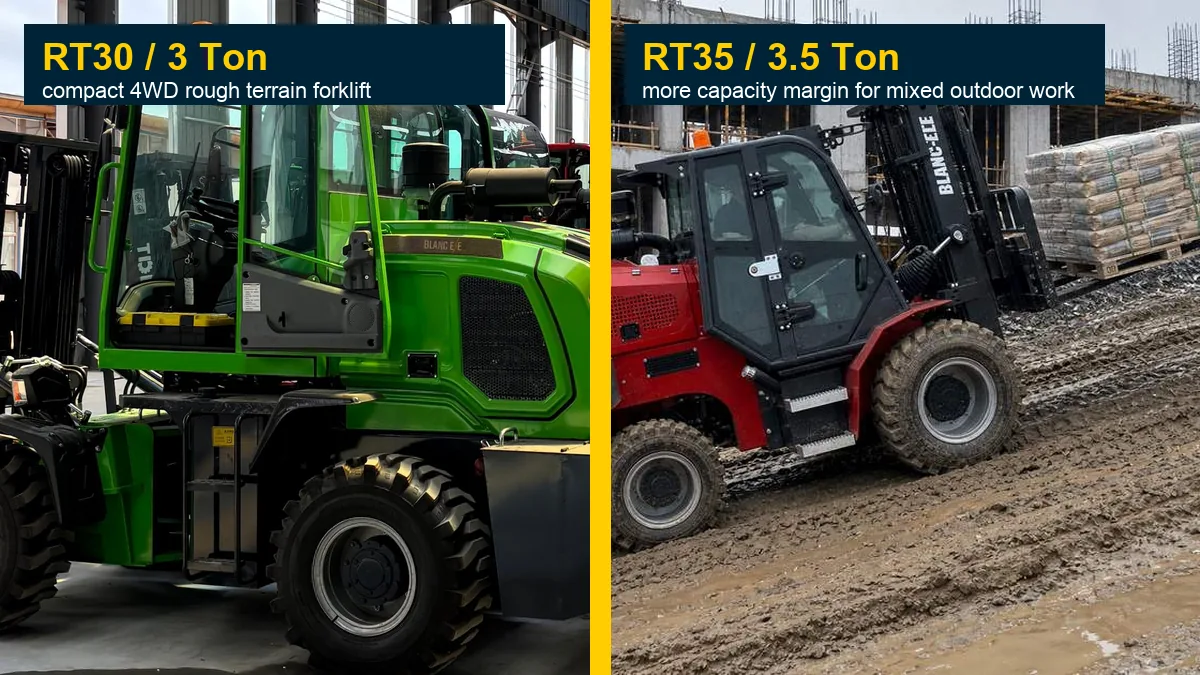
For many overseas buyers, the first message is simple:
"I need a 3 ton rough terrain forklift."
Or:
"Please quote 3.5 ton 4WD forklift."
That is a normal starting point, but it is not enough for a safe recommendation. A 3 ton load on smooth concrete is different from a 3 ton load moving across gravel, soil, mud, a ramp entrance, or a construction yard. A compact pallet is different from a long pallet, bale clamp, bucket, pipe bundle, or material with the center of gravity far forward.
From the supplier side, I use the 3 ton vs 3.5 ton discussion to answer one buyer question:
Where does the buyer need working margin, and where would the larger model only add cost and size?
Specification Basis For This Comparison
For this article, I checked BLANC-ELE RT30 and RT35 technical specification files and a BLANC-ELE RT30RB vs RT35RB comparison document. The public comparison below uses only stable, directly supported items. Where the source documents conflict, I do not turn the number into a sales claim.
| Item | BLANC-ELE RT30 reference | BLANC-ELE RT35 reference | What it means for the buyer |
|---|---|---|---|
| Rated load | 3,000 kg | 3,500 kg | RT35 gives an extra 500 kg rated-capacity margin before jobsite factors are reviewed. |
| Drive type | 4-wheel drive | 4-wheel drive | Both are outdoor rough terrain forklift directions, not warehouse-only choices. |
| Engine power in checked files | 42 kW | 58 kW | RT35 has a stronger power configuration in the reviewed spec files. |
| Standard lift height | 3,000 mm | 3,000 mm | The standard mast height does not decide the capacity choice by itself. |
| Fork length | 1,220 mm | 1,220 mm | Similar fork length means load geometry still needs to be checked separately. |
| Tire size | 20.5/70-16 agricultural tread | 20.5/70-16 agricultural tread | Tire pattern and ground condition remain important for both models. |
| Overall dimensions | 3,700 x 1,800 x 2,450 mm | 3,700 x 1,800 x 2,450 mm | In the checked files, the basic footprint is close, so the choice is mainly about load margin and configuration. |
| Operating weight | about 4,390 kg | about 4,400 kg | Transport and ground-bearing checks should still be confirmed for the final model. |
| Ground clearance | 240 mm | 240 mm | Clearance is similar in the checked files; the route still needs photos or video. |
| Gradeability | Source documents differ | Source documents differ | Do not select either model by a slope number alone. Confirm loaded slope use with the final spec and site condition. |
This table is a decision starting point, not a replacement for engineering confirmation. If the buyer needs a special mast, side shift, fork positioner, bucket, clamp, long forks, enclosed cabin, or emission option, the formal quotation should confirm the final configuration.
When A 3 Ton Rough Terrain Forklift Usually Makes Sense
A 3 ton rough terrain forklift is often enough when the work is lighter and the buyer needs a compact outdoor machine rather than more lifting reserve.
I would start with a 3 ton discussion when:
- the normal load is clearly below 3,000 kg;
- the cargo is compact and the load center is not far forward;
- the route is mostly firm ground, concrete yard, compacted soil, or short outdoor travel;
- the buyer does not need heavy attachments;
- the main concern is cost control, machine size, and simple outdoor mobility;
- the machine will work on farms, small yards, light construction support, or mixed indoor-outdoor routes with moderate loads.
The key phrase is "clearly below 3,000 kg." If the buyer says the load is "around 3 tons," I do not treat that as a finished answer. I ask for the real maximum load, the load size, the pallet or cargo type, and whether the operator will use long forks or attachments.
For buyers comparing this direction, the BLANC-ELE 3 ton rough terrain forklift page is the right model path to review before asking for a quotation.
When The 3.5 Ton Model Is Worth Comparing
A 3.5 ton rough terrain forklift becomes more interesting when the buyer needs reserve, not only a bigger number.
In the BLANC-ELE specification files checked for this article, the RT35 reference lists a 3,500 kg rated load and a 58 kW engine configuration. That does not mean every buyer should upgrade. It means the 3.5 ton model should be compared when the job has less room for error.
I would compare a 3.5 ton model when:
- the normal load is often close to 3,000 kg;
- the buyer handles heavier pallets, farm materials, construction supplies, bricks, blocks, or bagged material;
- the route includes loose ground, uneven yard surfaces, muddy sections, or longer outdoor travel;
- side shift, fork positioner, bucket, clamp, long forks, or other attachments may be used;
- the dealer wants one middle-capacity stock model for a broader customer base;
- the customer wants more margin before moving into a 5 ton class machine.
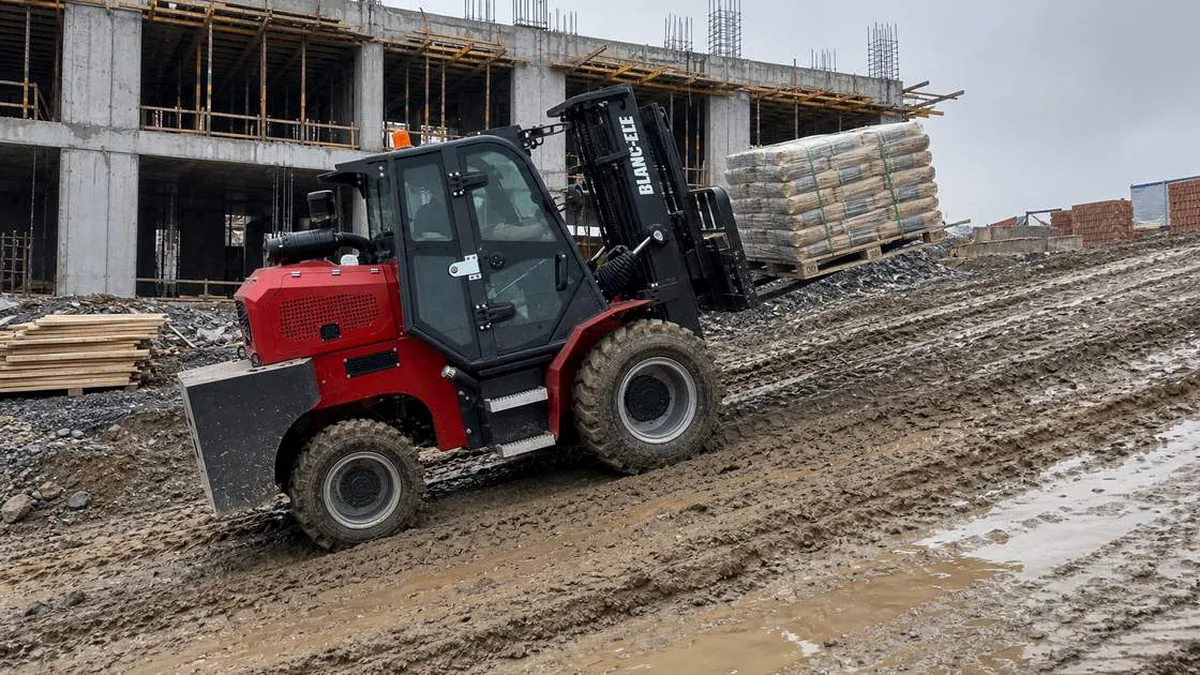
The BLANC-ELE 3.5 ton rough terrain forklift page is the better starting point when the buyer already knows the work is not only light outdoor handling.
The 500 Kg Difference Is Not Always The Real Difference
The easiest mistake is to compare 3,000 kg and 3,500 kg as if the forklift always lifts that number in every condition.
In real buyer discussions, the actual question is more specific:
Can the machine handle the buyer's real load, at the real load center, with the real mast, attachment, tire, route, slope, and ground condition?
For example, a compact 2,500 kg pallet on short firm ground may not justify moving from 3 ton to 3.5 ton. But a 2,800-3,000 kg load with long forks, rough ground, repeated travel, or a front-mounted attachment may need more margin. The rated capacity number is only the starting line.
This is why I avoid saying "3.5 ton is always better." A larger model may give more reserve, but it can also mean a different price level, different stock planning, and a configuration that still must be checked against the working route.
Buyer Decision Matrix
Use this matrix before asking for a quote.
| Buyer situation | Better starting point | Why |
|---|---|---|
| Normal load is below 2,500 kg, compact pallets, short firm route | 3 ton | The buyer may not need the extra capacity margin. |
| Load is often 2,800-3,000 kg and the site is outdoor | Compare 3 ton and 3.5 ton | The load is close enough to the 3 ton range that reserve matters. |
| Load is close to 3,000 kg and long forks or side shift may be used | 3.5 ton first | Attachment and load-center effects can reduce usable margin. |
| Dealer wants a general stock machine for farms, yards, and construction buyers | 3.5 ton first | The middle-capacity model is easier to position across different customers. |
| Work includes heavier construction material, stone, large blocks, or frequent heavy loads | Compare 5 ton as well | A 3.5 ton model may still be too small after load center and attachment checks. |
| The site has narrow doors, low entrances, or basement-like spaces | Confirm model height and steering version | Capacity alone will not solve access limits. |
This table is deliberately conservative. It helps the buyer avoid under-sizing the forklift, but it also avoids pushing a larger model when the work does not need it.
What Buyers Should Send Before We Recommend RT30 Or RT35
Before BLANC-ELE recommends a 3 ton or 3.5 ton rough terrain forklift, the buyer should send:
- maximum load weight;
- load size and load center;
- pallet, bale, bag, block, pipe, bucket, or attachment details;
- photos or short video of the ground route;
- slope or ramp sections, if any;
- required lift height and mast height limit;
- turning space and doorway or container-height limits;
- daily working hours and travel distance;
- destination country and emission requirement;
- preferred accessories such as cabin, side shift, fork positioner, long forks, bucket, clamp, heater, air conditioner, or spare-parts package.
With these inputs, the recommendation becomes much clearer. Sometimes the answer is RT30. Sometimes it is RT35. Sometimes the buyer should skip both and compare a 5 ton rough terrain forklift instead.
For Dealers And Importers
For dealers, the 3 ton vs 3.5 ton decision is also a stock-positioning question.
A 3 ton model can be easier to sell to buyers who care about a compact machine and a controlled budget. A 3.5 ton model can be easier to present as a middle-capacity rough terrain forklift for farms, construction yards, rental fleets, and outdoor material handling customers who may not describe their load perfectly in the first inquiry.
If the dealer's customer base is mixed, I would not choose stock only by the rated capacity. I would review common local jobs:
- farm supply and fertilizer pallets;
- building-material yards;
- plantation roads;
- small construction sites;
- rental-fleet replacement needs;
- outdoor warehouses and rough loading points.
If many customers are close to the 3 ton limit or use attachments, the 3.5 ton direction deserves stronger consideration. If most customers handle lighter, compact loads and need a smaller machine, the 3 ton direction may be enough.
My Practical Recommendation
Choose a 3 ton rough terrain forklift when the load is comfortably below 3,000 kg, the cargo is compact, the route is not extreme, and the buyer wants a practical outdoor 4WD machine without paying for unused reserve.
Choose or at least compare a 3.5 ton rough terrain forklift when the job often approaches 3,000 kg, when attachments or long forks may be used, when the route is rougher, or when a dealer needs a more flexible middle-capacity model for different outdoor customers.
For a wider view, start with the BLANC-ELE rough terrain forklift range. Then compare the 3 ton rough terrain forklift and 3.5 ton rough terrain forklift pages. If attachments are part of the job, also review our guide to rough terrain forklift attachments and configurations.
When you contact BLANC-ELE, send the real load, route, ground photos, lift height, attachment plan, and destination country. We can then confirm whether RT30, RT35, or another rough terrain forklift configuration is the better quotation starting point.