
When farm and plantation buyers ask me about rough terrain forklifts, the first question is often simple:
"Which model is suitable for farm use?"
That sounds easy, but farm work is not one single application.
One farm may handle fertilizer bags and pallets on compacted soil.
Another plantation may move fruit crates, feed, timber, bales, or loose material across soft ground after rain.
Another buyer may want one machine to work in the yard, enter a simple warehouse, carry attachments, and keep running during the busy season.
So when I recommend a rough terrain forklift for farm or plantation use, I do not only ask about capacity.
I ask what the machine will really do during the hardest normal working day.
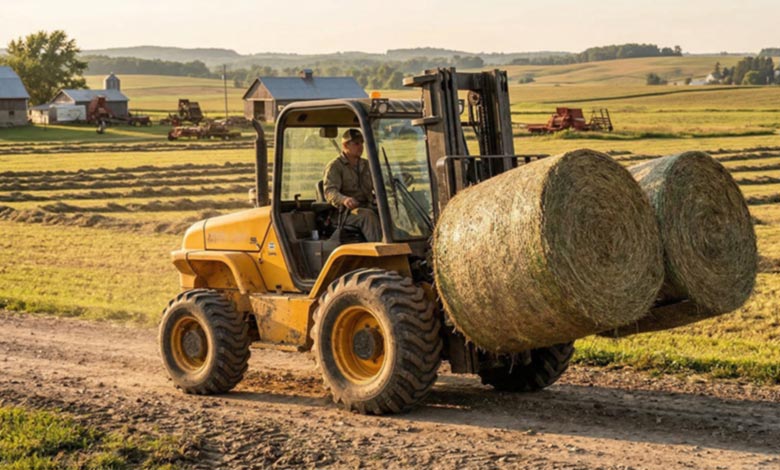
If your main concern is muddy or wet ground, you may also read our article on why standard forklifts get stuck in mud.
Farm Buyers Should Not Start Only With Capacity
Capacity matters, of course.
But on a farm, the load is only one part of the question.
The supplier also needs to understand:
- What type of material you handle
- Whether the load is palletized or loose
- Whether the ground is dry, wet, sandy, muddy, or uneven
- Whether the forklift works inside a shed or only outdoors
- Whether the machine needs attachments
- Whether the farm has a busy harvest season
- Whether local maintenance and spare parts are easy to arrange
Many buyers say:
"My load is not very heavy."
But after we talk more, the real work may include long working hours, soft soil, rough paths, narrow farm roads, or attachments that move the load center forward.
That is why a farm forklift should be selected by the whole working condition, not only by the heaviest load number.
Confirm What The Forklift Will Carry
The first detail is the cargo.
Farm and plantation work can include many different loads:
- Fertilizer bags
- Feed bags
- Fruit crates
- Pallets
- Bales
- Seed, grain, or packaged crops
- Timber or branches
- Loose material
- Tools and farm supplies
- Irrigation or construction materials
These loads do not behave the same way.
A pallet of fertilizer bags is different from a bale clamp job.
A crate of fruit is different from a bucket of loose material.
Long timber is different from a compact pallet.
OSHA's forklift guidance also explains that load composition and load center affect capacity and handling. In practical supplier language, this means the same weight can feel very different depending on shape, size, and position.
So before choosing the forklift, send the supplier:
- Normal daily load weight
- Maximum load weight
- Load dimensions
- Whether the load is stable or loose
- Whether the load center may move forward
- Whether attachments will be used
Ground Condition Is Usually The Real Farm Problem
Many farm buyers do not have a concrete yard everywhere.
The forklift may need to drive on:
- Soil
- Grass
- Gravel
- Farm tracks
- Wet yard areas
- Mud after rain
- Sandy plantation roads
- Uneven paths between storage and field
This is where a rough terrain forklift becomes useful.
But even then, the supplier still needs details.
For example:
- Does rain make the road soft?
- Are there deep tire tracks?
- Is the ground flat or sloped?
- Does the forklift need to turn with a load?
- Is the road wide enough?
- Are there stones, roots, or broken ground?
The phrase "farm ground" is too general.
Photos and short videos are much better.
If I can see the route, I can understand whether the buyer needs more attention on tire traction, ground clearance, turning radius, or operating margin.
Dive Deeper: A Typical Plantation Case
A typical plantation case looks like this.
At first, the buyer says:
"We only need to move farm products and supplies."
But after asking more questions, the job becomes clearer:
- The plantation has a rainy season.
- Some roads are compacted soil, not concrete.
- The forklift moves fruit crates and fertilizer bags.
- During busy season, working hours become longer.
- The buyer may need a bale clamp or bucket later.
- The storage shed has limited entrance height.
Now the question is not only:
"Which forklift can lift the load?"
The better question is:
"Which configuration can keep working when the farm is busy, the ground is wet, and the machine needs more than one job?"
This is where many wrong choices begin.
The buyer chooses based on a normal day, but the machine is later used during the hardest season.
What Looks Simple Before Buying And What Appears Later
| Before buying | What appears during real farm work |
|---|---|
| "The load is not very heavy" | The same machine works longer during busy season |
| "The road is acceptable" | Rain makes soft areas harder to cross |
| "Standard forks are enough" | The buyer later needs bucket, clamp, or longer forks |
| "The shed entrance is high enough" | Mast lowered height becomes important |
| "The site is open" | Narrow farm roads make turning more difficult |
| "Maintenance can wait" | Filters, hoses, tires, and grease points affect downtime |
This is why I usually ask buyers to think about the hardest normal day, not only the easiest work.
Attachments Should Be Discussed Early
Farm forklifts often become multi-purpose machines.
At first, the buyer may only want standard forks.
Later, the same forklift may need:
- Bale clamp
- Bucket
- Fork extensions
- Side shift
- Crane jib
- Fork positioner
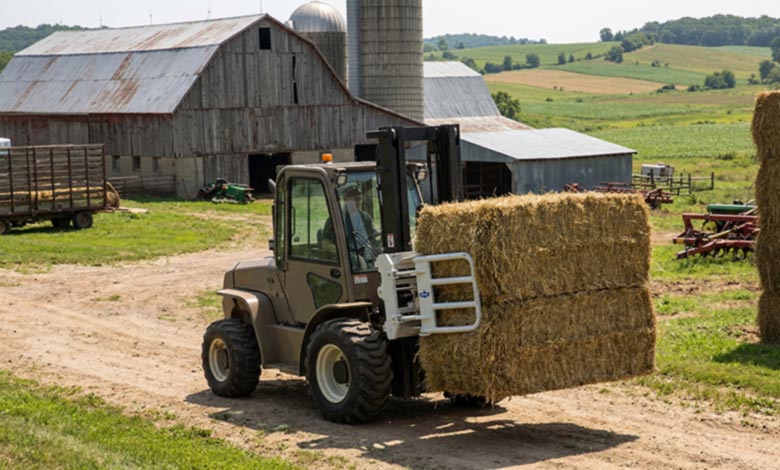
Attachments can change the way the load is carried.
They may affect load center, hydraulic requirement, visibility, mast choice, and real working margin.
This is why attachments should be discussed before production, not only after the forklift arrives.
For more detail, see our guide on rough terrain forklift attachments and configurations.
Tire Choice Matters On Farms And Plantations
Tire choice can change daily operation more than many buyers expect.
On farms, the forklift may move between dry ground, wet soil, gravel, and storage areas.
A tire that works acceptably on a dry yard may not perform the same in muddy field paths.
Before choosing the forklift, confirm:
- Whether the site becomes muddy after rain
- Whether the ground is sandy or soft
- Whether there are sharp stones or crop debris
- Whether the forklift also works on hard surfaces
- Whether replacement tires are easy to find locally
The goal is not to choose the most aggressive tire in every case.
The goal is to choose the tire that matches the real route.
Check Shed Entrance, Mast Height, And Turning Space
Farm buyers often focus on outdoor ground.
But many farms also have sheds, simple warehouses, feed rooms, packing areas, or container loading areas.
Before ordering, confirm:
- Required lifting height
- Mast lowered height
- Shed entrance height
- Warehouse door width
- Turning space near storage
- Whether the forklift must enter a container or truck area
- Whether the road from field to storage is narrow
A forklift can be suitable for outdoor traction but still create problems if it cannot enter the storage area.
So the supplier needs both outdoor and indoor details.
Busy Season Is Different From Normal Season
Many farms have seasonal workload.
During normal days, the forklift may only work a few hours.
During harvest, planting, or shipping season, the same machine may work much harder.
This matters because busy season can expose weak choices:
- The machine works longer hours.
- Operators may move faster.
- Loads become more frequent.
- Maintenance may be delayed.
- Roads may be wetter or more damaged.
- Small downtime becomes more expensive.
When I ask about working hours, I do not only mean the average day.
I want to know the busy season.
If the forklift is selected only for quiet periods, the buyer may regret it when the farm really needs the machine.
Maintenance Access And Spare Parts Should Be Planned
Farm machines often work far from professional service centers.
That is why maintenance planning matters.
Before buying, ask about:
- Common spare parts
- Filters
- Hydraulic hoses
- Grease points
- Tire availability
- Pins and bushings
- Operation manual
- Maintenance video
- Remote troubleshooting
For overseas buyers, this is especially important.
If the forklift works in a rural area, a small part can stop the machine longer than expected.
For a related ownership view, you can read why some rough terrain forklifts become expensive to maintain.
Practical Checklist For Farm And Plantation Buyers
| What to check | Why it matters |
|---|---|
| Load type | Fertilizer, feed, bales, crates, timber, and pallets behave differently |
| Normal and maximum load | Prevents choosing too little working margin |
| Ground condition | Soil, mud, sand, grass, and gravel affect traction |
| Rainy season | Wet ground changes daily operation |
| Attachments | Bucket, clamp, and long forks can change load center |
| Tire type | Farm routes need matched traction and durability |
| Shed entrance | Mast lowered height and overall height matter |
| Turning space | Narrow farm roads may limit operation |
| Busy season hours | The hardest season should guide selection |
| Maintenance ability | Spare parts planning reduces downtime |
What Information Should You Send To BLANC-ELE?
If you want a more accurate recommendation, send:
- Country and farm type
- Main cargo
- Normal load weight
- Maximum load weight
- Cargo size
- Ground photos or videos
- Rainy season condition
- Required lifting height
- Shed or warehouse entrance height
- Road width and turning area
- Attachment needs now or later
- Working hours during busy season
- Spare parts expectations
You can also start from the BLANC-ELE rough terrain forklift range or the agriculture forklift solution page, then send us your working condition for configuration advice.
Conclusion
Choosing a rough terrain forklift for farms and plantations is not only about capacity.
The better question is whether the forklift matches your cargo, ground, rainy season, attachments, shed entrance, turning space, busy season, and maintenance situation.
After working with overseas buyers, I have learned that farm forklift problems often come from incomplete information before order.
If you are planning to use a rough terrain forklift on a farm or plantation, send BLANC-ELE your cargo details, ground photos, working route, lifting height, attachment plan, and busy-season workload. We will help you check the suitable configuration before order.
References
- OSHA, Powered Industrial Trucks: https://www.osha.gov/powered-industrial-trucks
- OSHA eTool, Powered Industrial Trucks - Load Composition: https://www.osha.gov/etools/powered-industrial-trucks/load-handling/load-composition
- BLANC-ELE rough terrain forklift product and specification documents. Final configuration should be confirmed before order.