
When brick yard or block factory buyers ask me about rough terrain forklifts, the first question is often about capacity.
"Can this forklift lift our brick pallets?"
That question is important, but it is not enough.
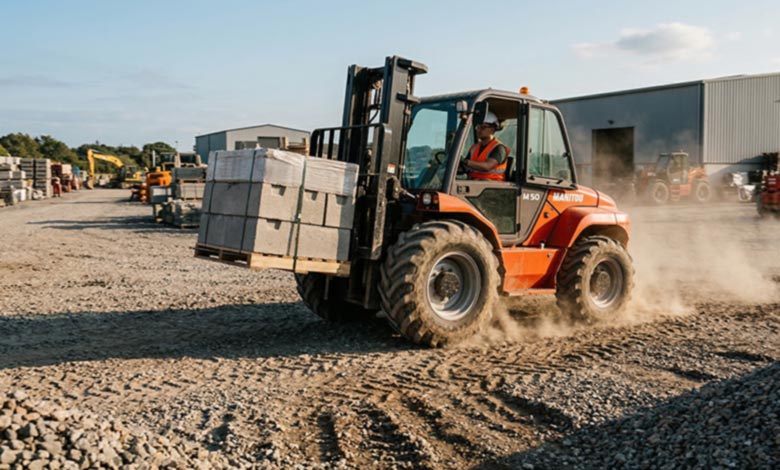
Brick yards are not like clean warehouse floors. The forklift may work on gravel, compacted soil, broken concrete, dust, brick chips, slopes near storage areas, wet ground after rain, and narrow paths between stacked materials.
The load also changes. One pallet may be compact and well stacked. Another may be loose, uneven, partly broken, or heavier on one side. The forklift may need to move from production to drying area, from storage yard to truck loading point, or between outdoor stacks all day.
So when I recommend a rough terrain forklift for brick yards, I do not only ask:
"How heavy is the load?"
I also ask:
"What does the yard look like after a full working day?"
The Short Answer
A rough terrain forklift is usually a good fit for brick yards when the buyer needs to move palletized bricks, blocks, cement products, or construction materials across outdoor ground that is too rough for a normal warehouse forklift.
But the right configuration depends on several details:
- pallet weight and pallet size
- load center and load stability
- ground condition
- tire type and tire protection
- lifting height
- turning space
- dust and debris
- attachment needs
- daily working hours
- local maintenance ability
If the buyer only chooses by rated capacity, the forklift may look correct on paper but feel uncomfortable in real work.
A Typical Brick Yard Situation
A typical buyer may tell me:
"We produce bricks and blocks. We need one forklift to move pallets from the production area to the storage yard and load trucks."
At first, this sounds simple.
But after seeing photos, the working condition may be more complicated:
- pallets are not always the same size
- some bricks are wet or dusty
- some pallets are damaged
- the outdoor yard has broken brick pieces on the ground
- trucks enter and leave the same road every day
- the forklift must turn between stacked materials
- rainy days make the surface softer
- the operator may work long hours during peak orders
In this case, the forklift is not only lifting bricks.
It is dealing with weight, dust, vibration, tire wear, visibility, ground condition, and repeated loading cycles.
That is why brick yard buyers should check more than tonnage.
If you are comparing application pages, this existing guide may also help: how to choose the right forklift for a brick and block factory.
1. Check the Real Pallet Weight, Not Only the Best-Looking Pallet
Brick and block pallets are often heavy, but the bigger problem is consistency.
Some buyers send one neat pallet photo and one weight number. That is useful, but it does not always show the real daily condition.
Before choosing a machine, check:
- normal pallet weight
- maximum pallet weight
- pallet dimensions
- whether the pallet is wooden, steel, or custom-made
- whether products are wet, dry, hollow, solid, wrapped, or loose
- whether broken or uneven pallets are common
OSHA's powered industrial truck guidance explains that load composition, weight distribution, and load center affect forklift stability and capacity. In practical terms, a compact, balanced load close to the mast is different from a wide, loose, uneven pallet.
This is why a supplier should not recommend a forklift only from one weight number.
2. Check Load Center and Fork Length
Brick pallets can look simple, but the load center still matters.
If the pallet is long, wide, or not positioned close to the mast, the forklift may feel different from what the rated capacity suggests. Long forks may help support a larger pallet, but they can also move the load farther forward if the operator does not handle the load correctly.
For brick yards, I usually ask:
- How wide is the pallet?
- How deep is the pallet?
- Does the pallet sit fully on the forks?
- Does the operator need fork extensions?
- Does the forklift need to load trucks from one side or both sides?
- Is there enough room to approach the pallet straight?
If the pallet size changes often, the buyer may also need to discuss fork spacing, side shift, or a fork positioner. For many yards, standard forks are enough. For others, a small front-end configuration change can save a lot of daily repositioning.
For more detail on fork setup, see rough terrain forklift attachments and configurations.
3. Check the Yard Surface After Trucks Have Passed
Brick yards often look different in the morning and in the afternoon.
In the morning, the road may look firm.
After trucks, loaders, forklifts, and workers move through the same path for hours, the surface may become rutted, dusty, broken, or muddy.
This matters because a rough terrain forklift still needs a workable route. It is not a machine that can ignore every ground problem.
Before choosing the forklift, buyers should check:
- compacted soil or loose soil
- gravel depth
- broken brick debris
- wet ground after rain
- slope near loading points
- narrow turns between storage stacks
- road width for truck and forklift traffic
- whether the route needs repair or reinforcement
If the yard is very rough, choosing 4WD alone may not solve the whole problem. Tire pattern, ground clearance, axle strength, turning space, operator habits, and route maintenance also matter.
For a broader construction-site angle, see how rough terrain forklifts improve efficiency on construction sites.
4. Do Not Ignore Tires
Brick yards can be hard on tires.
Broken brick pieces, sharp concrete edges, nails, gravel, steel scraps, and rough ground can all affect tire life. If the wrong tire is chosen, the buyer may think the forklift is weak when the real problem is contact between tire, ground, and daily route.

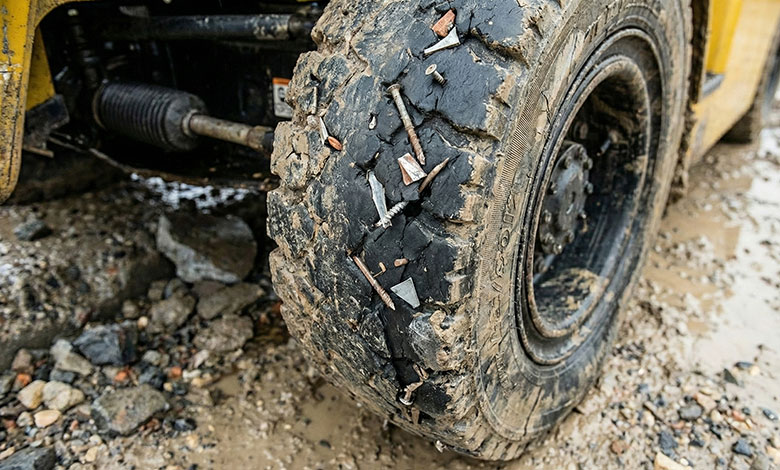
For brick yard work, check:
- whether the ground has sharp debris
- whether the yard becomes muddy in rain
- whether the route includes gravel, concrete, or mixed surfaces
- how far the forklift travels loaded
- whether replacement tires are easy to find locally
- whether the operator checks tire damage regularly
A tire is not only a consumable part. It affects traction, comfort, stability, and downtime.
If the tire does not match the yard, the machine may spend too much time slipping, bouncing, or stopping for service.
5. Check Lifting Height and Stacking Method
Some brick yards only move pallets from one place to another.
Other yards need to stack materials, load trucks, or place pallets into storage areas with limited height.
Before order, confirm:
- truck bed height
- maximum stacking height
- storage shed entrance height
- overhead obstacles
- mast lowered height
- whether the forklift must enter containers or simple warehouses
Mast choice should match the real lifting work. A forklift that lifts the load but cannot enter the shed, or cannot stack at the required height, still creates problems after delivery.
This is one of the most common details buyers forget when they focus only on capacity.
6. Think About Dust, Heat, and Daily Maintenance
Brick yards can be dusty.
Dust enters radiators, filters, engine compartments, electrical areas, grease points, and moving parts. During long working days, small maintenance habits become important.
For brick yard buyers, I like to discuss:
- engine air filter access
- radiator cleaning
- grease points
- hydraulic hose protection
- daily visual inspection
- spare filters and common wear parts
- tire inspection
- operator cleaning habits after work
This is not only a maintenance topic. It is a productivity topic.
A forklift that is easy to inspect and service is more useful in a dusty yard than a machine that looks strong but is difficult to maintain.
For related ownership thinking, see why some rough terrain forklifts become expensive to maintain.
7. Decide Whether Attachments Are Needed Early
Many brick yard buyers start with standard forks.
That may be correct.
But some applications may need:
- side shift for better pallet alignment
- fork positioner for different pallet sizes
- longer forks for deeper pallets
- clamps for special loads
- a bucket for loose material in some mixed-use yards
The attachment should be discussed before final configuration, not after the machine arrives.
Attachments can change weight distribution, load center, visibility, hydraulic needs, and the daily operating method. OSHA 1910.178 also treats attachments and modifications seriously when they affect capacity and safe operation.
If the buyer may use attachments later, tell the supplier early.
It may affect the recommended forklift, hydraulic preparation, fork carriage, mast, and working margin.
8. Do Not Forget Operator Comfort and Visibility
Brick yard work is repetitive.
The operator may spend hours loading, unloading, turning, stacking, reversing, and checking pallet position. If visibility is poor, if the seat is uncomfortable, or if controls are difficult to use, the problem appears every day.
For brick yards, visibility matters because:
- pallets may be stacked close together
- workers may move near the forklift
- trucks may enter the same loading area
- dust may reduce visibility
- the operator may need to see fork tips clearly
- broken pallets may require careful handling
Comfort is not a luxury in this situation. It affects fatigue, concentration, and daily efficiency.
My Brick Yard Forklift Checklist
Before choosing a rough terrain forklift for a brick yard or block factory, I would check these points:
| What to Check | Why It Matters |
|---|---|
| Normal and maximum pallet weight | Prevents choosing by one easy load only |
| Pallet size and load center | Affects real lifting margin and fork choice |
| Yard surface | Mud, gravel, debris, and broken brick change the job |
| Tire type and tire availability | Affects traction, wear, and downtime |
| Lifting height | Must match truck loading and stacking needs |
| Turning space | Narrow yards can make operation slower |
| Attachment plan | Side shift, fork positioner, or long forks may change configuration |
| Dust and daily maintenance | Brick yards can punish filters, radiators, hoses, and tires |
| Local support | Spare parts and service planning matter after delivery |
This checklist is more useful than asking only:
"How many tons can it lift?"
What to Send Before Asking for a Recommendation
If you want a supplier to recommend the right rough terrain forklift for a brick yard, send:
- photos of the yard surface
- photos of the normal pallets
- pallet size and load weight
- maximum load weight
- truck loading height
- required stacking height
- road width and turning space
- rainy-season ground condition
- daily working hours
- attachment needs
- destination country and spare parts expectations
You can start from the BLANC-ELE rough terrain forklift range and then send us your working condition for configuration advice.
Final Thought
A brick yard forklift is not only a lifting machine.
It is a daily production tool.
If the forklift cannot handle rough ground, heavy pallets, dust, broken debris, turning space, tire wear, and repeated loading cycles, the buyer may lose time even when the rated capacity looks correct.
So before choosing a rough terrain forklift for a brick yard, do not ask only about tonnage.
Ask whether the machine fits the yard.
That is the difference between a forklift that looks suitable on paper and a forklift that works smoothly every day.
References
- OSHA Powered Industrial Trucks eTool: Load composition, load center, stability, and capacity considerations: https://www.osha.gov/etools/powered-industrial-trucks/load-handling/load-composition
- OSHA 29 CFR 1910.178: Powered industrial trucks, including requirements related to attachments, modifications, nameplates, and rated capacity: https://www.osha.gov/laws-regs/regulations/standardnumber/1910/1910.178
- BLANC-ELE rough terrain forklift product pages, application pages, and supplier-side configuration experience. Final configuration should be confirmed before order.