
Buyer Questions From Real Inquiries
Rough Terrain Forklift FAQ
Practical answers for overseas buyers comparing BLANC-ELE 3T, 3.5T, 5T and 7T diesel 4WD rough terrain forklifts, including model selection, quotation details, engine and mast options, attachments, shipping, warranty and spare-parts support.
 4WD Diesel Forklift FAQ
FAQ 01
Rough Terrain Forklift Basics
What is a rough terrain forklift used for?
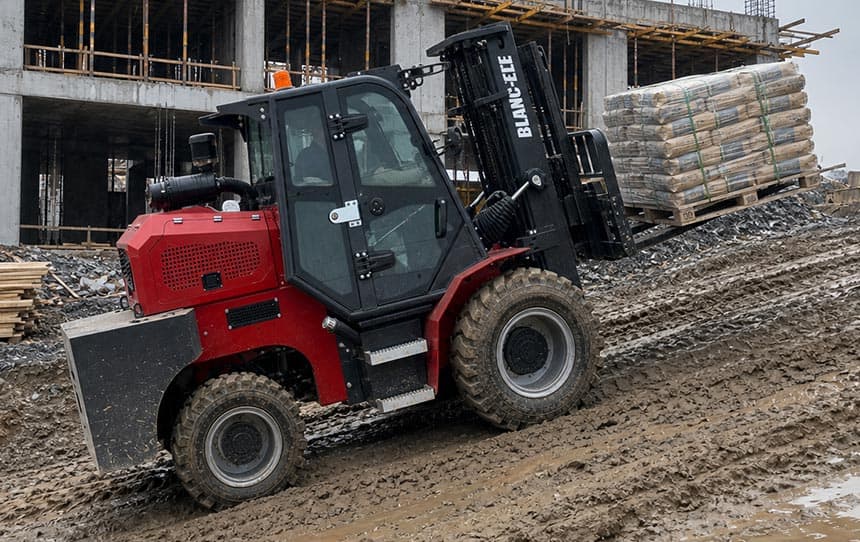
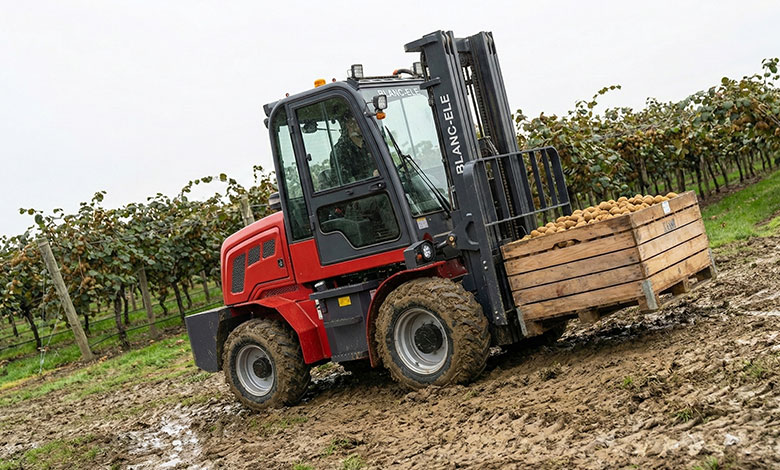
A rough terrain forklift is used where a normal warehouse forklift does not have enough traction, ground clearance or stability. Buyers usually ask about it for construction sites, farms, orchards, brick yards, outdoor storage yards and other uneven working areas. It is still a forklift, so load weight, load center, lifting height and ground condition must be checked together before choosing a model.
Can BLANC-ELE rough terrain forklifts work on muddy or uneven ground?
BLANC-ELE rough terrain forklifts are designed for outdoor ground such as gravel, packed soil, uneven yards and farm routes. Four-wheel drive, off-road tyres and ground clearance help improve traction compared with standard warehouse forklifts. However, real suitability depends on soil condition, slope, route length, load weight and operator method. For muddy sites, buyers should share photos or videos before quotation.
What information should I send before asking for a quotation?
The fastest quotation normally requires rated load, actual load dimensions, required lifting height, working ground, destination country, destination port, quantity and any required options. If you need a special attachment, longer forks, closed cabin, A/C or a specific emission requirement, include that early. This helps the sales team recommend a suitable configuration instead of sending a generic price.
Is a rough terrain forklift the same as an all terrain forklift or off road forklift?
Many buyers use these terms to describe similar outdoor forklifts. In BLANC-ELE product discussions, rough terrain forklift, 4WD forklift and off road forklift usually refer to diesel forklifts for outdoor ground where traction and clearance matter. The exact configuration can still differ by capacity, steering layout, tyre type, mast height, engine and attachment. The safest approach is to describe the job site instead of relying only on the name.
Can I use a rough terrain forklift on both outdoor yards and concrete floors?
Yes, many buyers use one machine across outdoor yards, loading areas and concrete sections. The important point is to check tyre type, turning space, door height, floor condition and whether the machine needs to enter warehouses or containers. A rough terrain forklift is optimized for outdoor traction and clearance, so it may not replace a compact warehouse forklift in tight indoor aisles.
FAQ 02
Models and Capacity
Which model should I choose: 3T, 3.5T, 5T or 7T?
Model choice should start with real load weight, load size, lifting height and site condition. The 3 Ton Rough Terrain Forklift suits compact outdoor handling. The 3.5 Ton Rough Terrain Forklift gives more reserve capacity. The 5 Ton Rough Terrain Forklift and 7 Ton Rough Terrain Forklift are better for heavier materials and more demanding sites.
Should I choose 3T or 3.5T?
Buyers comparing 3T and 3.5T usually want to know whether the extra capacity is worth it. Choose 3T when the load is clearly within the rated range and the site is compact. Choose 3.5T when loads vary, the ground is rougher, or you want more reserve capacity without moving to a larger 5T machine. Share the heaviest pallet and lifting height before deciding.
When is a 5T rough terrain forklift a better choice?
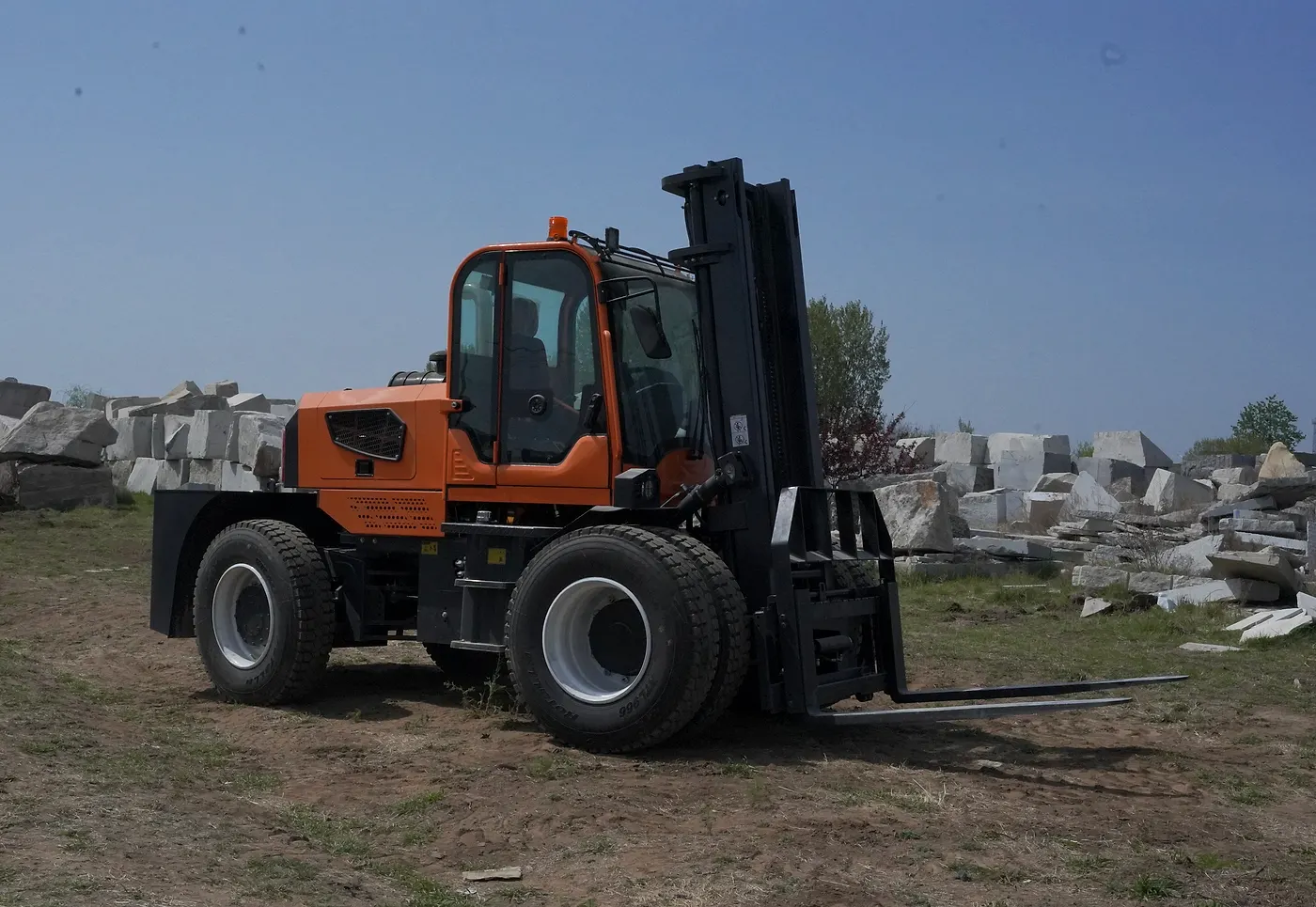
A 5T model is usually considered when the buyer handles heavier construction materials, stone-yard loads, large pallets, timber or project cargo. It may be more suitable than 3.5T when load weight, attachment weight or working duty is higher. The tradeoff is larger machine size, higher shipping consideration and different cost structure. For quotation, BLANC-ELE normally checks load details and route condition first.
When should I consider the 7T model instead of a 5T model?
The 7T model is usually reviewed when the buyer handles heavy stone, large construction materials, dense timber, big pallets or loads that leave little reserve capacity on a 5T machine. It is not automatically the better choice, because size, turning route, container loading and cost also increase. Share the real load weight, load dimensions and working route before moving up to 7T.
Can BLANC-ELE recommend one model for mixed farm and construction work?
Yes, but the recommendation should be based on the heaviest regular job, not the lightest daily task. Buyers doing mixed work should share the main materials, maximum pallet weight, route width, ground condition and required lift height. A 3.5T or 5T machine may be more practical than choosing only by budget if the site includes heavier or more varied loads.
Do you support dealers or distributors buying multiple models?
Yes. Many inquiries come from dealers and importers who compare several capacity classes before placing an order. For dealer discussions, it is useful to share target market, expected customer applications, preferred capacity range, emission requirements and first-order quantity. Dealer pricing, sample units, marketing material and spare-parts planning can be discussed after company verification and configuration confirmation.
FAQ 03
Engine, Mast and Tire Options
What engine options are available?
Engine configuration depends on the selected model and destination-market requirement. Some buyers ask for standard diesel configuration, while others need a different engine brand or emission standard. BLANC-ELE should confirm the destination country before quoting higher emission configurations. Do not assume that every emission standard is included in the base configuration; engine and emission options are quoted separately when required.
Can you meet Euro V, Stage V or local emission requirements?
Emission requirements should be confirmed before quotation because rules differ by country and application. If the buyer needs Stage V, Tier 4 Final or another local requirement, BLANC-ELE can review whether a matching engine configuration is available for the selected model. Price, lead time and technical documents may change with the required emission standard, so this should be stated clearly at the inquiry stage.
What mast height should I choose?
Mast height should match the highest stacking or loading point, but it should also be checked against residual capacity and transport height. Buyers often ask for 3 m, 4.5 m, 5 m or 6 m options. A higher mast can affect stability and usable capacity, especially with attachments or long loads. Send the required lifting height, load size and overhead clearance before choosing the mast.
What tire type is used for rough terrain work?
Rough terrain forklifts normally use deep-tread off-road tyres to improve traction on outdoor routes. Tyre selection should match mud, gravel, packed soil, construction-site debris or yard surfaces. Buyers should not choose by tyre appearance only; the whole machine configuration matters, including drive system, ground clearance, weight, axle structure and operator practice. If the site is very soft or steep, send photos before ordering.
Does a higher mast reduce the usable capacity?
It can. Rated capacity, load center, mast height and attachment weight work together. A higher mast may reduce residual capacity at height, especially when handling long, bulky or off-center loads. This is why buyers should not choose a mast only by the maximum height number. Send the load size, load weight and required stacking height so the configuration can be checked properly.
FAQ 04
Attachments and Custom Configurations
Can I choose side shift, clamps or longer forks?
Common buyer requests include side shift, fork extensions, longer forks, clamps, fork positioning and bucket-type solutions. Compatibility depends on forklift capacity, hydraulic system, load type and residual capacity after the attachment is installed. Attachments can change price, lead time and usable load capacity. Before quoting, BLANC-ELE needs to know the material handled, load size, load weight and operating method.
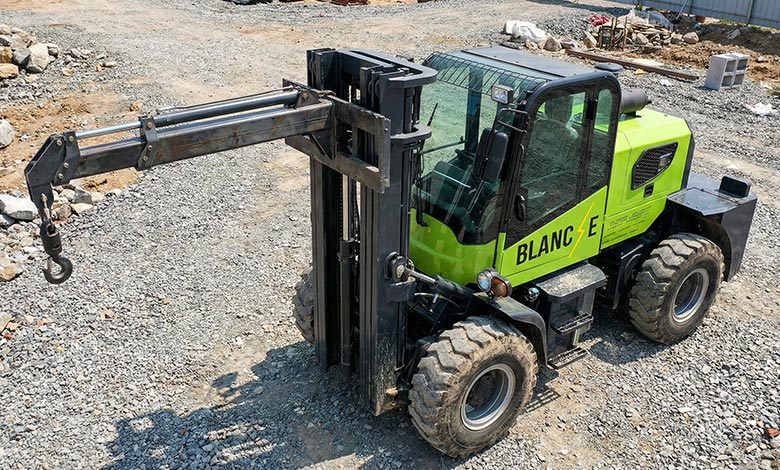
Can I use a crane jib attachment on a rough terrain forklift?
Crane jib attachments can be reviewed for some lifting tasks, but they must be checked carefully because the load position and lifting method are different from normal fork handling. The quotation team needs the load weight, lifting radius, required height and working ground condition. A crane jib should not be selected only from a picture; compatibility and safe usable capacity must be confirmed first.
How do I decide the right fork length?
Fork length depends on pallet size, load depth, load stability and the way the machine enters the load. Longer forks may help with wide or deep materials, but they can also affect handling and residual capacity. Buyers should send load dimensions and photos if the material is not a standard pallet. BLANC-ELE can then review whether standard forks, longer forks or fork extensions make sense.
Can I add a closed cabin or air conditioner?
Closed cabin and A/C are common options for hot, dusty or rainy outdoor sites. They can improve operator comfort, but they also affect price, configuration and sometimes delivery planning. Buyers should state whether the machine will work in farms, construction sites, mines, rental fleets or long daily shifts. Cabin type should be confirmed together with visibility, maintenance access and local climate requirements.
Can BLANC-ELE customize a forklift for my site?
Many configurations can be reviewed, but customization should be based on a real work requirement, not a long option list. Useful details include load dimensions, lifting height, road width, turning space, slope, ground condition, attachment need and destination regulations. BLANC-ELE can discuss a practical configuration and explain how options may affect cost, delivery time, maintenance and residual capacity.
Can I request technical specifications, catalog or videos before ordering?
Yes. Buyers often ask for technical specifications, catalogs, photos or working videos before confirming a model. BLANC-ELE can provide available product materials after the target capacity and application are clear. For a formal quotation or Proforma Invoice, the team still needs configuration details and destination port. Technical files should match the selected model and options rather than being treated as universal across all machines.
FAQ 05
Price, MOQ and Lead Time
How do you calculate FOB and CIF price?
FOB quotation usually covers the machine and export handling at the departure port, while CIF quotation also includes sea freight to the destination port. CIF cannot be calculated accurately without a destination port because freight changes by route, vessel space and shipping date. Buyers should send model, configuration, quantity and port so BLANC-ELE can prepare a configuration-based FOB or CIF quotation.
Why is there no fixed public price on the page?
Rough terrain forklift price changes with capacity, engine, emission requirement, mast height, cabin, attachment, tyre configuration, quantity and shipping terms. A public starting price can easily mislead buyers if it excludes important options or freight. BLANC-ELE uses configuration-based quotation so the buyer can compare the correct machine, not only the lowest visible number. Dealer pricing is reviewed after company verification.
What is the MOQ?
Many rough terrain forklift inquiries start with one unit, especially for first-time importers, end users or sample orders. MOQ and quotation conditions should be confirmed according to model, configuration and shipment plan. Dealers and distributors may request multi-unit pricing after confirming their market and product mix. If you plan to order several units, mention the expected quantity and timeline in the first inquiry.
What is the lead time after deposit?
Lead time depends on whether the forklift is a standard configuration or includes special engine, mast, cabin, attachment or emission requirements. Production schedule, component availability and shipping plan can also affect timing. BLANC-ELE should confirm the latest estimated lead time in the Proforma Invoice or formal quotation. Buyers with urgent projects should state the target delivery date before confirming the order.
FAQ 06
Shipping, Warranty and After-sales Support
How are rough terrain forklifts shipped?
Shipping method depends on forklift size, weight, selected model and destination. Some machines may require specific loading plans, partial disassembly or careful securing before container shipment. Larger capacity models need more attention to dimensions and loading method. For accurate shipping advice, send the model, quantity and destination port. BLANC-ELE can review available packing and loading information after configuration is confirmed.
How many units fit in one container?
Container loading quantity depends on the model, mast height, tyre size, attachment, cabin and whether any parts are removed for shipment. Buyers often ask this question when comparing 5T or 7T machines, but it should not be answered with one fixed number for every configuration. BLANC-ELE can confirm the loading plan after the final machine dimensions and shipping method are reviewed.
What warranty and spare-parts support do you provide?
Warranty terms and spare-parts arrangements should be confirmed in the formal quotation and sales contract. For export buyers, BLANC-ELE can discuss recommended wear parts, manuals, parts diagrams, photos and videos to support remote maintenance. It is better to plan key spare parts with the machine shipment, especially for farms, construction sites or remote areas where downtime is expensive.
Can you provide after-sales support overseas?
BLANC-ELE can support export customers through email, WhatsApp, photos, videos, manuals and parts diagrams. The support method depends on the issue, machine configuration and parts availability. The page should not be understood as a promise of local technicians in every country or same-day on-site service. For dealers, spare-parts planning and basic service material can be discussed before the first order.
What export documents are usually discussed before shipment?
Export document requirements vary by country, buyer type and shipping term. Buyers commonly ask about commercial invoice, packing list, bill of lading and documents needed for customs clearance. Any special certificate, inspection document or local registration requirement should be mentioned before quotation. BLANC-ELE can review available documents after the final model, configuration, shipment method and destination country are confirmed.
Need help choosing a rough terrain forklift?
Send us your working site, lifting capacity, mast height, and attachment requirements. Our team will help recommend a suitable model.
Request a Quote