
When many overseas buyers ask me for a rough terrain forklift, the first question is usually very simple:
"What rated load should I choose?"
I understand why buyers ask this first. Rated load is easy to compare. It is written clearly in brochures. It also feels like a safe number: if the load is not heavier than the rated capacity, the machine should be suitable, right?
In real outdoor work, it is not that simple.
Rated load matters. I never say it is unimportant. But for rough terrain forklifts, rated load is only the starting point. The real decision also depends on load center, cargo shape, lifting height, ground condition, tire choice, attachment plan, operator habit, and daily workload.
This is why some buyers do not regret the machine on the first day.
They regret it after a few months of real work.
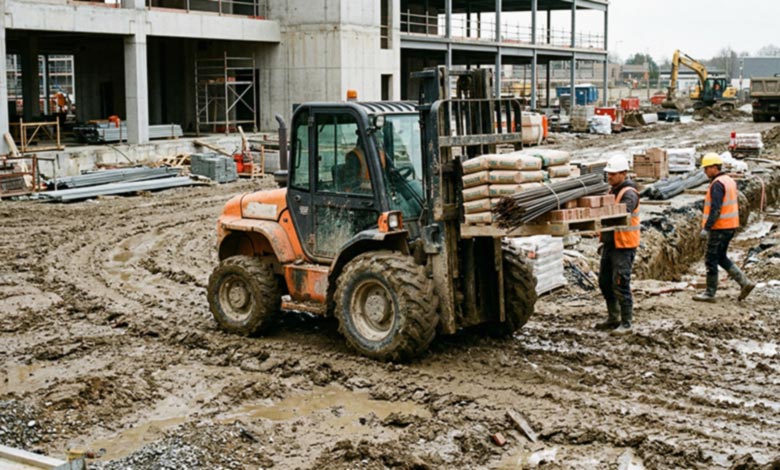
The Common Mistake: "The Load Is Within Capacity"
One sentence I hear very often is:
"Our load is within the rated capacity, so it should be okay."
Sometimes yes.
But not always.
A compact pallet near the mast is very different from a long steel bundle sitting far forward on the forks. A dry concrete yard is different from a muddy construction route. A short lift is different from high stacking. Forks are different from a bucket, clamp, fork extension, or lifting jib.
The load weight may be the same, but the working condition is not the same.
This is the part buyers often miss.
The brochure number tells you what the machine can be rated for under defined conditions. It does not automatically answer every real job site. For outdoor sites, the gap between "rated capacity" and "comfortable daily work" can become very large.
If you want a broader view of wrong selection before delivery, this related article is useful: most forklift problems actually start before the machine arrives.
A Typical Case I See
Here is a typical situation from construction and material-yard buyers.
A buyer says:
"We only lift normal construction materials. The maximum load is not higher than the rated load of the forklift. Please recommend the most suitable model."
Then I ask for photos.
After checking the photos, the work becomes more complicated:
- some loads are long steel or pipe bundles
- some pallets are wrapped loosely and not evenly balanced
- the forklift must travel across unfinished ground
- the buyer wants longer forks for larger pallets
- some work happens during rainy season
- the operator may need to lift while turning in a narrow yard
Now the original question changes.
It is no longer only:
"Can the forklift lift this weight?"
It becomes:
"Can the forklift handle this load shape, at this load center, on this ground, with this attachment, for this daily route?"
That is a very different question.
And if we do not ask it before order, the buyer may only discover the problem after the machine arrives.
Rated Load Is Usually Based on Load Center
One of the most important ideas is load center.
OSHA's powered industrial truck guidance explains that load composition, weight distribution, and load center affect forklift stability and capacity. In simple words, a load is not only about weight. It is also about where that weight sits.
If the load sits close to the mast, the forklift has a better working condition.
If the load sits far forward, the machine has a harder job.
This is why two loads with the same weight may feel completely different in operation.
For example:
- a compact pallet of blocks close to the mast
- a long bundle of pipe extending forward
- a large bag that is not centered well
- a wide pallet that needs longer forks
- an attachment that adds its own weight before the material is lifted
All of these can change the real handling condition.
That is why I do not like giving a recommendation only from the maximum load weight.
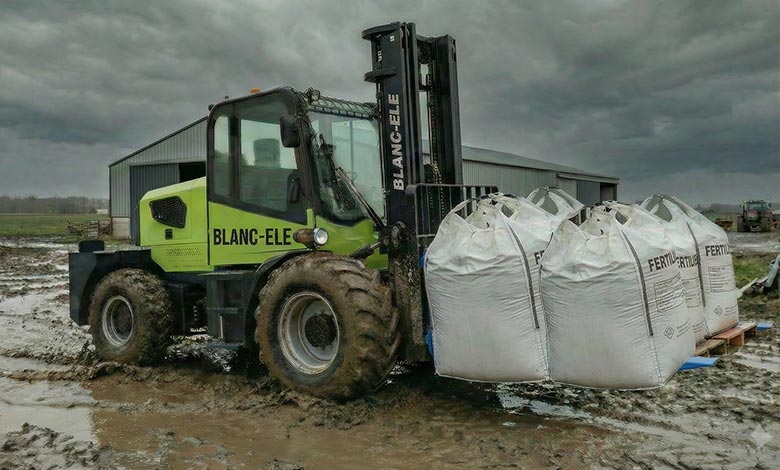
Long Loads Create More Risk Than Buyers Expect
Long loads are very common in outdoor work.
Construction buyers handle steel bars, pipes, timber, formwork, panels, and long material bundles. Agricultural buyers may handle long crates, large bags, or irregular cargo. Yard buyers may handle materials that are not packed neatly like warehouse pallets.
When the load is long, the center of gravity may move forward.
When the center of gravity moves forward, the forklift may lose some working margin.
This does not mean the forklift cannot do the job. It means the supplier needs to understand the real cargo before recommending the configuration.
For long loads, I usually want to know:
- cargo length
- cargo width
- cargo height
- normal load weight
- maximum load weight
- whether the load is evenly packed
- whether fork extensions are needed
- lifting height
- travel distance with the load
- ground condition on the route
Without these details, the rated load number alone is not enough.
Attachments Can Change the Real Capacity Discussion
Many buyers first ask for forks.
Later, they add:
"Can we also use a bucket?"
"Can we add a clamp?"
"Can we use fork extensions?"
"Can we lift some material with a jib?"
This is exactly why I prefer to discuss attachments early.
Attachments can affect:
- load center
- visibility
- hydraulic requirement
- front-end weight
- fork length
- mast selection
- machine balance
- operator difficulty
OSHA's powered industrial truck standard also treats attachments seriously. When additions or modifications affect capacity and safe operation, approval and proper markings are required. This is not just paperwork. It is a reminder that attachments can change the way a forklift works.
So if a buyer chooses the machine only by rated load and then adds an attachment later, the original decision may no longer be correct.
For this topic, I strongly suggest reading this guide before finalizing a machine: rough terrain forklift attachments and configurations.
Ground Condition Can Turn a "Safe Number" Into a Hard Job
A rated capacity number does not describe the ground.
That is another reason buyers make mistakes.
A rough terrain forklift may be designed for outdoor use, but outdoor use still has many different conditions:
- compacted soil
- gravel
- broken concrete
- soft mud
- sand
- farm paths
- slopes
- narrow job-site routes
- rainy-season ground
- stone yards or brick yards
The same machine may feel very different on different surfaces.
If the forklift lifts a load near its working limit on flat, firm ground, that is one situation. If it travels with the same load on uneven ground, soft soil, or a slope, the work becomes harder and the margin becomes smaller.
This is why I always ask for site photos or a short route video.
A buyer may think they are asking a product question.
Actually, they are asking a site-condition question.
For slope-related decisions, this related BLANC-ELE article may help: what slope can a forklift handle?
Lifting Height Also Changes the Feeling of Capacity
Some buyers only mention weight, but forget lifting height.
That is a problem.
Lifting a load a short distance for truck unloading is different from stacking higher under a shed or placing materials on a raised platform. As lift height increases, stability and mast choice become more important.
So when a buyer says:
"The load is not heavy."
I still ask:
"How high do you need to lift it?"
For rough terrain forklifts, mast height, overhead clearance, container loading, shed entrance height, and stacking height should be discussed before order. If the mast is not suitable, the machine may still lift the weight but fail the real job.
This is one of the quiet reasons buyers regret choosing only by rated load. They got the capacity right but missed the height, route, or clearance.
Daily Workload Matters More Than One Successful Lift
There is a difference between "can lift once" and "can work comfortably every day."
In my experience, many buyers think about the heaviest load only. They do not always think about the full working day.
For example:
- How many hours does the machine work each day?
- Does it travel loaded most of the time?
- Is the operator working in heat, dust, mud, or rain?
- Does the machine turn often with a load?
- Does it work during peak harvest, construction deadlines, or factory loading periods?
- Is there time for daily maintenance?
A machine that is always working close to its limit may wear faster, feel less stable, and create more pressure on the operator and maintenance team.
This is why the best choice is not always the smallest machine that can technically lift the load.
It is also not always the biggest machine available.
The better choice is the configuration that matches the real work rhythm.
Bigger Is Not Always the Answer
Some buyers hear all this and think:
"Then I should just buy a bigger forklift."
Not always.
Bigger machines can bring other problems:
- higher shipping weight and size
- larger turning radius
- more space needed on site
- different tire and ground pressure considerations
- harder work in narrow yards
- more machine than the job really needs
So my advice is not "always choose bigger."
My advice is:
"Choose with enough working margin for your real condition."
There is a difference.
If the job is compact pallet handling on firm ground, the recommendation may be straightforward. If the job includes long loads, rough ground, attachments, higher lift, or long working hours, we need to check more carefully.
What I Ask Before Recommending Capacity
Before I recommend a rough terrain forklift, I prefer to ask these questions:
| Question | Why It Matters |
|---|---|
| What is the normal load weight? | Daily work matters more than only the maximum load. |
| What is the maximum load weight? | The machine should not be selected below the real peak load. |
| What is the load size? | Large cargo can move the load center forward. |
| Is the load compact or irregular? | Uneven loads change handling and visibility. |
| What lifting height is required? | Mast choice and stability depend on height. |
| What ground does the forklift travel on? | Mud, gravel, slope, and soft soil change the job. |
| How far does it travel with load? | Long loaded travel creates different stress than short lifting. |
| Are attachments needed? | Attachments can change load center and operation. |
| How many hours per day will it work? | Daily workload affects machine selection and maintenance planning. |
| Who will maintain it locally? | Support ability should match machine complexity. |
This table is simple, but it prevents many wrong recommendations.
A More Useful Way to Ask for a Recommendation
Instead of asking:
"What rated load should I choose?"
Send a message like this:
"We need a rough terrain forklift for outdoor material handling. The normal load is [weight], maximum load is [weight], and the load size is [length x width x height]. The ground is [soil/gravel/mud/concrete/slope]. Required lifting height is [height]. The forklift will travel about [distance] with load. We may use [attachment]. Please help check the suitable configuration."
This kind of inquiry saves time for both sides.
It also helps the supplier avoid recommending a machine only from one number.
You can start from the BLANC-ELE rough terrain forklift range and then send us your working condition for configuration advice.
Final Thought
Rated load is important.
But rated load is not the whole decision.
Many buyers regret choosing a forklift only by rated load because the real job includes more than weight. Load center, cargo shape, ground condition, lifting height, attachments, daily workload, and maintenance support all affect whether the machine works comfortably after delivery.
As a supplier, I would rather spend a little more time checking these details before order than see the buyer discover the problem after the machine arrives.
The right question is not only:
"How much can it lift?"
The better question is:
"Can it handle my real load, on my real ground, in my real daily work?"
That is the question that leads to a better forklift decision.
References
- OSHA Powered Industrial Trucks eTool: Load composition, load center, stability, and capacity considerations: https://www.osha.gov/etools/powered-industrial-trucks/load-handling/load-composition
- OSHA 29 CFR 1910.178: Powered industrial trucks, including requirements related to modifications, attachments, nameplates, and rated capacity: https://www.osha.gov/laws-regs/regulations/standardnumber/1910/1910.178
- BLANC-ELE rough terrain forklift product pages, specification documents, and supplier-side configuration experience. Final configuration should be confirmed before order.