When overseas buyers compare rough terrain forklifts, many of them focus on the big things first:
- Engine
- Capacity
- 4WD system
- Mast height
- Tire type
- Attachments
- Delivery time
These details are important.
But after working with more outdoor forklift buyers, I have learned that one detail is often underestimated:
Maintenance access.
A rough terrain forklift may work on farms, construction sites, stone yards, plantations, outdoor warehouses, and muddy roads. These jobs are harder than clean warehouse work. The machine may face dust, mud, rain, vibration, long working hours, and operators with different maintenance habits.
In that situation, the question is not only:
"Can the forklift work?"
The better question is:
"Can the local team inspect, grease, clean, and service it easily when it is working every day?"
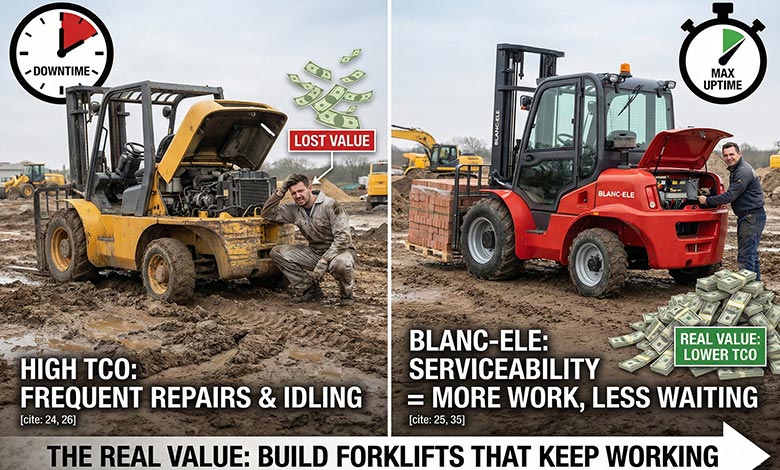
If you are already thinking about long-term ownership, you may also read our article on why some rough terrain forklifts become expensive to maintain.
Maintenance Access Is Not A Small Design Detail
Some buyers treat maintenance access as something to check after the machine arrives.
I do not agree.
For rough terrain forklifts, it should be discussed before order.
Why?
Because the easier a machine is to inspect and service, the more likely the operator or local mechanic will actually do the work on time.
If filters are difficult to reach, grease points are hard to find, covers are inconvenient to open, or hoses are difficult to identify, daily maintenance becomes easier to ignore.
At first, the machine may still work.
But after weeks or months of outdoor use, small ignored issues can become bigger problems:
- Dust blocks filters.
- Grease points are missed.
- A small hose leak is not noticed early.
- Loose wiring is not checked.
- Tire damage is ignored.
- Operators skip daily inspection because it feels too troublesome.
This is why easy maintenance access is part of real machine quality.
Outdoor Work Makes Maintenance More Important
Rough terrain forklifts usually work in tougher places than warehouse forklifts.
They may face:
- Mud
- Dust
- Rain
- Gravel
- Crop debris
- Stone chips
- Uneven ground
- Long outdoor shifts
- Frequent starting, turning, and lifting
These conditions do not only test the engine and axle.
They also test the maintenance routine.
OSHA's powered industrial truck guidance includes pre-operation checks because inspection is part of safe daily use. For outdoor forklifts, this idea becomes very practical: the operator should be able to notice problems early.
But if the machine is not easy to check, small problems can stay hidden.
That is why I like to ask buyers:
"Who will maintain the forklift after it arrives?"
"Can that person easily check the basic service points?"
Dive Deeper: A Typical Overseas Job-Site Problem
A typical overseas case looks like this.
At first, the buyer focuses on capacity and delivery.
The machine arrives and starts working on an outdoor site. For the first few weeks, everything seems normal.
Then the site becomes dusty or muddy.
The operator is busy.
The local mechanic has limited time.
The machine still works, so daily inspection becomes shorter and shorter.
After some time, small issues begin to appear:
- A filter is dirty.
- A hose starts to leak.
- A grease point is missed.
- A loose part makes noise.
- A warning sign is noticed too late.
The problem is not always one big failure.
Often, it is a chain of small maintenance delays.
If the service points are easy to reach and easy to identify, the local team has a better chance to handle problems early.
What Looks Fine At Delivery And What Appears Later
| At delivery | After real outdoor work starts |
|---|---|
| Machine looks strong and clean | Dust, mud, and vibration create daily inspection needs |
| Service points seem like small details | Hard-to-reach parts are skipped more often |
| Operator says maintenance is simple | Busy sites shorten inspection time |
| Spare parts are not urgent | A small part can stop work later |
| Local team can repair machines | They still need clear access and parts identification |
| The machine works well in early use | Long-term reliability depends on service habits |
This is why I recommend buyers check maintenance access before choosing only by model or configuration.
Filters Should Be Easy To Reach
Filters are normal maintenance items.
But if the filter position is inconvenient, the operator may delay replacement or cleaning.
Before ordering, buyers can ask:
- Where are the air filter and fuel filter located?
- Can the operator access them without removing too many parts?
- Is there enough room for the local mechanic to work?
- Are filter models easy to identify?
- Can the supplier provide clear parts photos?
This is especially important in dusty environments such as construction sites, farms, stone yards, and dry outdoor roads.
If the forklift works in dust every day, filter access is not a small issue.
It becomes part of uptime.
Grease Points Should Be Clear
Greasing is one of the simplest maintenance tasks.
But simple does not mean it always happens.
If grease points are difficult to find or scattered without clear guidance, operators may miss them.

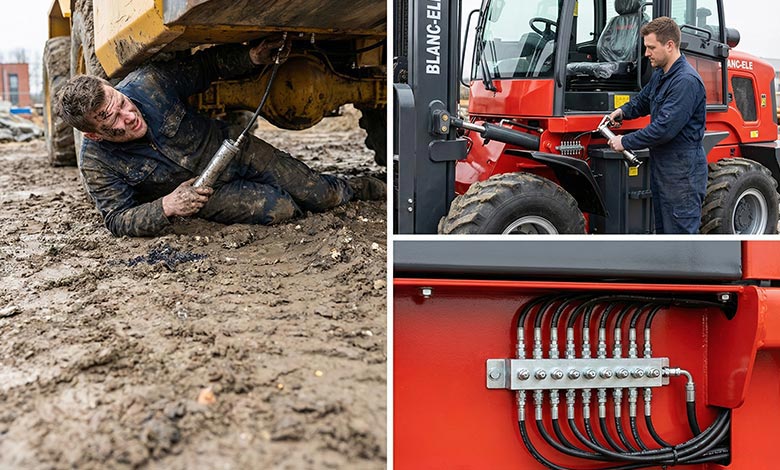
For rough terrain forklifts, greasing matters because outdoor work often involves vibration, uneven ground, mast movement, steering movement, and attachment use.
Before order, ask:
- Are grease points easy to find?
- Does the supplier provide a grease point guide?
- Are important pivot points convenient to reach?
- How often should the operator check them?
- Can the buyer get photos or videos for maintenance training?
For overseas buyers, photos and videos are very useful.
They reduce confusion when the machine is already far away from the supplier.
Hoses And Hydraulic Areas Should Be Easy To Inspect
Hydraulic hoses are normal working parts on forklifts.
They should be checked regularly, especially on rough terrain applications.
Outdoor sites can expose hoses to:
- Vibration
- Dirt
- Mud
- Stone impact
- Repeated mast movement
- Attachment movement
- Operator mistakes
If a hose starts leaking, early detection matters.
Before choosing a forklift, ask whether the hydraulic hose routing is easy to inspect and whether common hose positions can be photographed and identified clearly.
This does not mean every issue can be avoided.
It means the local team should not need to guess where the problem is.
Electrical Checks Should Not Be Overcomplicated
Electrical issues are frustrating for overseas buyers because diagnosis can take time.
The buyer may be far from the supplier.
The local mechanic may need photos, wiring guidance, or video support.
Before order, buyers should ask:
- Are key electrical components easy to access?
- Can the supplier provide basic troubleshooting guidance?
- Are dashboard warnings easy to understand?
- Can parts be identified by photo?
- Is remote support available when needed?
The goal is not to turn the buyer into an engineer.
The goal is to make basic inspection and communication easier.
When a buyer can send clear photos and the supplier can identify the part quickly, support becomes faster.
External Filling Points Can Save Time
Some design details look small, but they matter in daily work.
External filling points, clear caps, visible levels, and easy access covers can reduce the chance of skipped maintenance.
On a busy job site, the operator may not have much patience for complicated service steps.
If checking and filling are simple, the work is more likely to be done.
This is especially useful for:
- Farms during busy season
- Construction sites with long shifts
- Outdoor yards with dust
- Remote jobsites with limited mechanics
- Dealers supporting many machines
Small service design details can support better maintenance habits.
Spare Parts Identification Is Part Of Maintenance Access
Maintenance access is not only physical access.
It is also information access.
For overseas buyers, clear parts identification is very important.
Before order, ask the supplier:
- Can you provide a common spare parts list?
- Can you provide parts photos?
- Can you mark filter, hose, seal, pin, and electrical parts clearly?
- Can the buyer send photos for identification later?
- Which parts should be prepared for normal maintenance?
This helps reduce downtime later.
When a local team can identify the correct part quickly, communication becomes easier and mistakes are reduced.
Maintenance Access Matters More For Dealers And Rental Buyers
Dealers and rental companies should pay even more attention to maintenance access.
Why?
Because one machine may be used by different operators and customers.
The dealer may need to inspect, service, and prepare machines repeatedly.
If service access is poor, every maintenance job takes more time.
If parts are difficult to identify, support becomes slower.
If operators miss basic checks, small issues can return again and again.
For dealers, a machine that is easy to inspect and service can be easier to manage across different customers.
What Buyers Should Ask Before Order
| Question | Why it matters |
|---|---|
| Are filters easy to reach? | Filters are common service items, especially in dusty sites |
| Are grease points clear? | Missed lubrication can create long-term wear |
| Are hydraulic hoses easy to inspect? | Small leaks should be noticed early |
| Are electrical parts easy to identify? | Remote troubleshooting becomes faster |
| Are filling points convenient? | Simple daily service is more likely to happen |
| Is there a common spare parts list? | Overseas buyers can prepare normal maintenance parts |
| Can the supplier provide maintenance photos or videos? | Helps local operators and mechanics |
| Can parts be identified by photo later? | Reduces wrong-part communication |
What Information Should You Send To BLANC-ELE?
If maintenance access is important for your project, send:
- Job site type
- Working hours per day
- Dust, mud, rain, or stone conditions
- Local mechanic ability
- Whether the forklift will be used by multiple operators
- Whether the machine is for your own use, rental, or resale
- Preferred spare parts preparation
- Any local maintenance limits
You can also start from the BLANC-ELE rough terrain forklift range and then send us your working condition for configuration advice.
Conclusion
Easy maintenance access is not the most exciting feature on a rough terrain forklift.
But after the machine starts working every day, it becomes very important.
A forklift that is easier to inspect, grease, clean, and service is more likely to be maintained correctly by the local team.
For overseas buyers, this can reduce confusion, speed up support, and help small problems get noticed earlier.
If you are choosing a rough terrain forklift, do not only ask about capacity, 4WD, tires, and attachments. Also ask how easy the machine is to maintain after it arrives.
References
- OSHA 29 CFR 1910.178, Powered Industrial Trucks: https://www.osha.gov/laws-regs/regulations/standardnumber/1910/1910.178
- OSHA eTool, Powered Industrial Trucks - Pre-Operation: https://www.osha.gov/etools/powered-industrial-trucks/operating-forklift/pre-operation
- BLANC-ELE rough terrain forklift product, service, and specification documents. Final configuration should be confirmed before order.