
Quick Answer: On flat, dry ground, 2WD (Two-Wheel Drive)1 and 4WD (Four-Wheel Drive)2 forklifts perform similarly. However, in real outdoor projects, 4WD provides essential traction redundancy3. While 2WD requires the operator to constantly manage grip limits to avoid getting stuck, 4WD allows for continuous, predictable workflow even when ground conditions change from mud to gravel.
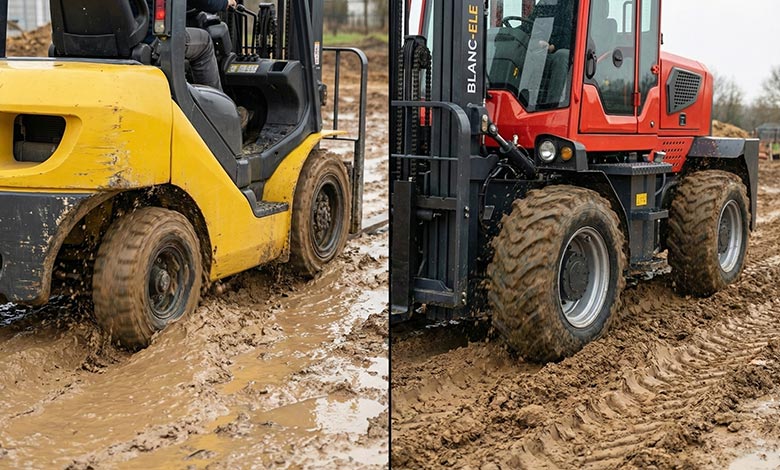
When customers evaluate rough terrain forklifts, the question of 2WD or 4WD almost always comes up. From our experience at BLANC-ELE4 working with real outdoor applications, this is not a question that can be answered by a spec sheet or a short demo alone.
The real difference appears when the forklift must operate under changing ground conditions5 and continuous workloads, not just ideal surfaces.
1. An Honest Starting Point: On Ideal Ground, They Feel the Same
Let’s start with a reality many people overlook.
On dry, flat, hard ground, 2WD and 4WD rough terrain forklifts can feel very similar. Some customers even tell us during early trials:
“The 2WD version seems to work just fine. Why pay more?”
In short-term, controlled conditions, that impression is understandable. The issue is that real outdoor work rarely stays in ideal conditions for long.
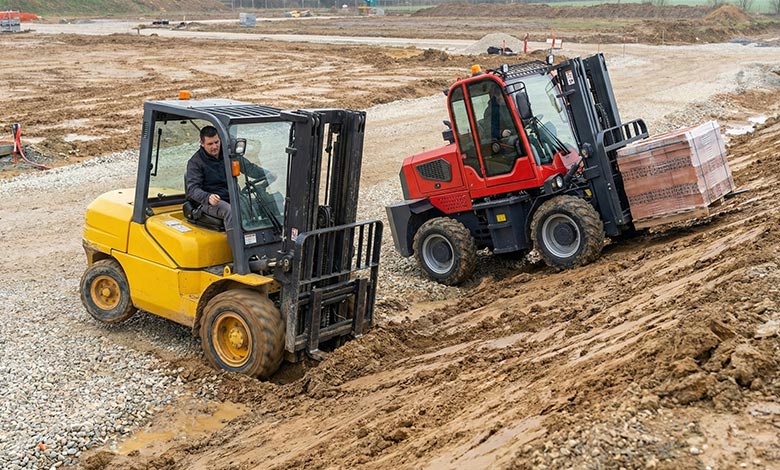
2. The Real Gap Appears When Stability Limits Are Tested
In outdoor environments, ground conditions are not fixed. They change constantly:
- Soft soil alternating with compacted ground.
- Gravel mixed with dirt and wet patches after rain.
- Mild but continuous slopes.
- Frequent transitions between loaded (heavy front axle) and unloaded (light rear axle) operation.
Why 2WD Reaches Its Limits Faster
From an engineering standpoint, the challenge with 2WD is not that it cannot work, but that its stable operating range6 is narrower.
When the driven wheels (usually the front) encounter reduced grip:
- Available traction drops quickly.
- Wheel slip becomes inevitable.
- The operation stops.
At that point, the operator must compensate: stop, reverse, reduce speed, and try again. Occasionally, this is manageable. Repeated throughout a long working day, it destroys productivity.
What 4WD Actually Changes
The key advantage of a BLANC-ELE4 4WD system is not that every wheel must always grip the ground. It is that the system reduces the chance of total traction loss.
In practical terms:
With 2WD, losing grip at the drive wheels stops the task. With 4WD, as long as some wheels maintain traction, work continues.
This "Traction Redundancy" is the real reason 4WD feels more stable.
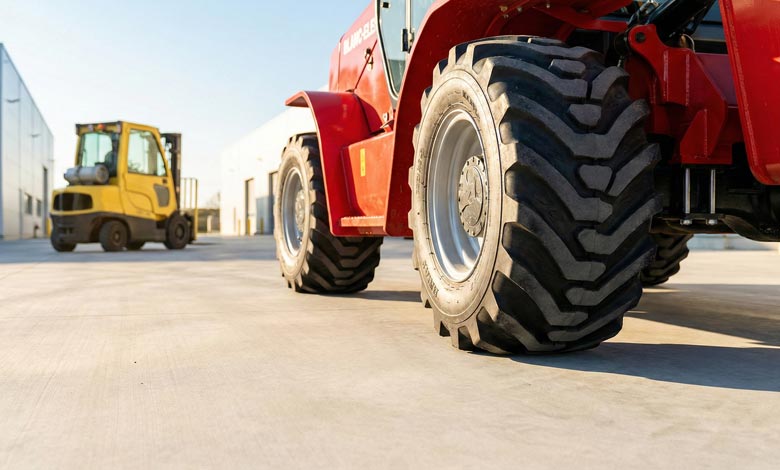
3. 2WD’s Limitation is Predictability, Not Just Capability
In rough terrain applications, we see predictability7 as a critical factor.
With 2WD forklifts on uneven ground, operators often need to:
- Continuously assess surface conditions.
- "Fight" the steering to maintain a line.
- Anticipate potential slip before it happens.
This means part of the stability responsibility shifts from the machine to the operator. Over time, this increases fatigue. A tired operator makes mistakes, and mistakes affect safety.
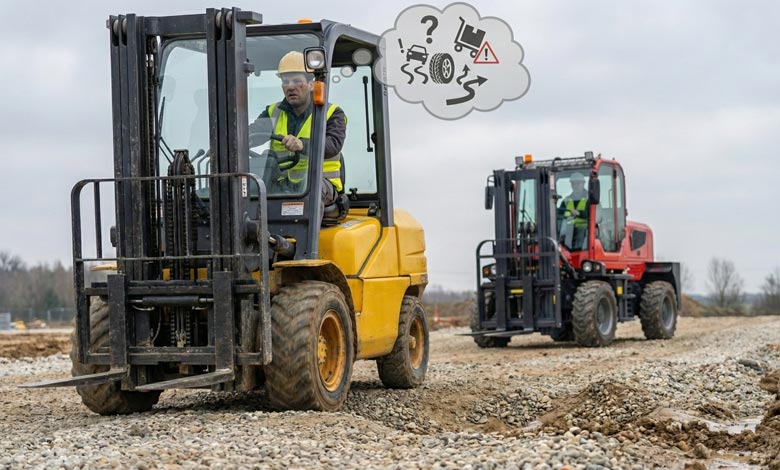
4. 4WD Changes How People Work (The Mental Load)
Many customers initially choose 4WD because they expect better access to difficult areas. However, after extended use, the feedback we hear most often is different:
“The job feels less stressful.”
Why Work Rhythm Changes with 4WD
With more consistent traction, 4WD forklifts experience fewer interruptions. This leads to:
- Fewer forced stops and retries.
- Smoother movement across the yard.
- Less mental load8 on the operator.
As a result, operators can focus more on load handling and safety9 instead of constantly worrying about getting stuck in that one muddy patch near the gate.
5. From One Task to an Entire Season
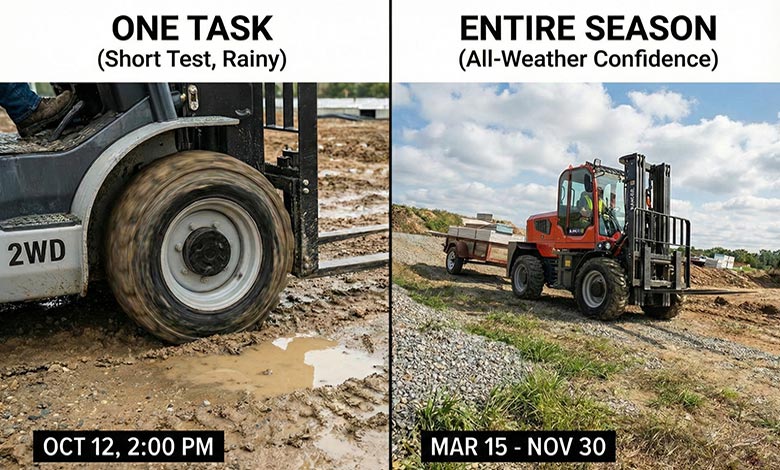
If you only evaluate a forklift during a short test, 2WD and 4WD may not look dramatically different. But over time, differences accumulate:
- Variability: Can you work on rainy days?
- Confidence: Does your operator hesitate before entering a slope?
- Flexibility: Can the machine help pull other equipment if needed?
Based on customer feedback, in environments with seasonal variation10 (like agriculture and construction), 4WD is the difference between a machine that works "most of the time" and a machine that works "all the time."
Conclusion: The Real Difference
On paper, the difference between 2WD and 4WD is just a drivetrain spec. In real rough terrain applications, the distinction is clear:
- 2WD works within a narrow stability margin.
- 4WD is not just more aggressive—it is more forgiving.
From our experience, choosing a rough terrain forklift is not about finding a machine that can move once—but about choosing one that can keep working reliably on the hardest days of the year.
Not sure if your site requires 4WD? [Contact BLANC-ELE4] for a site assessment and recommendation.
Explore the benefits of 2WD forklifts to understand their role in outdoor projects and when they might be sufficient. ↩
Learn how 4WD forklifts enhance performance and reliability in challenging outdoor conditions. ↩
Discover the concept of traction redundancy and how it impacts forklift efficiency and safety. ↩
Explore the unique features of BLANC-ELE forklifts that make them ideal for challenging outdoor environments. ↩
Understand the challenges posed by varying ground conditions and how they influence forklift performance. ↩
Find out how the stable operating range affects the choice between 2WD and 4WD forklifts. ↩
Explore the significance of predictability in forklift operations and its impact on safety and efficiency. ↩
Learn about the mental load on operators and how different forklift designs can alleviate stress. ↩
Discover best practices for ensuring safety and efficiency in load handling with forklifts. ↩
Understand how seasonal changes affect forklift operations and the importance of choosing the right type. ↩