
When many buyers first test a rough terrain forklift1, the first thing they focus on is usually engine power.
But after seeing more outdoor job sites over the years, I’ve realized something important:
The real danger on slopes is often not lack of power.
It’s when the forklift suddenly starts feeling unstable or “light” in the steering.
From my experience, forklifts that suddenly feel difficult to control on slopes are usually affected by weight transfer, traction loss, tire grip, drivetrain design, and steering axle load changes.
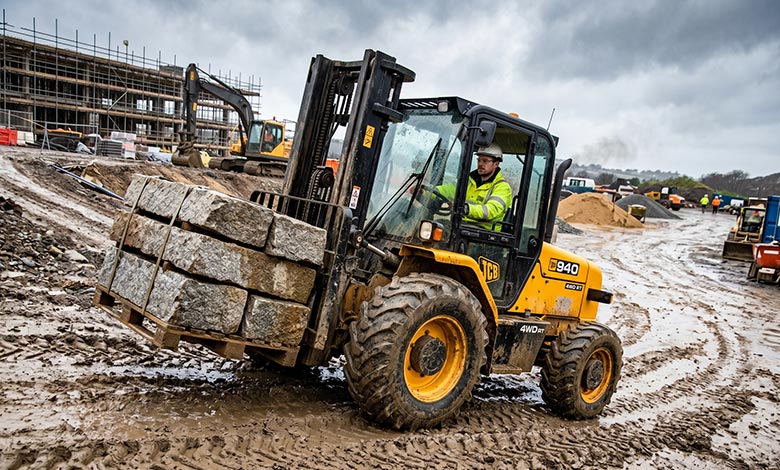
Once forklifts enter real slope conditions, many problems that never appear on flat ground suddenly become much more obvious.
Why Do Some Forklifts Feel Fine on Flat Ground but Unstable on Slopes?
Many forklifts feel stable during normal flat-ground operation.
But once they enter:
- Uphill driving
- Downhill braking
- Side-slope turning
- Heavy-load climbing
operators often notice the steering suddenly feels very different.
Slopes significantly change both weight distribution and tire traction.2
Dive Deeper
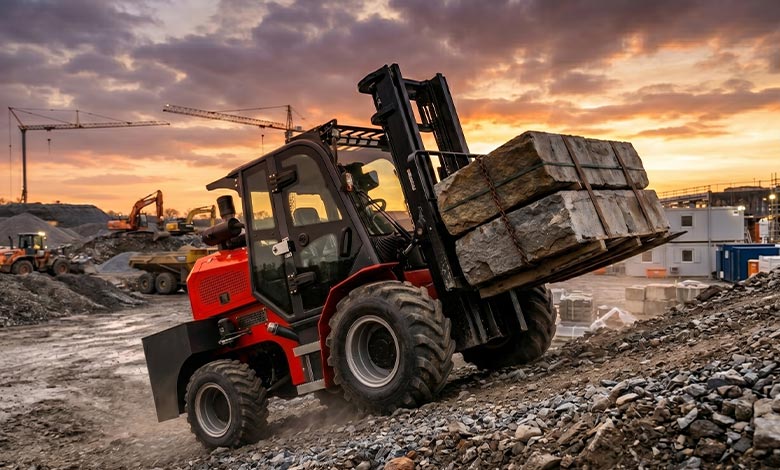
I first noticed this clearly while watching equipment testing on a rainy construction site.
The forklift felt completely normal while unloaded.
But once it started climbing uphill with a full load, the operator began constantly correcting the steering.
Especially on uneven slopes, the front wheels started feeling noticeably lighter.
That feeling can become dangerous very quickly.
Because operators instinctively begin making more steering corrections.
And the more corrections they make, the less stable the machine becomes.
Common Problems on Slopes
| Condition | Typical Problem |
|---|---|
| Loaded uphill driving | Light steering feel |
| Downhill braking | Front-end drifting |
| Side-slope turning | Weight transfer |
| Wet slopes3 | Reduced traction |
Very often, the real issue is not lack of power — it’s that the tires can no longer maintain stable directional control4.
Why Do Heavy Loads Make Steering Feel Worse?
Many customers rarely test forklifts while climbing slopes under full load.
But in real work environments, this situation is extremely common.
Especially in:
- Stone yards
- Mountain job sites
- Farms
- Muddy slopes
Heavy loads dramatically change axle weight distribution.5
Dive Deeper
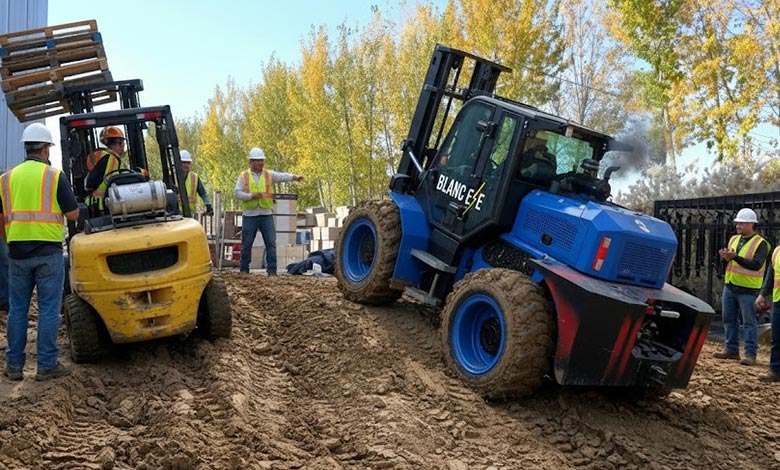
Under heavy loads, forklift weight naturally shifts rearward.
And during uphill climbing, the load pushes even more weight toward the rear axle6.
This reduces front axle pressure.
Since steering response depends heavily on front-end traction feedback7, the steering often begins feeling lighter.
Operators may notice:
- Lighter steering feel
- Slower steering response
- Difficulty correcting direction
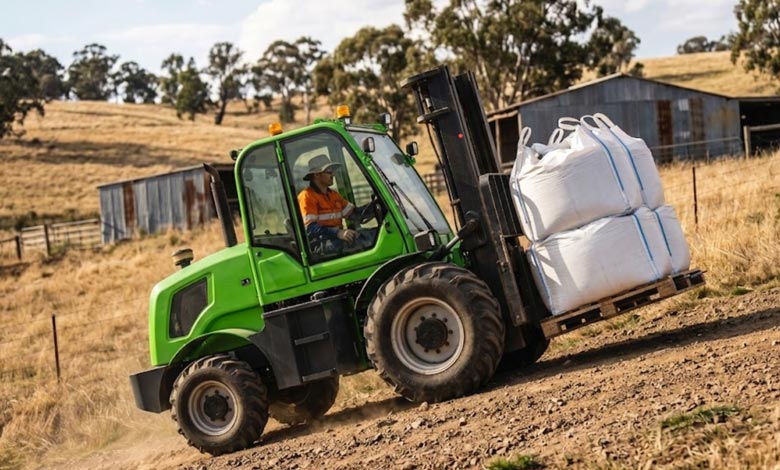
I once spoke with an Australian farm customer who described this exact issue.
Their previous forklift worked perfectly on flat ground.
But once climbing uphill with heavy loads, operators constantly complained that the steering felt “vague.”
After switching to a 4WD forklift with wider tires, the problem improved significantly.
Why Heavy Loads Affect Steering
| Cause | Effect |
|---|---|
| Rearward weight transfer | Reduced front axle pressure |
| Lighter steering axle | Weaker steering feedback |
| Increased slope angle | More weight shift |
| Uneven terrain | Traction fluctuation |
Many operators initially believe this is a steering system failure.
But very often, it is simply a physical weight distribution issue.
Why Does Tire Traction Matter So Much on Slopes?
Many buyers underestimate how important tires are.
But on slopes, tires often determine whether the forklift can continue maintaining steering control at all.
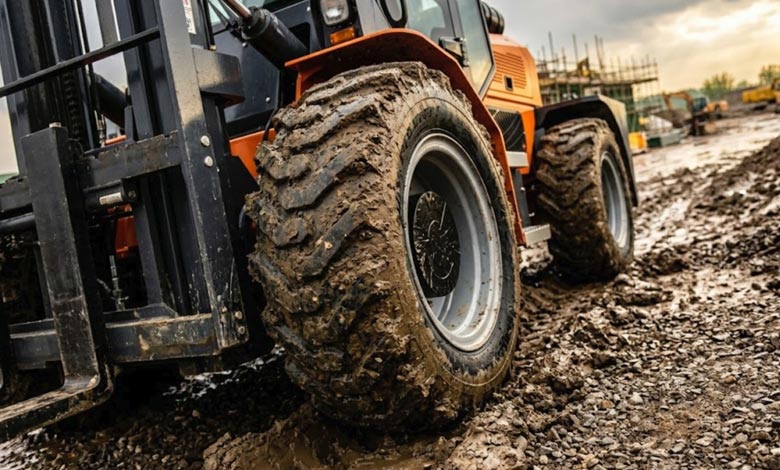
Especially on muddy ground, gravel surfaces, and wet terrain, traction changes very quickly.
Dive Deeper
I’ve noticed many buyers focus heavily on engines and lifting capacity during equipment selection.
But once forklifts enter difficult outdoor terrain, tire performance suddenly becomes critical8.
Especially on:
- Wet slopes
- Gravel roads
- Muddy terrain
If tire traction becomes unstable, operators begin constantly correcting steering.
And excessive steering correction usually makes the forklift even harder to control.
Tire Problems That Reduce Slope Control
| Tire Problem | Effect |
|---|---|
| Worn tread9 | Reduced traction |
| Narrow tires | Reduced support |
| Wet mud | Increased slipping |
| Small contact area | Reduced stability |
In many situations, slopes test tire grip far more than engine power.
Why Does 4WD Feel More Stable on Slopes?
Many people assume four-wheel drive is mainly useful for mud.
But on slopes, the value of 4WD becomes extremely obvious.
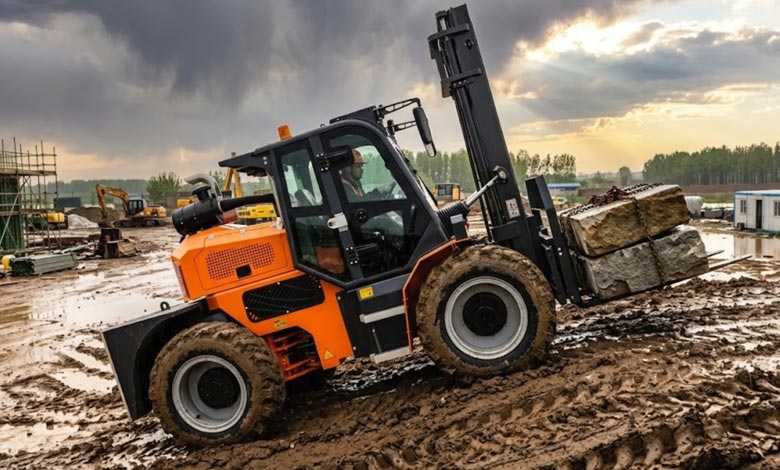
Four-wheel drive not only improves mobility, but also significantly improves stability and directional control.10
Dive Deeper
After seeing more mountain job sites and rough outdoor environments, the difference between 2WD and 4WD became very clear to me.
Once a two-wheel drive forklift begins slipping on a slope, operators constantly fight the steering.
Meanwhile, four-wheel drive forklifts maintain traction across multiple wheels simultaneously11.
This makes the machine feel much more stable.
Especially during:
- Loaded uphill driving
- Slope turning
- Wet terrain operation
the difference becomes very noticeable.
Why 4WD Performs Better on Slopes
| Feature | Benefit |
|---|---|
| Four-wheel drive | Improved traction |
| Balanced power delivery | Reduced wheel slip |
| Better slope mobility | Increased stability |
| Less steering correction | Reduced control loss |
Many buyers who regularly work outdoors eventually begin prioritizing 4WD systems much more seriously.
Why Can Incorrect Operator Actions Make Slope Problems Worse?
I’ve seen this happen many times in real outdoor conditions.
Once steering begins feeling light, many operators instinctively:
- Over-correct steering
- Apply too much throttle
- Brake suddenly
But these reactions usually make the situation even worse.
On slopes, excessive operator input is often more dangerous than insufficient power.
Dive Deeper
Especially on wet slopes, repeated aggressive steering corrections reduce traction even further.
Sudden braking can also create rapid weight transfer.12
At that point:
- The front end may drift
- Tires lose grip faster
- Overall stability drops quickly
Experienced operators usually behave very differently on slopes.
They operate slower and more smoothly.
Because they understand something important:
On slopes, control matters far more than speed.
Dangerous Operator Behaviors
| Incorrect Action | Result |
|---|---|
| Aggressive steering | Chassis instability |
| Excessive throttle | Increased slipping |
| Sudden braking | Rapid weight transfer |
| Sharp slope turning | Reduced stability |
Many slope-related forklift accidents are not caused by mechanical failure, but by traction loss, weight transfer, and operator overreaction happening at the same time.13
What Kind of Forklift Performs Better on Slopes?
Over the years, I’ve realized something clearly:
A forklift that performs well on slopes is not simply the one with the biggest engine.
The best slope forklifts are the ones that maintain stable control under heavy loads, uneven terrain, and difficult outdoor conditions.
Forklifts designed for slope work usually combine proper 4WD systems, stable chassis design, good tires, balanced weight distribution, and strong traction.

Dive Deeper
Today, many buyers intentionally test forklifts in difficult conditions such as:
- Loaded uphill driving
- Slope turning
- Wet terrain
- Uneven surfaces
Because this is where the real differences appear.
Features That Improve Slope Stability
| Feature | Benefit |
|---|---|
| 4WD system | Better traction |
| Wider tires | Increased support |
| Deep tread tires | Reduced slipping |
| Stable chassis | Less movement |
| Balanced weight distribution | Better control |
Many forklifts appear similar on flat ground, but once they enter real slope environments, the differences become extremely obvious.
Conclusion
After seeing more outdoor job sites over the years, I’ve realized slopes do not simply test climbing ability — they test whether a forklift can continuously maintain stable steering and control under difficult conditions.
"Rough Terrain Forklift training course; OSHA doesn't approve ...", http://www.osha.gov/laws-regs/standardinterpretations/1999-08-23. OSHA materials classify rough-terrain forklifts as powered industrial trucks used for load handling on uneven or unimproved outdoor surfaces, establishing the technical meaning of the term. Evidence role: definition; source type: government. Supports: A rough terrain forklift is a forklift intended for outdoor or uneven-terrain job-site operation.. Scope note: Supports the definition and intended operating context of rough-terrain forklifts, not the article’s experiential claim about what buyers focus on during testing. ↩
"eTool : Powered Industrial Trucks (Forklift) - Ramps and Grades", http://www.osha.gov/etools/powered-industrial-trucks/workplace/ramps-grades. Powered industrial truck safety guidance describes ramps, grades, surface condition, load position, braking, and turning as factors that alter forklift stability and control, supporting the claim that slopes affect both load distribution and tire-road grip. Evidence role: general_support; source type: government. Supports: Slopes significantly change both weight distribution and tire traction.. Scope note: The source is safety guidance rather than a quantitative model of a specific forklift on a specific slope. ↩
"[PDF] The Little Book of Tire Pavement Friction", https://www.pa.gov/content/dam/copapwp-pagov/en/penndot/documents/research-planning-innovation/researchandtesting/roadwaymanagementandtesting/documents/little-book-tire-pavement-friction.pdf. Road-surface and vehicle-safety research consistently reports that wet surfaces reduce tire-surface friction compared with dry surfaces, which supports the claim that wet slopes increase the risk of reduced traction. Evidence role: mechanism; source type: research. Supports: Wet slopes reduce available traction for forklift tires.. Scope note: Friction values vary widely with tire tread, soil or pavement type, mud content, speed, and slope angle. ↩
"[PDF] Dynamic Friction Models for Longitudinal Road/Tire Interaction", https://dcsl.gatech.edu/papers/iasted02b.pdf. Vehicle dynamics literature explains that steering control depends on the available friction force at the tire contact patch; when available lateral or longitudinal friction is exceeded, directional control is reduced or lost. Evidence role: mechanism; source type: paper. Supports: Loss of tire traction on slopes can prevent stable directional control.. Scope note: General vehicle dynamics principles apply to forklifts, but the source may not test rough-terrain forklifts specifically. ↩
"Powered Industrial Truck Operator Training - Stability of ... - OSHA", http://www.osha.gov/training/library/powered-industrial-trucks/app-a. Forklift stability references describe how a truck-and-load combined center of gravity changes with load weight, load position, mast tilt, and movement, which in turn affects axle loading and stability. Evidence role: mechanism; source type: government. Supports: Heavy loads can substantially change forklift axle weight distribution.. Scope note: The exact axle-load change depends on forklift geometry, load center, mast position, and slope direction. ↩
"eTool : Powered Industrial Trucks (Forklift) - Ramps and Grades", http://www.osha.gov/etools/powered-industrial-trucks/workplace/ramps-grades. Engineering mechanics sources on vehicles on grades show that gravitational components on an incline alter normal loads between axles, providing context for how uphill or downhill travel can change steering-axle loading. Evidence role: mechanism; source type: education. Supports: Uphill climbing can change axle loading and steering-axle load on a forklift.. Scope note: The direction and magnitude of axle-load transfer depend on whether the forklift is traveling forks-uphill or forks-downhill, the load center, and the truck’s wheelbase. ↩
"[PDF] Integrated Vehicle Control via Coordinated Steering and Wheel ...", https://www.me.psu.edu/toboldlygo/Publications/Conferences/2001_Brennan_IntegratedVehicleControlViaCoordinatedSteeringAndWheelTorqueInputs.pdf. Vehicle handling references explain that steering response is generated through lateral tire forces at the steered wheels, so reduced normal load or reduced friction at those wheels lowers available steering authority. Evidence role: mechanism; source type: education. Supports: Steering response depends on traction at the steered wheels.. Scope note: This supports the steering-traction mechanism generally; forklift steering layouts and rear-axle steering designs may vary by model. ↩
"1910.178 - Powered industrial trucks. | Occupational Safety ... - OSHA", http://www.osha.gov/laws-regs/regulations/standardnumber/1910/1910.178. Occupational safety guidance for powered industrial trucks identifies tire condition, floor or ground surface, and operating environment as factors that affect safe handling and stability, supporting the importance of tire performance in outdoor terrain. Evidence role: expert_consensus; source type: government. Supports: Tire performance is critical to forklift control on difficult outdoor terrain.. Scope note: The guidance is general and does not rank tire performance against engine power for all slope conditions. ↩
"Tire Safety Ratings and Awareness | TireWise - NHTSA", https://www.nhtsa.gov/vehicle-safety/tires. Transportation safety research and tire-safety guidance indicate that reduced tread depth decreases a tire’s ability to channel water or loose material, which can reduce grip and increase slipping risk. Evidence role: mechanism; source type: government. Supports: Worn tread can reduce traction and slope control.. Scope note: Most tire-tread evidence comes from road vehicles; the same friction principle is relevant but not a direct test of every forklift tire type. ↩
"Four-wheel drive - Wikipedia", https://en.wikipedia.org/wiki/Four-wheel_drive. Four-wheel-drive vehicle references explain that distributing drive torque to multiple wheels can improve traction on low-friction or uneven surfaces, supporting the mobility and directional-control aspect of the claim. Evidence role: mechanism; source type: encyclopedia. Supports: Four-wheel drive can improve traction and directional control on difficult surfaces.. Scope note: Improved traction does not guarantee overall stability, which also depends on speed, load height, center of gravity, tires, and operator behavior. ↩
"Four-wheel drive - Wikipedia", https://en.wikipedia.org/wiki/Four-wheel_drive. Technical descriptions of four-wheel drive define it as a drivetrain that can deliver torque to both front and rear axles, allowing more than one axle to contribute tractive force on uneven or low-grip ground. Evidence role: definition; source type: encyclopedia. Supports: Four-wheel-drive forklifts can distribute tractive effort across multiple wheels.. Scope note: Actual traction at each wheel depends on differential design, tire contact, locking mechanisms, and surface conditions. ↩
"[PDF] 2 Forward Vehicle Dynamics", https://athena.ecs.csus.edu/~grandajj/me143/3_Forward%20Dynamics/Pages%20from%20Vehicle.Dynamics.pdf. Vehicle dynamics sources describe braking as producing longitudinal load transfer from one axle to another because of deceleration acting through the vehicle’s center of mass, supporting the claim that sudden braking rapidly changes axle loading. Evidence role: mechanism; source type: education. Supports: Sudden braking can create rapid weight transfer.. Scope note: The amount of transfer depends on deceleration, center-of-gravity height, wheelbase, load position, and slope angle. ↩
"Workers Who Operate or Work Near Forklifts | NIOSH - CDC", https://www.cdc.gov/niosh/docs/2001-109/default.html. Forklift accident-prevention materials from occupational safety agencies identify tipovers, unstable loads, excessive speed, turning, braking, grades, and surface conditions as recurring contributors to incidents, supporting the general emphasis on operational and stability factors rather than only mechanical failure. Evidence role: expert_consensus; source type: government. Supports: Slope-related forklift incidents often involve stability, traction, and operator-control factors rather than mechanical failure alone.. Scope note: The source may not quantify the exact share of slope-related accidents attributable to each factor or prove simultaneous causation in all cases. ↩