
When we talk with overseas buyers, there’s one question I hear quite often:
“Is a rough terrain forklift basically a stronger forklift?”
Many people assume that if a machine is called a “rough terrain” forklift, it must be better than a standard forklift in almost every situation.
But from what I’ve seen over the years working with different projects, that’s not really how it works.
A rough terrain forklift1 is not simply a stronger forklift.
It’s a machine designed for very specific working environments2.
In some situations, it’s the perfect solution. In others, it may actually be less efficient than a standard forklift.
So in this article, I want to share a few practical observations from our experience and explain where rough terrain forklift1s are commonly used — and where they usually are not.
Rough Terrain Forklifts Are Designed for Difficult Ground
If you take a close look at the design of a rough terrain forklift1, it’s quite different from a typical warehouse forklift.
Most rough terrain forklift1s feature:
- Four-wheel drive systems
- Large off-road tires
- Higher ground clearance
- Stronger traction on uneven surfaces
These features are not there to make the machine look more powerful. They exist because rough terrain forklift1s are built to operate in places where the ground conditions are far from perfect.
In many outdoor projects, the ground may be:
- Dirt
- Gravel
- Mud
- Temporary construction roads
In these environments, standard forklifts often struggle to operate efficiently, while rough terrain forklift1s can move more reliably.
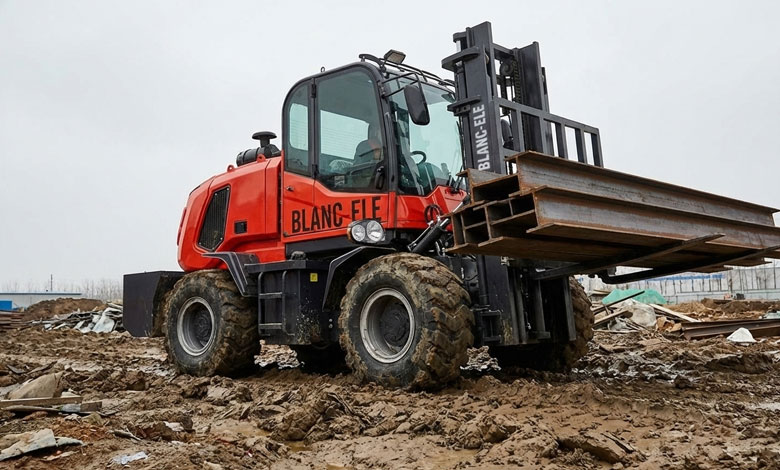
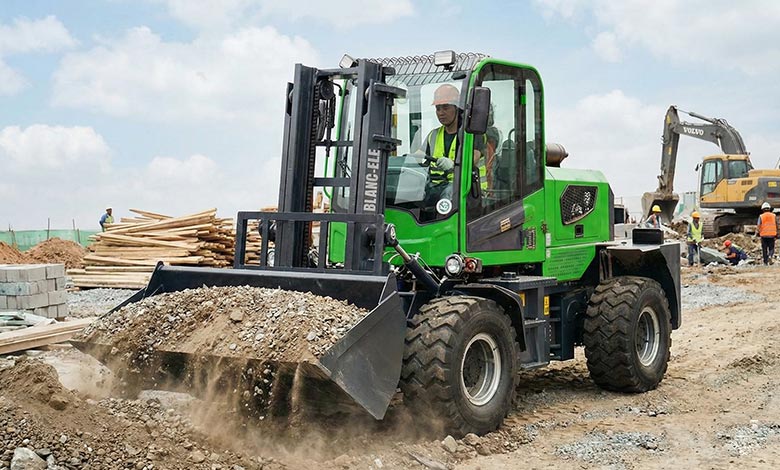
Construction Sites Are the Most Common Application
If someone asks me where rough terrain forklift1s are used the most, my answer is usually simple:
Construction sites.
On many construction projects, the ground conditions are constantly changing. One area might be compacted dirt, another might be loose gravel, and sometimes the roads are only temporary.
Standard forklifts often face several problems in these situations, such as:
- Wheels slipping on loose ground
- Low chassis hitting uneven surfaces
- Limited traction on rough terrain
Rough terrain forklifts handle these environments much better because of their large tires and four-wheel-drive systems.
On construction sites3, they are commonly used to move materials like:
- Bricks
- Cement
- Steel materials
- Scaffolding components
Mining and Quarry Operations
Another environment where rough terrain forklift1s are frequently used is in mining areas4 and quarries.
If you’ve ever visited a mining site, you probably noticed that the ground conditions can be quite challenging. Surfaces are often uneven, rocky, or sloped.
In these conditions, standard forklifts can experience issues such as:
- Rapid tire wear
- Chassis damage
- Insufficient traction
Rough terrain forklifts are designed to perform better in these situations.
In quarry operations, forklifts are often used to move:
- Stone materials
- Equipment tools
- Heavy pallets
In environments like this, reliability is usually more important than speed.

Agriculture and Farm Logistics
One application that surprises some people is agriculture5.
In larger farms or agricultural logistics areas, forklifts often need to travel across different types of surfaces such as:
- Grass
- Dirt roads
- Muddy ground
Standard warehouse forklifts can easily get stuck or lose traction in these environments.
Rough terrain forklifts, with their larger tires and four-wheel drive, handle these surfaces much more easily.
We’ve seen customers in agricultural projects use rough terrain forklift1s to move things like:
- Animal feed
- Farming equipment
- Palletized agricultural products

Stone Yards and Lumber Yards
Outdoor material yards are another common place where rough terrain forklift1s are used.
Examples include:
- Stone processing yards
- Lumber yards
These locations often share a few characteristics:
- Large outdoor working areas
- Surfaces that are not perfectly level
- Heavy materials being handled regularly
In stone yards6, forklifts may move stone slabs or blocks. In lumber yards7, they often transport large wood bundles or pallets.

Where Rough Terrain Forklifts Are Not Ideal
While rough terrain forklift1s perform well in many outdoor environments, they are not the best choice for every situation.
In fact, there are several scenarios where other types of forklifts are usually more suitable.
For example, in warehouse logistics operations where floors are smooth and aisles are narrow, electric forklifts are often much more efficient.
Rough terrain forklifts are larger machines with wider turning radiuses, which makes them less convenient in tight indoor spaces.
Similarly, in indoor factory environments, diesel-powered machines may create issues related to noise and emissions.
In these situations, rough terrain forklift1s are simply not the right tool for the job.
How to Know If Your Project Needs a Rough Terrain Forklift
If you are considering buying a forklift, the first step is usually to look at the working environment.
If your project involves places like:
- Construction sites
- Mining areas
- Agricultural operations
- Outdoor material yards
Then a rough terrain forklift1 can often be a very suitable option.
However, if your work mainly takes place in:
- Indoor warehouses
- Factory floors
- Smooth logistics environments
A standard forklift may be more efficient.
Final Thoughts
Over the years, we’ve worked with customers from construction, mining, agriculture5, and material handling industries in different regions.
One thing we’ve learned is that choosing the right equipment is rarely about finding the most powerful machine. It’s about finding the machine that fits the working environment.
At BLANC-ELE8, we focus on building practical rough terrain forklift1s designed for real outdoor conditions — with simple structures, reliable diesel engine platforms9, and configurations that work well on construction sites3, farms, and material yards.
If you're currently evaluating equipment for an outdoor project and are unsure whether a rough terrain forklift1 is the right choice, it’s always worth discussing the jobsite conditions first.
Sometimes the right question about the work environment can save much more time and cost than comparing specifications alone.
Explore the advantages of rough terrain forklifts to understand their unique capabilities in challenging environments. ↩
Learn about the various working environments where forklifts excel, helping you choose the right equipment. ↩
Discover why construction sites benefit from rough terrain forklifts and how they enhance efficiency. ↩
Find out how rough terrain forklifts improve operations in mining areas, ensuring reliability and performance. ↩
Understand the importance of rough terrain forklifts in agriculture and how they facilitate farm logistics. ↩
Explore the applications of forklifts in stone yards and how they handle heavy materials effectively. ↩
Learn about the efficiency of rough terrain forklifts in lumber yards and their role in material handling. ↩
Explore BLANC-ELE's offerings to find reliable rough terrain forklifts tailored for outdoor conditions, ensuring efficiency in your projects. ↩
Explore the advantages of diesel engine platforms in forklifts, especially for outdoor applications. ↩