
When many customers test a forklift for the first time, the things they usually focus on are:
- Engine power
- Acceleration
- Lifting strength
But after seeing more outdoor job sites over the years, I’ve realized something important:
The real difference between forklifts often does not appear during the first 30 minutes.
It appears several hours later.
Because many forklifts feel perfectly fine at the beginning, but once they enter long outdoor heavy-duty operation, hidden problems gradually begin to appear1.

Especially on construction sites, stone yards, and farms, the real challenge is not simply whether the forklift can move — it is whether the forklift can continue working reliably for long hours.
Why Do Many Forklifts Feel Good During Short Test Drives?
During initial testing, forklifts are usually operating under:
- No load
- Short running time
- Flat ground
- Brand-new machine condition
Under these conditions, most forklifts do not perform badly.
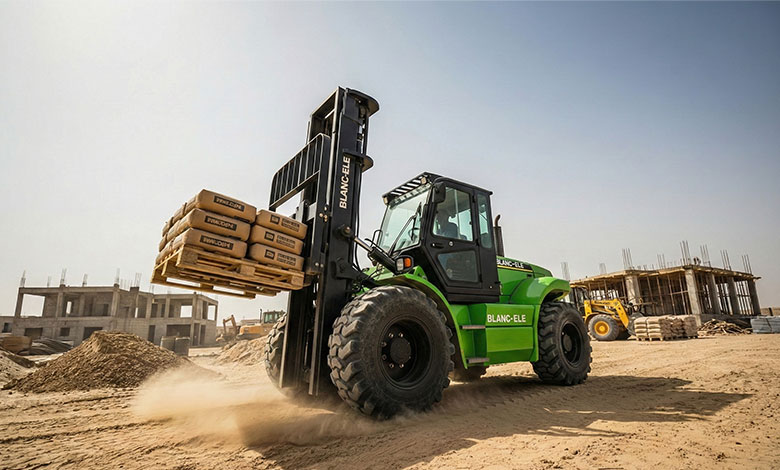
Dive Deeper
I’ve noticed many customers focus heavily on:
- Engine sound
- Acceleration feel
- Lifting speed
- Steering lightness
Those things are important.
But during real outdoor operation, forklifts may run continuously for:
- 8 hours
- 10 hours
- Or even longer
while constantly facing:
- High temperatures
- Dust
- Mud
- Uneven terrain
- Heavy loads
Many problems simply do not appear during short test drives.
Why Short Test Drives Hide Problems
| Short Test Drive | Long Outdoor Operation |
|---|---|
| No-load condition2 | Continuous heavy loads |
| Flat ground | Rough terrain |
| Short operation time | Long working shifts |
| New machine condition | Long-term wear accumulation |
Many forklift problems only begin appearing after the machine heats up.3
Why Do Hydraulic and Steering Systems Feel More “Tired” After Long Working Hours?
Many customers initially feel:
“The forklift power seems completely fine.”
But after several hours of continuous work, operators often begin noticing:
- Heavier steering
- Slower hydraulic response
- Increasing operating fatigue
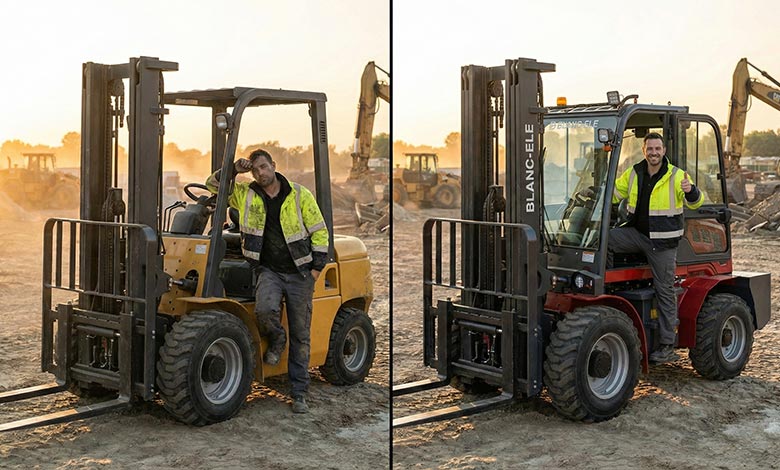
Dive Deeper
Especially under high temperatures and heavy-load conditions, hydraulic systems continuously generate heat4.
Once hydraulic oil temperature rises5, many forklifts gradually begin showing:
- Slower operation response
- Poorer steering feel
- Reduced lifting speed
Some operators initially think they are simply becoming tired.
But in reality, the machine itself is also changing.
I once spoke with a customer working on a North African construction site.
The environment was extremely hot and dusty.
At first, the forklift seemed powerful enough.
But after several continuous working hours, operators began increasingly complaining about:
- Hot cabins
- Slower hydraulic movements
- Heavier steering feel
- Much stronger fatigue during afternoon shifts
Especially during continuous heavy-load operation, the difference became very obvious.
Later, when selecting new equipment, the customer stopped focusing only on engine specifications.
Instead, they began paying much more attention to:
- Cooling performance
- Cabin comfort
- Long-shift operator fatigue
- Hydraulic stability
Because after long outdoor shifts, the real test is no longer peak power.
It is long-term operating condition.
Why Long Working Hours Affect Hydraulic Performance
| Continuous Operation Issue | Result |
|---|---|
| Rising hydraulic oil temperature | Slower movement |
| Long-term heavy loads6 | Higher system pressure |
| High-temperature environment | Greater cooling stress |
| Dusty conditions | Reduced cooling efficiency |
Many forklifts feel light and smooth initially, but the differences become increasingly obvious after several hours outdoors.
Why Does Operator Fatigue Often Appear Before Engine Problems?
Many customers used to focus mainly on:
“Is the engine powerful enough?”
But over the years, I’ve realized something different:
Very often, the operator becomes exhausted before the engine does.
Especially during:
- Long outdoor shifts
- Rough terrain operation
- Heavy-load handling
- High-temperature environments
operator fatigue gradually becomes more serious.
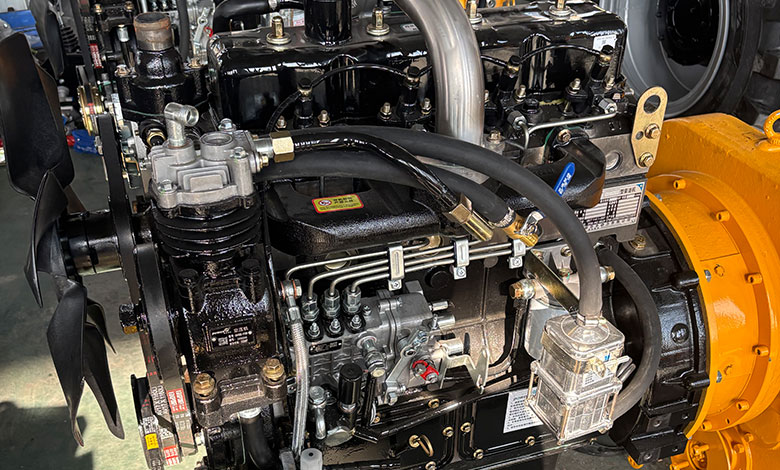
Dive Deeper
I once worked with a customer operating in a Middle Eastern stone yard.
Their previous forklift actually had acceptable engine performance.
But after several hours of continuous work, operators increasingly avoided using it.
Because:
- Vibration became exhausting
- The seat lacked proper support
- Cabin temperature became uncomfortable
- Steering became increasingly heavy
Eventually, operators preferred waiting for other forklifts instead of continuing to use that machine.
When purchasing new equipment later, the customer began focusing heavily on:
- Cabin comfort
- Air conditioning performance
- Steering feel
- Long-term operator fatigue
Problems That Increase Operator Fatigue
| Problem | Long-Term Effect |
|---|---|
| Excessive vibration7 | Higher physical fatigue |
| High cabin temperature8 | Reduced concentration |
| Heavy steering | Arm fatigue |
| Poor seat support9 | Long-term discomfort |
In many situations, continuous productivity depends less on engine power and more on whether operators can continue working comfortably.10
Why Do Heat and Dust Gradually Expose More Problems?
Real outdoor environments are far harsher than controlled testing conditions.
Especially in:
- Stone yards
- Construction sites
- Farms
- High-temperature regions
heat and dust continuously accumulate.
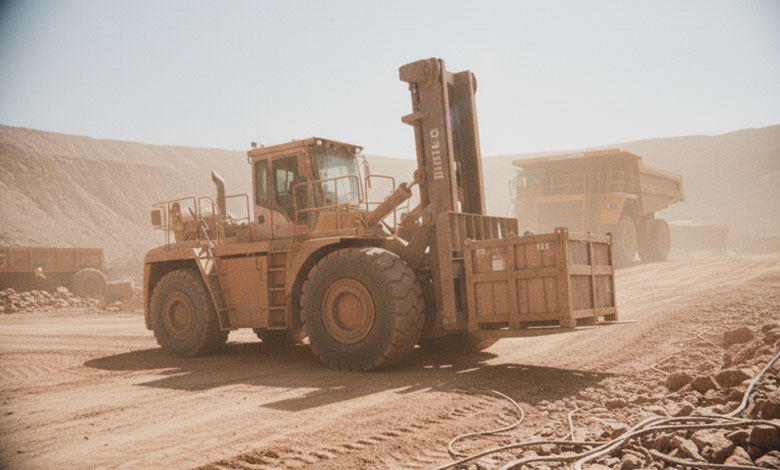
Dive Deeper
I’ve seen many forklifts perform very well at the beginning.
But after long exposure to high temperatures and dust, problems gradually become more obvious.
For example:
- Engine temperature begins rising
- Cooling efficiency decreases11
- Hydraulic systems run hotter
- Air conditioning performance weakens
Especially in stone yards with heavy dust, radiator blockage can happen surprisingly quickly12.
Why Harsh Outdoor Conditions Expose Weaknesses Faster
| Environment | Common Problem |
|---|---|
| High temperature | Increased cooling pressure |
| Dusty conditions | Radiator blockage |
| Long operation time | Heat accumulation |
| Heavy-load operation | Higher system stress |
Many forklift problems do not appear suddenly.
They gradually build up during long-term outdoor operation.
Why Do Some Forklifts Become More Annoying to Operate Over Time?
This is actually a very real issue.
Many forklifts feel acceptable when new.
But over time, operators begin increasingly complaining about:
- Noise
- Vibration
- Steering feel
- Mast shaking
- Operator fatigue
Dive Deeper
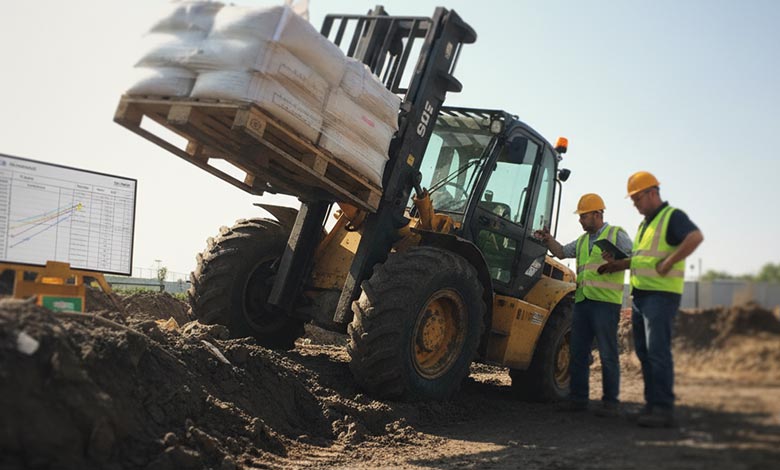
Over the years, I’ve realized truly good rough terrain forklifts are not simply machines that feel powerful at the beginning.
They are machines that still feel:
- Stable
- Smooth
- Comfortable
- Easy to control
after many continuous working hours.
Because outdoor work is already physically demanding.
If the machine continuously increases operator fatigue, efficiency gradually decreases.
Why Some Forklifts Become More Frustrating Over Time
| Long-Term Problem | Result |
|---|---|
| Increasing abnormal noise | Reduced operator confidence |
| Heavy steering | Higher fatigue |
| Mast movement | Less stability feeling |
| Stronger vibration | More physical exhaustion |
Many forklifts do not fail completely.
They simply become increasingly unpleasant to operate.
Why Do Good Rough Terrain Forklifts Focus More on Long-Term Working Stability?
After seeing more outdoor applications over the years, I’ve realized something clearly:
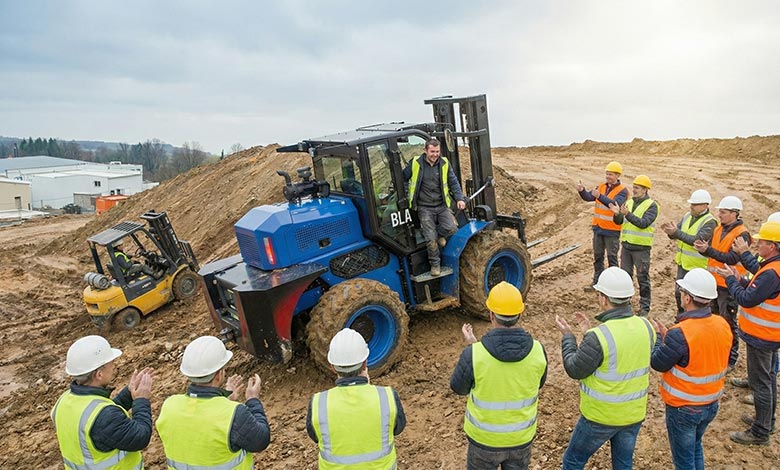
The best rough terrain forklifts are not simply the ones with the strongest engine performance.
The best forklifts are the ones that remain stable after many continuous working hours.
Good forklifts usually focus much more on:
- Cooling systems
- Hydraulic stability
- Cabin comfort
- Steering feel
- Long-term durability
Dive Deeper
Today, many experienced buyers no longer focus only on:
“Does the forklift feel powerful?”
Instead, they pay much closer attention to:
- Performance after long operation
- Hydraulic consistency
- Long-shift operator comfort
- Whether the forklift still feels smooth after hours of work
Because truly profitable equipment is not the machine that works well for 20 minutes.
It is the machine that continues working reliably all day long.
Features That Improve Long Outdoor Working Performance
| Feature | Long-Term Benefit |
|---|---|
| Better cooling system | Reduced overheating risk |
| Stable hydraulic system | Consistent operation |
| Comfortable cabin | Lower operator fatigue |
| Better vibration reduction | Smoother operation |
| Stable chassis design | Easier long-term control |
Many experienced outdoor users eventually begin valuing long-term operating stability much more than short-term performance impressions.
Conclusion
After seeing more outdoor working environments over the years, I’ve realized truly good rough terrain forklifts are not simply machines that feel powerful at the beginning — they are machines that still remain stable, comfortable, and reliable after many continuous hours of hard outdoor work.
"1910.178 - Powered industrial trucks. | Occupational Safety ... - OSHA", http://www.osha.gov/laws-regs/regulations/standardnumber/1910/1910.178. A technical source on forklift duty cycles and reliability would support the general principle that performance under short, unloaded operation may not reveal thermal, hydraulic, or durability issues that emerge under sustained load; this is contextual support rather than proof for all forklift models. Evidence role: general_support; source type: institution. Supports: many forklifts feel perfectly fine at the beginning, but once they enter long outdoor heavy-duty operation, hidden problems gradually begin to appear. Scope note: The evidence would likely support the operating principle broadly, not the exact frequency of hidden problems in every forklift. ↩
"eTool : Powered Industrial Trucks (Forklift) - Load Handling - OSHA", http://www.osha.gov/etools/powered-industrial-trucks/operating-forklift/load-handling. A source on powered industrial truck testing or load handling would support that unloaded operation is not equivalent to operating under rated load, particularly for stability, braking, hydraulic demand, and powertrain stress. Evidence role: mechanism; source type: government. Supports: No-load condition during short test drives can hide issues that appear during continuous heavy-load operation.. Scope note: The source may explain load effects generally rather than comparing specific short test drives with full-shift outdoor work. ↩
"Effects of temperature on the properties of HL32 oil in ... - PMC - NIH", https://pmc.ncbi.nlm.nih.gov/articles/PMC9732129/. A technical source on machinery thermal behavior would support that hydraulic, engine-cooling, and lubrication performance can change as operating temperature rises, making some faults apparent only after warm-up or sustained operation. Evidence role: mechanism; source type: research. Supports: Many forklift problems only begin appearing after the machine heats up.. Scope note: This would support the thermal mechanism but not quantify how often forklift problems appear only after heating. ↩
"Modeling of thermodynamic heating of water through hydraulic heat ...", https://scholars.csus.edu/esploro/outputs/graduate/Modeling-of-thermodynamic-heating-of-water/99257831064401671. A hydraulics engineering source would support that hydraulic systems generate heat through pressure losses, throttling, leakage, and mechanical inefficiencies during operation. Evidence role: mechanism; source type: education. Supports: Especially under high temperatures and heavy-load conditions, hydraulic systems continuously generate heat.. ↩
"Effects of temperature on the properties of HL32 oil in ... - PMC - NIH", https://pmc.ncbi.nlm.nih.gov/articles/PMC9732129/. A hydraulics reference or peer-reviewed source would support that hydraulic oil temperature affects viscosity, leakage, efficiency, and actuator response, which can alter machine performance during sustained operation. Evidence role: mechanism; source type: paper. Supports: Once hydraulic oil temperature rises, many forklifts gradually begin showing slower response, poorer steering feel, or reduced lifting speed.. Scope note: The source may describe hydraulic systems generally rather than forklift-specific systems. ↩
"Pascal's Principle and Hydraulics", https://www.grc.nasa.gov/WWW/K-12/WindTunnel/Activities/Pascals_principle. A hydraulic engineering source would support that greater external load generally requires higher hydraulic pressure to move or lift the load, increasing system stress under sustained heavy-load operation. Evidence role: mechanism; source type: education. Supports: Long-term heavy loads create higher system pressure in forklift hydraulic systems.. Scope note: This supports the pressure-load relationship generally, not a specific forklift model's pressure readings. ↩
"[PDF] Health Hazard Evaluation Report 1983-0349-1901 - CDC", https://www.cdc.gov/niosh/hhe/reports/pdfs/83-349-1901.pdf. Occupational health research supports that whole-body vibration exposure in vehicle operators is associated with discomfort, fatigue, and musculoskeletal risk, providing context for why excessive forklift vibration can increase operator fatigue. Evidence role: expert_consensus; source type: paper. Supports: Excessive vibration causes higher physical fatigue for forklift operators.. Scope note: Most studies address vehicle or machinery operators broadly and may not isolate rough-terrain forklifts specifically. ↩
"Overview: Working in Outdoor and Indoor Heat Environments - OSHA", http://www.osha.gov/heat-exposure. Occupational heat-stress guidance supports that high thermal exposure can reduce comfort, impair concentration, and increase fatigue risk during work, which contextualizes the claim about hot forklift cabins. Evidence role: expert_consensus; source type: government. Supports: High cabin temperature reduces concentration and contributes to operator fatigue.. Scope note: Heat-stress guidance applies broadly to workers and may not measure concentration specifically in forklift cabins. ↩
"Assessment of Spinal Range of Motion and Musculoskeletal ... - PMC", https://pmc.ncbi.nlm.nih.gov/articles/PMC7998771/. Ergonomics literature supports that inadequate seating and posture support in occupational vehicle operation can contribute to discomfort and musculoskeletal strain over time. Evidence role: expert_consensus; source type: paper. Supports: Poor seat support causes long-term discomfort for forklift operators.. Scope note: The evidence is likely general to occupational seating or vehicle operators rather than specific to every forklift seat design. ↩
"Occupational Ergonomics: A Special Domain for the Benefit ... - PMC", https://pmc.ncbi.nlm.nih.gov/articles/PMC9674068/. Ergonomics and occupational safety research supports that operator comfort, fatigue, heat exposure, vibration, and workstation design can affect work performance and productivity, giving contextual support to the claim that comfort can be more limiting than engine power. Evidence role: expert_consensus; source type: research. Supports: Continuous productivity often depends more on operator comfort and fatigue control than on engine power alone.. Scope note: Such evidence supports the productivity role of operator comfort generally; it does not prove that comfort outweighs engine power in every forklift application. ↩
"[PDF] Air-side fouling of finned heat exchangers - Purdue e-Pubs", https://docs.lib.purdue.edu/cgi/viewcontent.cgi?article=1410&context=coolingpubs. Engineering sources on heat exchangers support that fouling or blockage of radiator surfaces reduces airflow and heat-transfer performance, which can decrease cooling efficiency in dusty environments. Evidence role: mechanism; source type: education. Supports: After long exposure to high temperatures and dust, cooling efficiency decreases.. Scope note: This supports the heat-transfer mechanism generally and may not provide forklift-specific field measurements. ↩
"Cooling System - GovInfo", https://www.govinfo.gov/content/pkg/GOVPUB-PR32_4900-1925ca777ec02a486b8fdbad5e7684df/html/GOVPUB-PR32_4900-1925ca777ec02a486b8fdbad5e7684df.htm. A maintenance or engineering source would support that airborne dust, debris, and particulate accumulation can obstruct radiator fins and reduce heat-transfer efficiency in off-road or industrial equipment. Evidence role: mechanism; source type: institution. Supports: In dusty stone yards, radiator blockage can happen quickly and reduce cooling performance.. Scope note: The source may establish the mechanism of blockage and reduced cooling, but not how quickly blockage occurs in a specific stone yard. ↩