
When I discuss attachments with customers who are buying a rough terrain forklift, Crane Jib is almost never the first option they ask about.
Most conversations usually start with things like:
- Should we add a side shifter?
- Do we need a bucket1 for bulk material?
- Is a bale clamp2 better for agricultural work?
These attachments are easy to understand. Their value is very visible, and customers can quickly imagine using them every day.
Compared to those, a crane jib feels less “obvious.”
The most common question I hear is:
“When would we actually use this?”
And to be honest, that’s a very fair question.
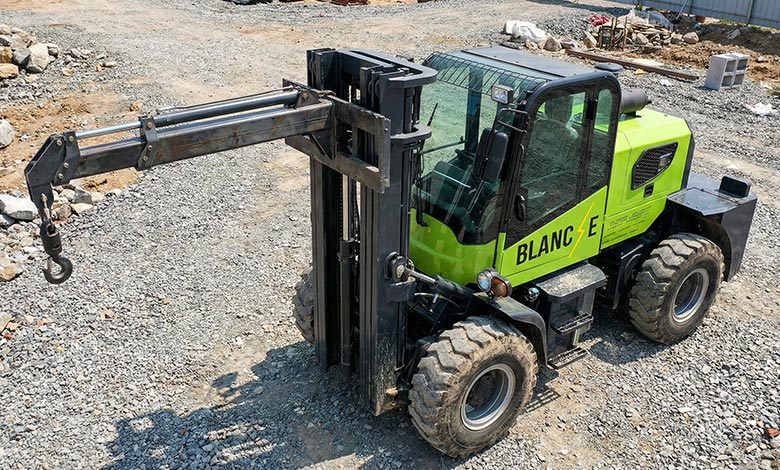
Crane Jib Isn’t About Doing More Work — It’s About Not Getting Stuck
One thing I often tell customers is this:
A crane jib is not there to make your forklift busier every day.
It’s there to make sure you’re not stuck when a normal attachment can’t do the job.
This is where crane jibs3 are very different from attachments like side shifters4, bucket1s, or bale clamp2s.
- Side shifters improve daily efficiency
- Buckets help you handle loose material
- Bale clamps make agricultural handling easier
Crane jibs, on the other hand, are low-frequency but high-impact tools5.
They are used when:
- The load cannot be handled with forks
- The object has lifting points but no pallet access6
- Precise positioning matters more than speed
In these situations, the problem is rarely weight.
The real challenge is control, stability, and safety7.
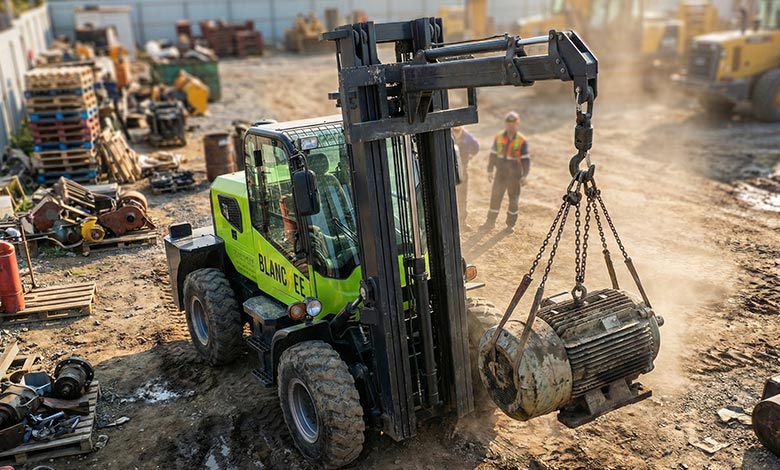
Where Crane Jibs Are Actually Used — Almost Always Outdoors
From our real project experience, crane jibs3 are rarely used in standard warehouse environments.
They show up much more often in places like:
- Construction and installation sites
- Equipment maintenance areas
- Agricultural and infrastructure-related outdoor work
These environments usually have a few things in common:
- Uneven or temporary ground conditions
- Irregular, non-repetitive tasks
- Certain lifting steps where mistakes are not acceptable
That’s why many customers don’t think about crane jibs3 at the beginning.
They only realize the need after facing a situation where forks, bucket1s, or clamps simply don’t work well.
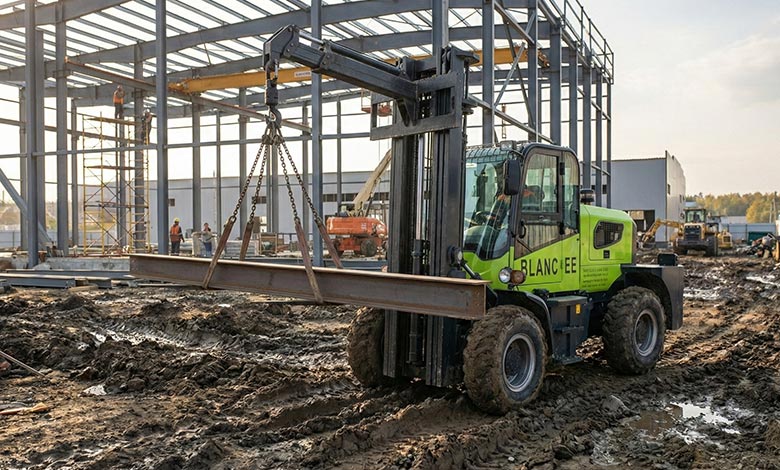
Crane Jibs Are Not a “Default” Attachment — and That’s Exactly the Point
I’m very careful about this part.
I don’t recommend crane jibs3 as a default attachment for every rough terrain forklift8.
They are not meant to be installed just because “it might be useful someday.”
If a customer’s work is mainly pallet handling, bulk material loading, or agricultural clamping, then side shift, bucket1, or bale clamp2 will always be higher priority.
But when customers tell me things like:
- “Sometimes we need to lift equipment with eye bolts”
- “Calling a small crane every time is inefficient”
- “We need better control in tight spaces”
That’s when a crane jib becomes a serious topic.
For those customers, it’s not about using it often —
it’s about having a reliable solution when nothing else fits.
From a Manufacturing Perspective, Crane Jibs Are About Safety and Structure
At first glance, a crane jib looks simple — basically a lifting arm.
But from a manufacturing and configuration point of view, it’s one of those attachments where structure and safety margins matter a lot.
In real projects, we pay close attention to:
- Structural strength and material selection
- Load distribution and stress points
- Proper matching with the forklift’s stability limits
These factors don’t attract much attention in brochures,
but they are exactly what make a crane jib feel controlled and safe when it’s actually being used.
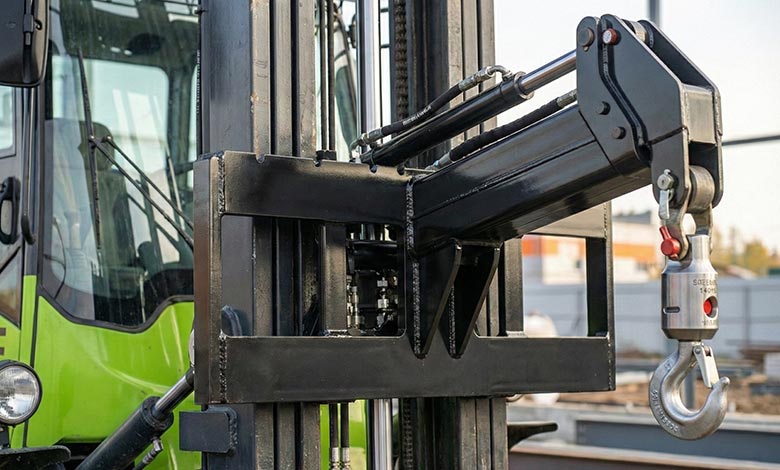
How Crane Jibs Are Seen in BLANC-ELE Projects
In many BLANC-ELE projects, crane jibs3 are not the most frequently used attachment.
But interestingly, they are often the attachment customers remember most clearly.
Not because they use it every day —
but because when they need it, it solves a problem that would otherwise stop the job.
It’s the kind of attachment that doesn’t show its value on a daily checklist,
but proves itself at the most inconvenient moments.
Final Thoughts
I believe outdoor attachment selection is always about balance.
Some attachments are there to improve daily efficiency.
Some are there to handle specific materials.
Crane jibs are there to handle special situations — safely and predictably.
They won’t be right for every customer.
But if your work includes lifting irregular objects, precise positioning9, or occasional tasks where forks simply don’t make sense, a crane jib is worth considering seriously.
If you’re unsure whether a crane jib fits your real working conditions, BLANC-ELE is always happy to talk through your application and help you decide — based on how you actually work, not just on specifications.
Explore this resource to understand how bucket attachments enhance efficiency and versatility in material handling. ↩
Explore this resource to understand how bale clamps enhance efficiency and handling in agricultural tasks. ↩
Explore this resource to understand how crane jibs enhance safety and efficiency in challenging lifting situations. ↩
Explore this resource to understand how side shifters enhance efficiency and maneuverability in material handling. ↩
Discover tools that may not be used daily but are crucial for specific tasks in construction. ↩
Find solutions for lifting challenges when traditional methods are not applicable. ↩
Understand the importance of these factors in ensuring safe and effective lifting operations. ↩
Learn about the versatility and applications of rough terrain forklifts in various industries. ↩
Understand the significance of precise positioning in achieving successful lifting outcomes. ↩