
When configuring rough terrain forklifts1 for customers, I keep seeing the same pattern.
Most discussions focus on lifting capacity, engine brand, tires, and drive type. Sometimes we even spend time on cabins, air conditioning, or cameras. But when the conversation reaches the side shifter2, it’s often treated as a minor detail.
“Is this really necessary?”
“Can we skip it for now?”
Honestly, I understand why people think this way. A side shifter2 doesn’t look impressive on a specification sheet. It doesn’t increase rated capacity. And compared to attachments3 like buckets4 or bale clamps5, it feels subtle.
But after working with outdoor forklift projects across construction sites, farms, yards, and temporary work areas, one thing has become very clear to me:
For outdoor forklift work, side shift is almost essential — it’s just often underestimated at the beginning.
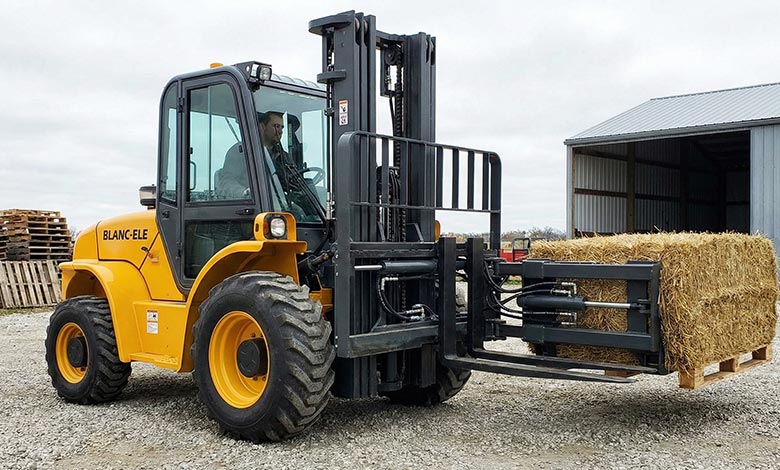
The Real Outdoor Problem Is Usually Alignment, Not Lifting
Inside a warehouse, things are predictable.
The floor is flat. Pallets are standardized. Load positions are fixed.
Even without side shift, an operator can usually line things up with a bit of steering and patience.
Outdoor environments are completely different.
In real-world rough terrain applications, what we typically see is:
- Uneven or sloped ground
- Irregularly placed pallets or materials
- Loads that are already slightly misaligned
In these situations, the forklift’s limitation is rarely lifting power.
The real challenge is precise positioning.
Without a side shifter2, operators are forced to compensate by repeatedly driving forward and backward, adjusting steering angles, and raising or lowering the mast just to get the forks aligned. The job gets done — but slowly, inefficiently, and with much more fatigue.
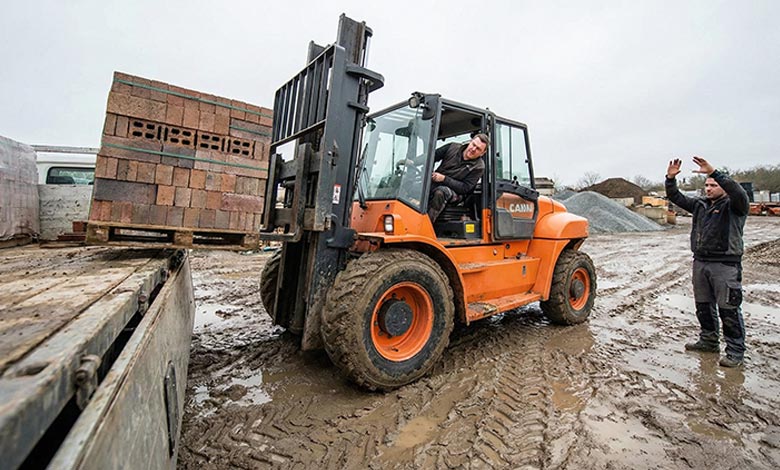
Without Side Shift, Simple Tasks Become Bigger Problems
Across many outdoor projects, rough terrain forklifts1 without side shift tend to show the same operating patterns:
- Multiple reversing movements just to align with a load
- Frequent mast adjustments to correct small positioning errors
- Slower working pace to avoid instability or collisions
Each individual movement may seem minor. But over the course of a full workday — or an entire operating season — these inefficiencies add up quickly.
Operators often say the forklift feels “awkward” or “hard to use,” when in reality the machine itself is capable. It’s simply missing the fine adjustment tool that outdoor conditions demand.
After Adding Side Shift, Customer Feedback Is Surprisingly Consistent
One thing that always stands out to me is what happens when customers add side shift later.
In many cases, side shift wasn’t part of the original configuration. It was added only after the forklift had already been working on site for some time. And once it’s installed, the feedback is almost always the same:
“We should have chosen this from the beginning.”
Side shift doesn’t make the forklift stronger — it makes it smoother.
Customers typically report:
- Faster and more accurate alignment
- Fewer repeated movements
- Less operator fatigue6
- Greater confidence when working on uneven ground7
These improvements don’t look dramatic on paper, but in daily outdoor operations, they make a very real difference.
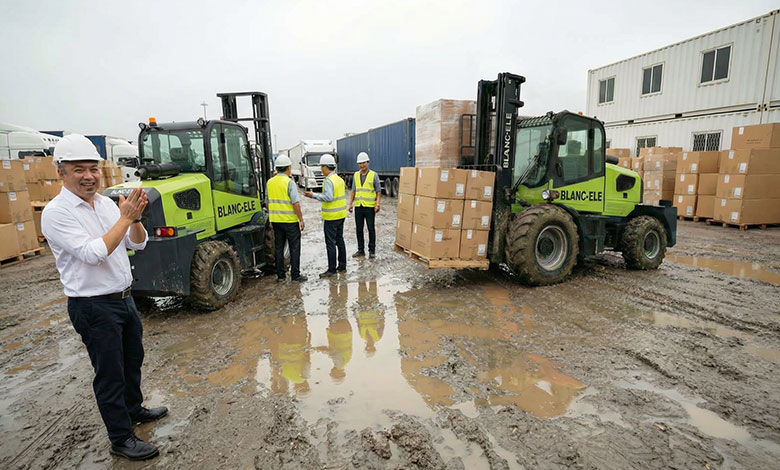
From a BLANC-ELE Perspective, Side Shift Is One of the Highest-Return Options
From a manufacturing and configuration standpoint, side shift is not a high-cost option. But in outdoor applications, its impact is often much larger than expected.
We see its value increase even more when rough terrain forklifts1 are used with other attachments3, such as:
- Buckets, where precise positioning8 matters when handling loose material
- Bale clamps, especially for irregular agricultural or recycling loads
- Frequent loading and unloading9 in unstable environments
That’s why, in many BLANC-ELE10 rough terrain forklift projects, we no longer treat side shift as a simple optional accessory. Instead, we actively discuss it as part of the core configuration for outdoor use.
The question is no longer “Can you add side shift?”
It becomes “What happens to your efficiency if you don’t?”
Side Shift Isn’t About Adding Features — It’s About Removing Waste
At its core, side shift doesn’t add power or capacity.
What it really does is remove unnecessary movements.
Outdoor productivity is rarely determined by maximum specifications alone. It’s shaped by small, repeated actions that either slow the operator down — or allow the forklift to work naturally with the environment.
Side shift quietly eliminates many of those wasted actions.
Final Thoughts: Why I Consider Side Shift Almost Essential Outdoors
In real outdoor conditions:
- Perfect alignment is rare
- Ground conditions constantly change
- Operator comfort and confidence directly affect productivity
Side shift addresses all of these challenges in a simple, mechanical way.
If you’re configuring a rough terrain forklift for outdoor work and side shift is still sitting in the “optional” column, it’s worth taking a second look. The difference between a forklift that can work and one that works well often comes down to details like this.
If you’re unsure whether side shift makes sense for your specific application, BLANC-ELE10 is always happy to discuss your real working conditions — not just specifications — and help you choose a configuration that delivers long-term value.
Explore expert insights on maximizing the efficiency of rough terrain forklifts in challenging environments. ↩
Understanding the role of a side shifter can enhance your outdoor forklift operations significantly. ↩
Explore various attachments that can enhance the functionality of rough terrain forklifts. ↩
Explore how buckets enhance efficiency and precision in outdoor forklift operations, especially with side shift. ↩
Explore this resource to understand how bale clamps enhance efficiency and safety in outdoor forklift operations. ↩
Discover strategies to reduce operator fatigue and enhance productivity in forklift work. ↩
Find essential tips for safely navigating uneven ground with forklifts to prevent accidents. ↩
Learn how precise positioning can improve safety and efficiency in outdoor forklift tasks. ↩
Get expert advice on efficient loading and unloading techniques to optimize your operations. ↩
Discover how BLANC-ELE's innovative configurations can enhance your outdoor forklift performance. ↩