
This is a question I get quite often, especially from customers who are using forklifts outside the warehouse for the first time.
They usually already understand that standard forks alone are rarely enough for outdoor work. What they’re unsure about is this:
Do forklift attachments1 really work outdoors? And if they do, which ones are actually worth choosing?
My answer is usually straightforward:
Yes, forklift attachments1 can be very useful outdoors — but only if you stop choosing them with an indoor mindset.
Attachments Are Defined by the Task, Not the Building
I once came across a very accurate statement: forklift attachments1 are task-specific2, not facility-specific.
That idea is correct — but for outdoor applications, it needs one more layer.
From what we see at BLANC-ELE3 across real projects, whether an attachment works outdoors usually depends on three factors:
- The actual task you need to complete
- The ground conditions4 (uneven surfaces, soft soil, slopes)
- The forklift’s stability and structural design
An attachment that performs perfectly inside a warehouse can quickly become inefficient — or even risky — once it’s moved to a muddy construction site or an uneven yard. This is why many customers initially feel attachments are “not necessary,” only to realize later that the real issue was not the attachment itself, but choosing the wrong one for the jobsite.
When Loads Are Long, Loose, or Non-Standard
Outdoor sites rarely deal with perfectly standardized pallets.
On construction sites, farms, and temporary yards, loads are often too long, loosely packed, or irregularly shaped. A very common problem I see is simple:
the forks just don’t go in far enough.
This is where fork extensions5 (fork shoes) become useful.
They don’t increase lifting capacity — instead, they solve the problem of insufficient fork penetration, which is far more common outdoors than indoors.
Important note: Fork extensions are not a permanent solution.
They reduce effective load capacity and shift the load center forward. On uneven ground, they work best as a situational efficiency tool — not for continuous heavy-duty operation.
When the Job Is Not “Moving,” but “Dumping”
Many outdoor applications are not about transporting materials from point A to point B. Instead, the real task is dumping or handling bulk material.
Typical examples we see include:
- Dumping spoiled agricultural products into hoppers
- Unloading waste or scrap into containers
- Emptying bulk material from bins or totes
In these situations, standard forks are inefficient and often unsafe.
This is where tipping or dumping attachments6 make a real difference. They allow the forklift to move beyond simple lifting and become a material handling and processing tool.
In agriculture, recycling, and waste handling environments, these attachments are used far more frequently than many people expect — because they solve a very specific outdoor problem that forks simply cannot.
The Power of Combination: Side Shifts7, Buckets, and Clamps8
One defining feature of outdoor work is how quickly conditions can change.
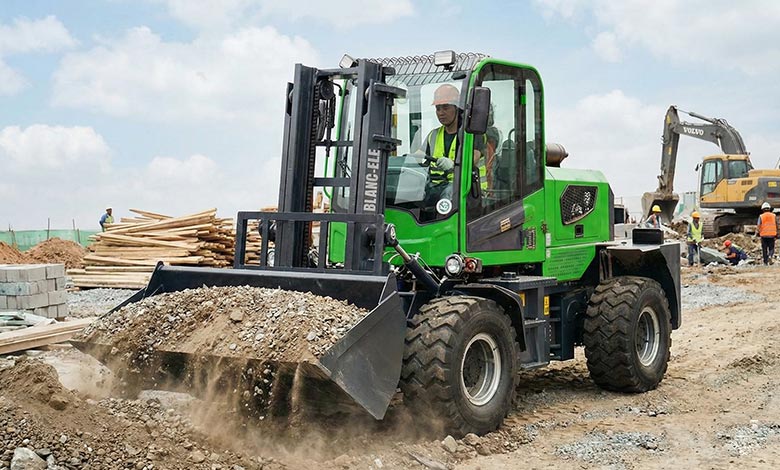
The same forklift may handle pallets in the morning, loose material in the afternoon, and non-palletized loads by the end of the day. That’s why the most successful outdoor setups I’ve seen are rarely built around a single attachment.
Instead, they often combine tools such as:
- Side shifters, to reduce repositioning and improve control on uneven ground
- Buckets, allowing forklifts to assist with loading, cleanup, or bulk handling
- Bale clamps, widely used in agriculture and recycling for irregular loads
From a practical standpoint, customer satisfaction9 usually doesn’t come from one specific attachment. It comes from having a forklift configuration that can adapt to changing tasks without constant compromises.
Why We Spend So Much Time Discussing Attachments
In real BLANC-ELE3 projects, discussions about attachment configuration often take more time than customers initially expect.
The reason is simple:
in outdoor applications, choosing the wrong attachment often creates bigger problems than choosing the wrong forklift model.
An unsuitable attachment can lead to lower efficiency, more complicated operation, and increased safety risks10. On the other hand, the right attachment can significantly extend what a forklift is capable of doing — without changing the machine itself.
So, Are Forklift Attachments Useful Outdoors?
Yes — very much so.
But only if:
- You clearly understand the task
- You respect real working conditions
- You avoid copying warehouse solutions into outdoor environments
Attachments are not about adding more equipment.
They’re about using the right tools so the forklift actually earns its value.
Explore how forklift attachments can enhance outdoor operations and improve efficiency. ↩
Understanding task-specific attachments can help you choose the right tools for your outdoor needs. ↩
Explore BLANC-ELE's expertise in forklift attachments to enhance outdoor efficiency and safety in material handling. ↩
Learn about the impact of ground conditions on forklift performance and safety. ↩
Discover how fork extensions can solve common outdoor loading issues effectively. ↩
Find out how these attachments can transform your forklift into a versatile material handling tool. ↩
Explore this resource to understand how side shifts enhance forklift efficiency and control on uneven outdoor surfaces. ↩
Explore this link to discover how clamps enhance outdoor forklift efficiency and safety, ensuring optimal performance in various conditions. ↩
Discover the link between attachment choices and overall customer satisfaction in outdoor tasks. ↩
Learn about the potential safety hazards of improper attachment use and how to mitigate them. ↩