
Quick Answer: Most 4WD rough terrain forklifts1 use Rear Wheel Steering2 because it separates the functions of the axles. The front axle focuses on carrying the heavy load and providing traction3, while the rear axle handles directional control. This Rigid Frame4 design offers superior stability when lifting high loads compared to articulated (center-pivot) machines.
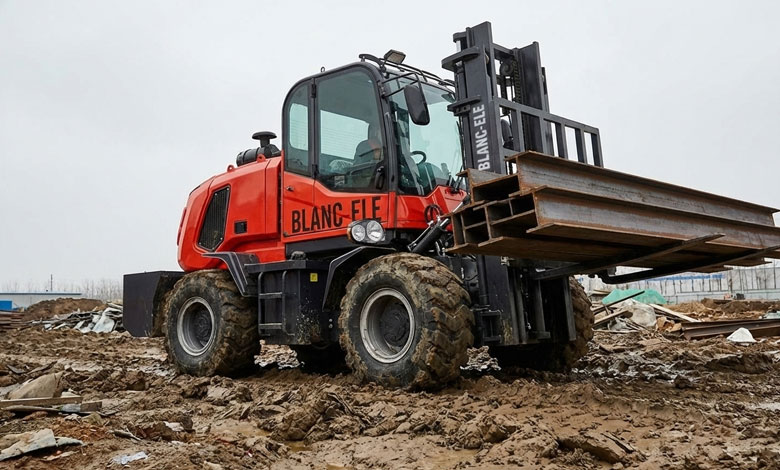
From our experience supplying and working with BLANC-ELE54WD rough terrain forklifts1, rear wheel steering is not a coincidence or a legacy habit from warehouse trucks. It is a deliberate engineering choice shaped by real outdoor working conditions.
Across farms, orchards, construction sites, and material yards, we have consistently seen that rear wheel steering delivers better control, stability, and predictability when a forklift operates on uneven ground under load.
1. Rough Terrain Conditions Demand More Stability
Rough terrain forklifts rarely work on smooth, predictable surfaces. They are typically used on:
- Mud, gravel, sand, or loose soil.
- Sloped or uneven ground.
- Irregular and confined outdoor work areas.
In these conditions, steering is not just about turning the machine. What matters more is whether the steering remains stable and predictable when the mast is fully raised.
2. The "Rigid Frame" Advantage (Vs. Articulated Loaders)
This is the most critical engineering insight that many buyers miss.
There are two ways to steer off-road equipment:
- Articulated Steering: The machine bends in the middle (like a wheel loader).
- Rear Wheel Steering2: The frame is solid, and only the rear wheels turn (like a BLANC-ELE5 forklift).
Why Rear Steering wins for Forklifts: When you lift a 3-ton pallet of bricks to 4 meters high, the center of gravity is very high.
- If you use an articulated machine, turning changes the stability triangle6 drastically, increasing the risk of tipping over.
- With Rear Wheel Steering2, the chassis remains rigid and square. The stability triangle6 stays constant, making it much safer for high-lifting operations on uneven ground.
3. Why the Front Axle Must Focus on Traction
On a 4WD rough terrain forklift, the front axle is the "workhorse." It carries 80-90% of the load weight and provides the primary driving force.
Asking the front wheels to steer and drive and support 5 tons of weight simultaneously creates massive mechanical stress and complexity.
By using Rear Wheel Steering2:
- The front axle can be built purely for strength and load-bearing.
- The front tires maintain maximum contact with the ground for traction3.
- The rear axle handles the steering in a lighter, more responsive way.
4. 4WD Determines Traction, Rear Steering Determines Control
Many customers naturally focus on "4WD" when evaluating a forklift. That makes sense—4WD is essential for not getting stuck.
But from an operational standpoint, we see a clear distinction:
“4WD determines whether the forklift can move forward. Rear wheel steering determines whether it can be controlled safely.”
In heavy-load situations, the load, mast, and front axle form a highly stressed system. By keeping steering inputs at the rear, we reduce lateral disturbance to the load. This results in smoother turns and less "wobble" when the load is high in the air.
5. Maneuverability in Tight Spaces
A common concern we hear is that rough terrain forklifts are big and clumsy.
In practice, Rear Wheel Steering2 allows the machine to pivot around its front wheels.
- The Pivot Point: The forklift can turn in a circle barely wider than its own length.
- Rear Swing: While operators need to be aware of the "tail swing," this feature allows the forks to be positioned with extreme precision in narrow orchard rows or crowded construction sites.
Conclusion
Rear wheel steering is not simply a traditional design—it is an engineering solution refined by real-world safety needs.
For a 4WD rough terrain forklift, it is the superior choice because it:
- Maintains a Rigid Frame4 for high-lifting stability7.
- Maximizes Front Traction by unburdening the drive axle.
- Improves Predictability on slopes and mud.
Looking for a stable machine for your site? [Check out the BLANC-ELE5 RT Series] to see how our rigid-frame design keeps your loads safe.
Discover the benefits of 4WD in enhancing traction and performance on uneven surfaces. ↩
Explore how Rear Wheel Steering enhances stability and control in rough terrain forklifts. ↩
Explore the role of traction in ensuring safe and effective forklift operation. ↩
Learn why a Rigid Frame design is crucial for maintaining stability during high lifts. ↩
Explore this link to discover how BLANC-ELE forklifts enhance stability and control in challenging environments. ↩
Understand the concept of the stability triangle and its importance in forklift safety. ↩
Discover key factors that ensure stability when lifting heavy loads high. ↩