
When customers ask me about a loader bucket for their rough terrain forklift, the first question is almost always the same: “How big is the bucket? How much can it load?”
But in real projects, I’ve seen this mistake too many times: The bucket looks right on paper (in terms of volume), yet once work starts, the forklift becomes slower, heavier, and feels “overloaded” even when the bucket isn’t full.
To be honest, the problem is rarely the forklift itself. In most cases, the bucket was simply chosen the wrong way from the start.
1. Why What You Load Matters More Than Bucket Size
Before discussing cubic meters or dimensions, I usually ask one simple question: What material are you loading most of the time?
Because a bucket full of agricultural products1 and a bucket full of wet sand may look similar in size — but their actual weight difference is massive.
- Grain, Crops, Fertilizer: Large volume, relatively light.
- Sand, Gravel, Wet Soil: Small volume, extremely heavy.
I’ve seen many forklifts work perfectly with light materials, then struggle immediately or tip forward when switching to high-density gravel.
That’s why I often tell customers one very direct sentence:
“A bucket is not about how much it holds — it’s about how much that material weighs.”
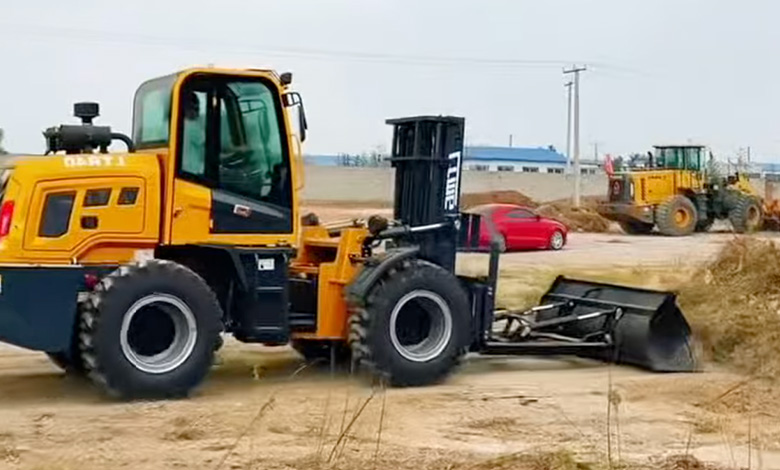
2. Different Materials Require Completely Different Bucket Designs
When we configure BLANC-ELE2 buckets for customers, we never rely on a single “standard solution.”
Light Materials (Crops, Grain, Fertilizer)
For these materials, the focus is Volume:
- Goal: Maximize load per trip.
- Design: Wide opening, deeper shell, lighter steel structure to save weight.
- Priority: Productivity and speed.
Medium-Density Materials (Wet Soil, Mixed Waste)
Here, Rigidity becomes critical:
- Goal: Prevent deformation when pushing into piles.
- Design: Thicker bottom plate, reinforced side plates3.
- Priority: Structural integrity.
High-Density Materials (Sand, Gravel, Stone)
This is where problems usually appear first. Durability is the only goal:
- Goal: Survive abrasion and heavy impact.
- Design: Heavy-duty wear strips, hardened cutting edge, reinforced mounting brackets.
- Priority: Survival.
The same bucket behaves very differently depending on the material inside it.
3. What You See in Videos Matters More Than Spec Sheets
On paper, many buckets look identical. In real operation, the difference becomes obvious very quickly.
 Video 1: Bucket Working Under Real Load
In this short video, what matters is not the bucket size, but how the bucket behaves while loading, lifting, and dumping.
What to watch for:
- Is the lifting movement smooth or jerky?
- Does the bucket stay stable under load?
- Is the material spilling?
These details never appear in catalogs — but they define real usability.
Video 2: Structural Details That Decide Long-Term Durability
This video shows the parts buyers often overlook: bottom plate thickness, side plate structure, and reinforcement layout.
Why this matters: Many buckets fail not immediately, but after months of repeated stress. As I often tell customers:
“Buckets that look the same on day one rarely perform the same after three months of digging.”
4. A Bucket Is Part of the Forklift System
This is a key point many buyers underestimate. A bucket is not just an attachment; it changes the physics of the machine.
A heavy bucket filled with sand directly affects:
- Center of Gravity: Moving it forward, reducing stability.
- Hydraulic System: Requiring more pressure to lift and dump.
- Front Axle: Placing massive stress on the tires and differential.
That’s why the same bucket:
- Causes tipping on a light-duty forklift.
- Feels stable and controlled on a BLANC-ELE2 rough terrain forklift, because our chassis is engineered for heavy front loads.
Bucket selection should never be separated from forklift design.
5. How I Usually Help Customers Choose
I rarely start with specs. Instead, I ask three questions:
- What is the heaviest material you will load? (Sand? Stone? Corn?)
- Is the bucket used occasionally or continuously? (1 hour a day vs. 8 hours a day?)
- Is the working surface flat or uneven? (Affects stability when the bucket is raised.)
Only after these are clear do we define the bucket size.
Summary: Recommended Bucket Selection
| Material Type | Density | Key Bucket Features Needed | Recommendation |
|---|---|---|---|
| Grain / Crops | Low | Large volume, lighter steel | High-Capacity Light Bucket |
| Fertilizer | Low–Med | Corrosion resistance, smooth flow | Agricultural Bucket |
| Wet Soil | Medium | Thicker bottom, balanced weight | General Purpose Reinforced Bucket |
| Sand | High | Heavy bottom plate, wear strips | Heavy-Duty Bucket |
| Gravel / Stone | Very High | Full armor, hardened cutting edge | Severe-Duty Rock Bucket |
Conclusion
A loader bucket is not an accessory you “add later.” It directly determines how easy, safe, and durable your forklift will be in daily work.
The smartest choice is never the biggest bucket — it’s the right bucket for your material density4.
Not sure which bucket fits your job? [Contact BLANC-ELE2] and we’ll help you calculate the perfect match for your materials.
- Explore how the nature of agricultural products affects bucket design for optimal performance.

- Explore BLANC-ELE’s innovative solutions for forklift attachments to enhance efficiency and safety in your operations.
- Learn about the importance of reinforced side plates in enhancing bucket strength and longevity.
- Understanding material density is crucial for selecting the right bucket, ensuring efficiency and safety in operations.